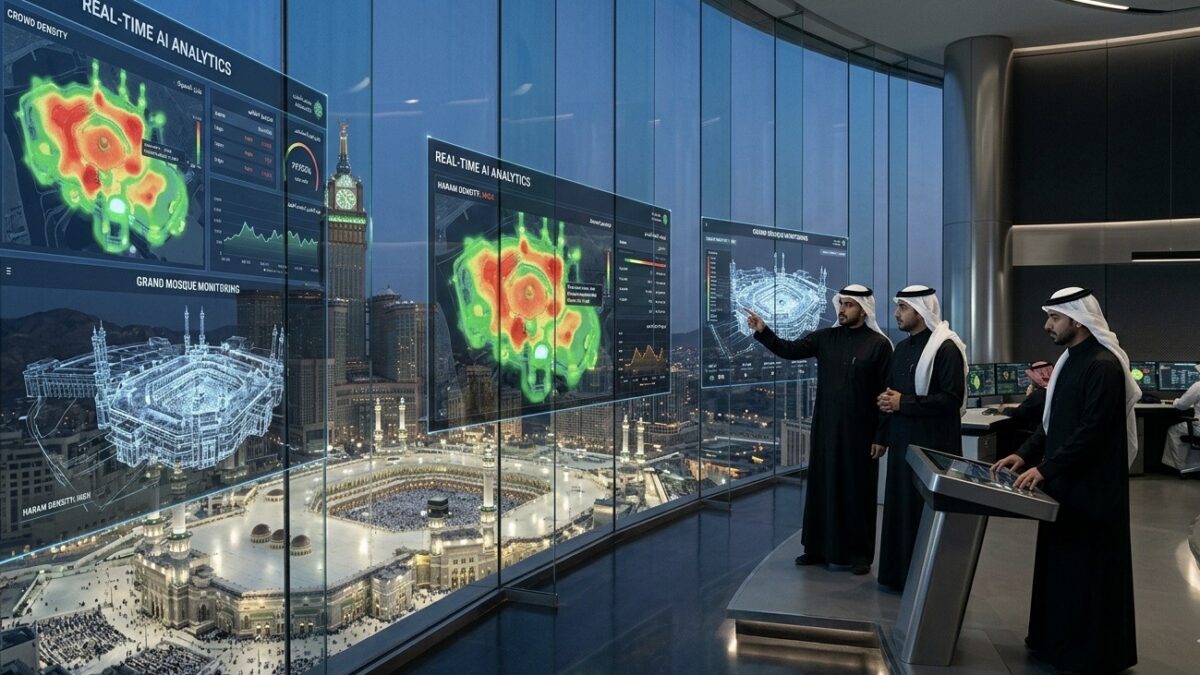
GovTech & Advanced Infrastructure Systems Smooth Movement of 1.6 Million Pilgrims at Arafat
The Kingdom of Saudi Arabia has successfully executed its largest single-day crowd deployment of the year, facilitating the movement of more than 1.6 million pilgrims as they gathered on the Plain of Arafat for the spiritual climax of the Hajj pilgrimage. According to operational logs released by the Saudi Press Agency, state entities deployed a highly integrated grid of digital systems, municipal transportation networks, and emergency response infrastructure to manage the massive influx of worshippers with maximum efficiency and safety.
Executive Summary
- Sovereign Crowd Logistics: Seamless transition of 1.6 million global worshippers from Mina to the Plain of Arafat under unified state command.
- GovTech Integration: Deployment of advanced crowd-control systems, automated transport dispatch trackers, and inter-agency data sharing.
- Climate Mitigation Protocols: Rapid activation of medical response teams and public hydration infrastructure to counter extreme peak temperatures exceeding 45°C.
- Vision 2030 Alignment: Direct utilization of Next-Gen smart governance frameworks to scale up the capacity and safety benchmarks of the holy sites.
From the dawn of the ninth day of Dhul-Hijjah, the multi-modal transport and crowd management apparatus synchronized across the 20-kilometer corridor stretching southeast of Makkah. Worshippers filled the designated boundaries of the sacred site for the central rite of Wuquf Arafah, gathered around Jabal Al-Rahmah (the Mount of Mercy). The massive logistical operation concluded smoothly at sunset as digital routing networks shifted the flow of pilgrims outward toward Muzdalifah.
Advanced Operations and Climate Resilience in Action
Managing a population of this scale within compressed spatial and temporal windows requires an elite level of inter-agency digital collaboration. Saudi ministries deployed extensive operational plans supported by automated crowd-control tracking systems, real-time transportation telemetry, and specialized emergency response units. These command centers monitored pedestrian densities to prevent bottlenecks along the primary transit arteries connecting the holy sites.
A critical test for the Kingdom’s GovTech framework was real-time climate management. With ambient temperatures climbing past 45°C, health authorities utilized smart surveillance networks to monitor pilgrim dense spots, proactively deploying localized cooling mist systems, mobile clinics, and hydration distribution teams. These tech-enabled interventions significantly lowered the incidence of heat exhaustion across vulnerable demographics.
The Saudi Perspective: Championing Smart Pilgrimage Ecosystems
The seamless execution of the Day of Arafah is a powerful testament to the Kingdom’s massive ongoing investments in smart pilgrimage infrastructure, a core pillar of the Vision 2030 Pilgrim Experience Program (PEP). Rather than treating Hajj logistics as a traditional seasonal event, Saudi Arabia has re-engineered the holy sites into a permanent, world-class smart city testing ground driven by modern GovTech architectures.
For enterprise technology leaders and public sector contractors in the GCC, this successful deployment highlights how large-scale data analytics, IoT sensor networks, and unified cloud command systems can be used to optimize massive public safety operations. By continuously upgrading the infrastructure of Makkah and Madinah, the Kingdom is establishing a global blueprint for high-density urban flow management, proving that sovereign digital transformation can preserve centuries-old cultural heritage while ensuring elite operational safety.