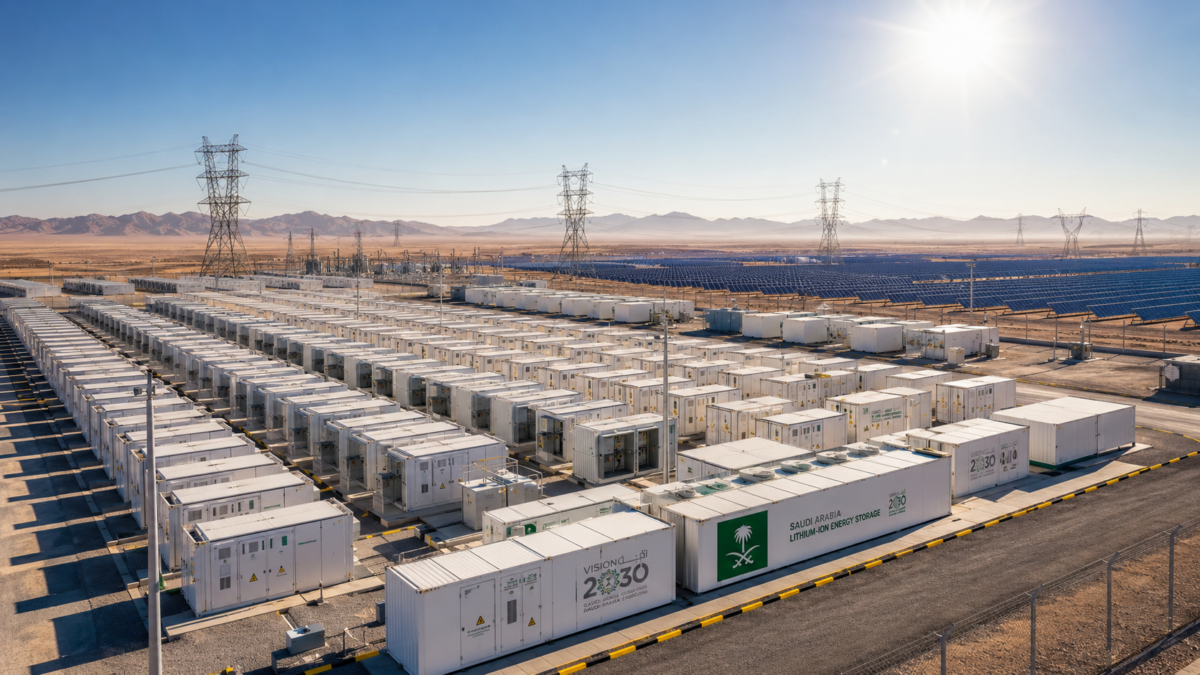
The Saudi Power Procurement Company (SPPC) has officially advanced the development of the Kingdom’s utility-scale grid infrastructure by prequalifying 27 top-tier international developers for the second phase of its commercial battery energy storage system (BESS) procurement initiative. This high-capacity procurement round represents a combined storage capacity of 12,000 megawatt-hours (MWh), creating one of the most capital-dense storage deployment tracks globally.
Executive Summary
- SPPC qualifies 27 institutional developers spanning Europe, the Americas, Asia, and regional Middle Eastern markets.
- The scope covers six strategically located facilities, with each individual installation rated at 500 MW / 2,000 MWh capacity.
- All selected projects follow a strict Build-Own-Operate asset model, drawing massive foreign direct investment into regional utilities.
- The grid-scale expansion removes baseline intermittency issues, allowing the national network to safely target 50% renewable integration.
As the commercial capital of the Middle East transitions toward low-carbon manufacturing, the physical grid must evolve to absorb surging gigawatt-scale outputs from solar and wind assets. This massive deployment of advanced energy storage systems provides the essential frequency balancing and load-shifting capacity required to maintain strict grid resilience under extreme industrial demand spikes.
A Cross-Continental Coalition of Utility Titans
The highly competitive bidding group highlights the massive commercial interest attracted by Saudi Arabia’s state-backed utility procurement. Elite global utility operators, including regional giants like Masdar and ACWA Power, are competing alongside prominent European developers such as EDF and TotalEnergies Renewables, as well as automotive energy titan Tesla Motors Netherlands.
The procurement track also marks significant participation from highly specialized Chinese infrastructure groups, including China Longyuan Power and Hefei Gotion High-Tech. Domestic industrial leaders including Al Jomaih Energy, Alfanar, and Nesma Renewable Energy are well positioned alongside these global groups, demonstrating the mature technical capabilities of the local energy ecosystem.
Geographic Layout and the BOO Commercial Architecture
The second group of facilities is divided across six strategically selected locations across the Kingdom’s provinces: Samha, Al-Leeth, Al-Henakiyah, Khulis, Sadawi, and Ashyrah. Each facility will be constructed utilizing a long-term Build-Own-Operate (BOO) partnership framework. This setup shifts capital expenditure weight over to private asset managers while providing long-term power purchase agreements (PPPs) guaranteed by the state framework.
These specialized high-capacity battery installations function as electronic reservoirs. By capturing excess photovoltaic current during peak midday generation and discharge intervals, the systems effectively balance the supply loop during peak evening demand hours, directly reducing national reliance on traditional heavy fuel oil generators.
Accelerating Towards the Vision 2030 Energy Target
This major procurement drive builds upon the momentum established during the initial Group 1 procurement round, which prequalified 33 enterprise consortiums. By maintaining a rapid, continuous cycle of utility tenders, SPPC provides absolute visibility for international capital supply chains.
Through the execution of these high-tier battery projects, Saudi Arabia is successfully building the critical grid infrastructure needed to deliver on its Vision 2030 sustainability mandates. For institutional venture teams and heavy industry suppliers monitoring the scaling of the regional green grid, track real-time changes via our central Clean Energy analysis hub.