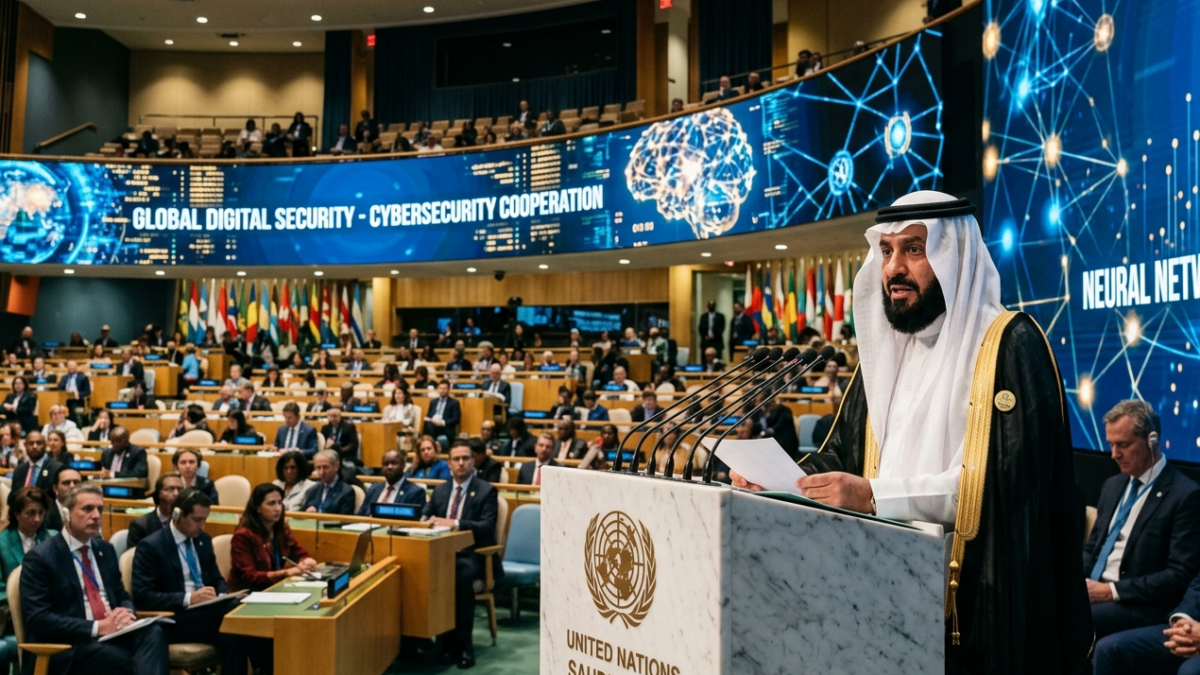
Saudi Arabia has delivered a definitive call to action at the United Nations General Assembly, urging member states to institute aggressive global cooperation strategies to counter the terrorist misuse of AI and emerging technologies. Addressing the assembly, Ambassador Abdulaziz Alwasil, the Kingdom’s Permanent Representative to the UN, clarified that multilateral technology governance is crucial to securing borders in the digital age.
Executive Summary
- Saudi Envoy warns that extremist networks are weaponizing generative AI, unmanned aerial systems, and deep tech.
- The Kingdom advocates for swift capacity-building programs, emphasizing judicial and defense support for Yemen.
- A solid foundation of counterterrorism leadership is highlighted, drawing on decades of sovereign financial support for the UNCTC.
- The address distinguishes technology as a neutral tool, placing the imperative on preventing illegal state and non-state exploitation.
Alwasil laid out evidence showing how transnational militant groups are rapidly adopting advanced machine learning models, autonomous drone configurations, and encrypted decentralized platforms. These technologies are being weaponized to accelerate extremist radicalization, manage illicit crowdfunding campaigns, and orchestrate complex asymmetric attacks on critical national infrastructure.
Strengthening Regional Defense and Capacity Building
A central pillar of the Saudi address focused on the immediate need for localized capacity-building frameworks. Alwasil pointed directly to Yemen as a vital theater requiring immediate international technical and legal assistance. Without robust institutional safeguards, sophisticated legal architectures, and integrated defense intelligence systems, developing nations remain highly vulnerable to tech-driven proxy warfare.
The Kingdom’s stance emphasizes that modern security cannot be achieved in isolation. To outpace agile, non-state actor networks, international law enforcement and defense intelligence agencies must develop standardized protocols for data sharing, vulnerability tracking, and digital forensics threat mapping.
Decades of Counterterrorism Leadership
This urgent appeal builds directly upon Saudi Arabia’s established position as a primary financier and strategic architect of global counter-extremism. The Kingdom’s landmark financial and diplomatic contribution spearheaded the launch of the UN Counter-Terrorism Centre (UNCTC) in 2011. Furthermore, Riyadh remains a leading voice within key security alliances, including the Global Counterterrorism Forum, the Global Coalition to Defeat Daesh, and the Islamic Military Counter Terrorism Coalition (IMCTC).
Concluding his address, Alwasil reiterated that artificial intelligence itself is an instrument for societal advancement. The threat lies exclusively in unregulated spaces and malicious deployment. Through its national agencies, including SDAIA, Saudi Arabia continues to champion responsible AI development while ensuring its defense mechanisms are fully capable of mitigating algorithmic threats.