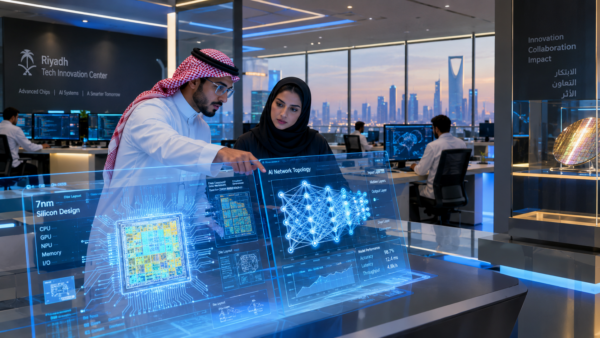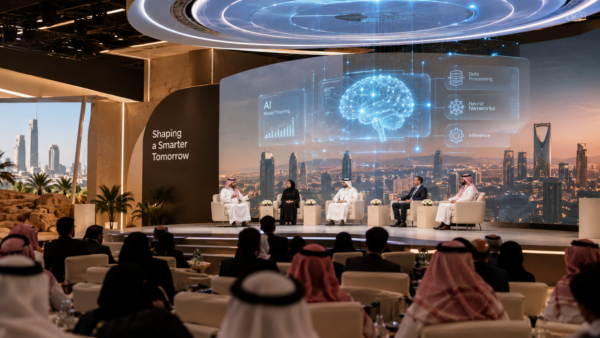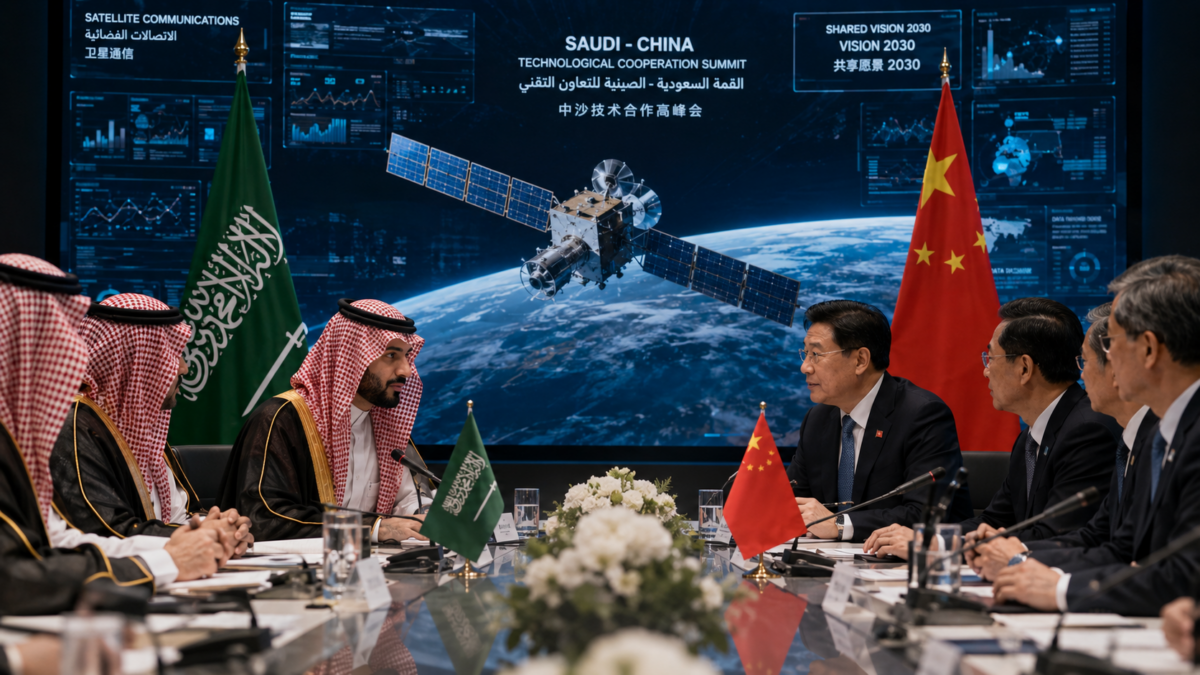
Saudi Arabia has substantially deepened its strategic digital ties with China, following a series of high-level bilateral meetings in Beijing led by Eng. Abdullah Alswaha, the Minister of Communications and Information Technology. According to a readout of the visit, the diplomatic mission has successfully established collaborative pipelines in artificial intelligence, advanced satellite manufacturing, and resilient subsea communications, positioning the Kingdom as the premier multi-aligned technology hub of the Middle East. This trip extends a pattern we’ve been following on Saudi Future Tech: the Kingdom courting technology partners on multiple fronts at once rather than tying its digital economy to a single bloc.
Executive Summary
- Strategic Technology Bilateralism: Leaders from the Saudi Ministry of Communications and China’s Ministry of Industry and Information Technology (MIIT) have formalized plans for policy alignment and mutual commercial investments.
- Generative AI & LLM Localization: Direct discussions with Chinese AI pioneers, including Moonshot AI and ByteDance, pave the way for sovereign data centers and localized Large Language Models.
- Sovereign Space Capabilities: Collaborative efforts with the China National Space Administration and China Aerospace Science and Technology Corporation (CASC) will focus on localizing satellite manufacturing and accelerating deep-space research.
Building Next-Generation Digital Infrastructure
The Beijing meetings signal a highly calculated policy move as Saudi Arabia continues to execute its multi-aligned digital sovereignty strategy. By courting both Western semiconductor alliances and Chinese engineering capabilities, the Kingdom is building a highly resilient foundation for its digital economy. Minister Alswaha, accompanied by Communications, Space and Technology Commission (CST) Governor Haytham AlOhali and the Saudi Ambassador to China, met with China’s Minister of Science and Technology, Yin Hejun, to discuss expanding cooperation in AI, the digital economy, technology transfer, and talent exchange, alongside separate talks on cloud computing and submarine optical fiber networks that serve as the critical backbone for international data transit.
A key focus of the discussions was expanding the direct presence of elite Chinese technology firms within Saudi borders. Establishing joint ventures will not only accelerate the localization of physical hardware manufacturing but will also fast-track knowledge transfer programs, preparing a highly skilled Saudi workforce to manage complex digital assets. We’ll continue tracking how these partnerships take shape on Saudi Future Tech.
AI Integration and Sovereign Space Exploration
In the field of deep learning, the Saudi delegation met with the executive leadership of Moonshot AI, developers of the Kimi Large Language Model, and Zhang Lidong, the Chairman of ByteDance China. According to the official readout, these high-level discussions centered on developing large language models and generative AI technologies, technology transfer, commercialization, and expanding both companies’ physical presence in the Kingdom. These initiatives directly support the goals of the Saudi National Strategy for Data and AI.
Parallel to these digital efforts, the Kingdom is aggressively scaling its aerospace ambitions. Minister Alswaha, acting as Chairman of the Saudi Space Agency, held critical talks with China National Space Administration Administrator Dr. Shan Zhongde and CASC leaders on expanding cooperation in space technologies. The resulting agreements will focus on transferring technical aerospace knowledge, co-developing advanced satellite technology, and training national engineering talent, ensuring that Saudi Arabia’s space program is fully equipped to meet its ambitious targets under Vision 2030.