Saudi Arabia has systematically transformed its artificial intelligence ambitions into concrete infrastructure, capital deployment, and national governance frameworks. Following the formal designation of 2026 as the Year of Artificial Intelligence by the Saudi Council of Ministers, under the patronage of Crown Prince Mohammed bin Salman, the Kingdom has signalled that its technological pivot is entering an execution-focused phase. Operating within a sector that saw approximately $9.1 billion in funding across 70 transactions in 2025, over 660 registered data and AI entities are actively expanding across the country.
For institutional investors, enterprise tech vendors, and strategic partners across the GCC, the primary objective is identifying high-yield deployment vectors. Eight distinct operational segments define the Kingdom’s market entry opportunities throughout the 2026–2030 Vision 2030 transformation window.
Executive Summary
- Designated AI Strategy: Driven by SDAIA and PIF-owned entities like HUMAIN, national policy prioritizes localized compute, Arabic LLMs, and data sovereignty.
- Infrastructure-First Allocation: Multibillion-dollar commitments, exemplified by the 480-megawatt Hexagon Data Centre, form the physical baseline for enterprise deployment.
- Target Sector Distribution: Key expansion vectors span generative models, sovereign cloud, digital twins, autonomous robotics, and industrial smart manufacturing.
1. Generative AI and Arabic Large Language Models
Arabic-language foundational models represent an addressable gap in global generative AI architectures. Saudi Arabia is deploying capital to resolve this localized latency through specialized R&D. AI & Deep Tech investments are expanding via HUMAIN, the Public Investment Fund (PIF) AI enterprise launched to spearhead national capabilities. HUMAIN’s multimodal Arabic model, ALLAM, underpins a broader effort to build enterprise-grade applications, natural language processing tools, and localized content delivery mechanisms tailored to regional regulatory requirements.
2. Sovereign AI and Data Residency Frameworks
Sovereign AI infrastructure, comprising nationally governed compute clusters, localized datasets, and strict data residency controls, has evolved from policy framework into operational mandate. Overseen by the Saudi Data and Artificial Intelligence Authority (SDAIA), the National Strategy for Data and AI governs six strategic pillars focused on security, domestic model oversight, and compliance with the Personal Data Protection Law (PDPL). This framework establishes standard operating procedures for financial institutions, healthcare providers, and public entities across the wider Gulf region.
3. Compute Infrastructure and Hardware Acceleration
Securing sustained compute capacity forms the core of the Kingdom’s capital allocation strategy. Strategic technology partnerships structured by HUMAIN with global hardware and cloud providers, including NVIDIA, AMD, Qualcomm, Cisco, and Amazon Web Services, are designed to establish high-density GPU processing capacity locally. Supported by dedicated financing frameworks, including an initial $1.2 billion facility, alongside strategic alignment from Saudi Aramco, local compute deployment is positioned as an industrial utility tied directly to energy production.
4. Hyperscale Data Centers and Sovereign Cloud Architecture
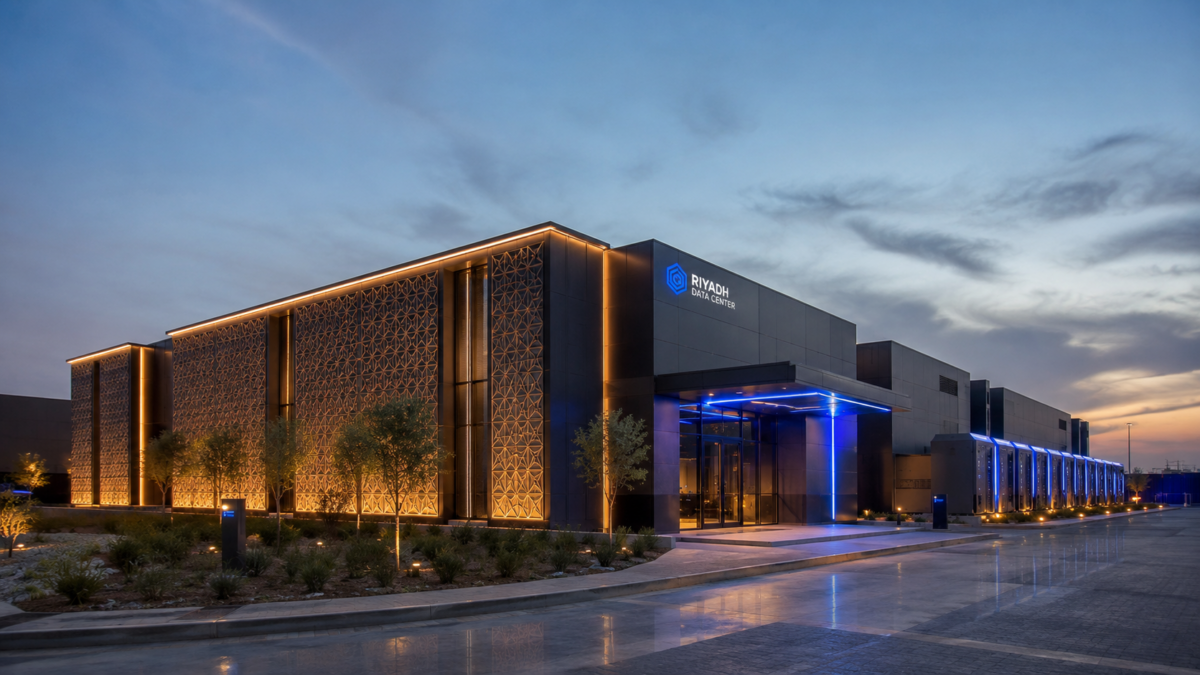
Physical facility construction is scaling alongside hardware procurement to support processing requirements. SDAIA initiated development on the Tier IV certified, 480-megawatt Hexagon Data Center in Riyadh, a sovereign project designed to consolidate core public sector systems while deploying direct liquid cooling technologies. Concurrently, commercial enterprise cloud services are advancing via localized cloud regions, including Microsoft’s planned Azure region in Saudi Arabia and joint sovereign cloud frameworks between PIF, SITE, and international technology partners.
5. Healthcare Diagnostics and Life Sciences AI
Precision medicine, genomics research, and predictive clinical diagnostics represent significant commercialization avenues under the Ministry of Health’s digital transformation programs. As national health data repositories consolidate under SDAIA’s unified governance standards, life sciences enterprises gain access to secure environments designed for deploying machine learning models across medical imaging, epidemiology, and patient management systems.
6. Industrial AI and Smart Manufacturing
Process automation, predictive maintenance, and supply chain monitoring are becoming operational benchmarks across Saudi Arabia’s heavy industries. Aramco’s operational integration with HUMAIN signals an intent to deploy machine learning algorithms across petrochemical extraction, energy grid routing, and manufacturing plants. These systems prioritize operational efficiency, carbon accounting, and safety monitoring within major industrial corridors.
7. Robotics, Autonomous Systems, and Physical AI
Embedded systems, frequently classified as physical AI, are being deployed across the Kingdom’s active construction, logistics, and mining ecosystems. Autonomous haulage units, inspection drones, and robotic site surveying platforms are systematically integrated into gigaproject sites, including NEOM, Red Sea Global, and Qiddiya. This integration opens commercial avenues for original equipment manufacturers (OEMs), sensor manufacturers, and edge-compute software integrators.
8. Smart Cities, Public Sector Automation, and Digital Twins
Spatial computing, 3D urban mapping, and automated administrative operations serve as the foundation for modern civic infrastructure in the Kingdom. Beyond signature urban developments like The Line, municipal governments across Riyadh, Jeddah, and the Eastern Province are integrating AI-driven traffic optimization, utility management, and digital twin monitoring platforms to increase municipal efficiency and public safety.
The Saudi Perspective: Strategic Pillars Driving Maturation
The progression of these eight technology segments relies on five core structural enablers established across public and private sectors:
- Human Capital Development: Dedicated national initiatives targeted at upskilling local engineers, alongside updated higher education curricula.
- Applied R&D Environments: Institutional grants, specialized university research centers, and regulatory sandboxes designed to accelerate product validation.
- Structured Public-Private Partnerships: Direct procurement mechanisms linking global technology vendors with sovereign capital funds.
- Regulatory Frameworks: Comprehensive oversight managed by SDAIA, balancing data privacy standards with enterprise access to localized training sets.
- International Ecosystem Engagement: Strategic participation in global tech governance organizations, positioning the Kingdom as an enterprise export node for sovereign tech solutions.