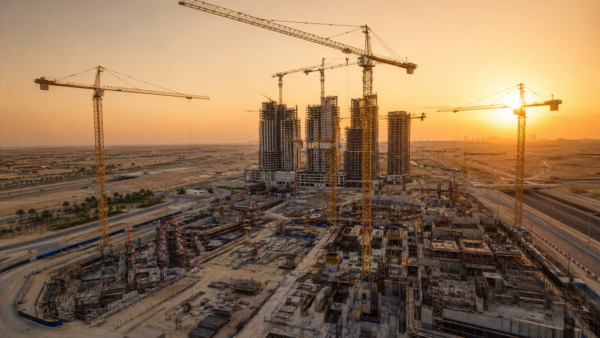
As Saudi Arabia’s giga-projects transition from visionary blueprints into active physical environments, the Kingdom’s telecommunications infrastructure faces an unprecedented architectural test. Destinations like NEOM and Red Sea Global are being constructed without traditional urban legacy constraints. Instead, they rely on autonomous transit networks, AI-managed power grids, drone logistics, and real-time spatial computing. To support this level of automation, national telecom operators stc and Zain KSA are executing a rapid commercial deployment of 5G-Advanced, also known as 5.5G, across key development corridors.
Operating under the regulatory stewardship of the Communications, Space and Technology Commission (CST), stc and Zain KSA are moving beyond early-stage 5G bandwidth upgrades. By leveraging 3GPP Release 18 capabilities, including Ultra-Reliable Low-Latency Communication (URLLC), sub-1 GHz spectrum aggregation, and native network artificial intelligence, these operators are building the deterministic wireless backbone required for mission-critical autonomous infrastructure.
Executive Summary
- Deterministic Latency Mandate: Autonomous electric shuttle systems, eVTOL aircraft, and remote machinery at NEOM require deterministic sub-10ms end-to-end latency and 99.999% network reliability.
- Sub-1 GHz & Multi-Band Aggregation: Zain KSA’s deployment of 5G Standalone (5G SA) on the 600 MHz spectrum band delivers expansive coverage and a 50% latency reduction at the cell edge.
- 10 Gbps Peak Speeds: stc’s commercial trials using mmWave and upper 6 GHz spectrum have achieved throughput exceeding 10 Gbps, laying the pipe for real-time spatial digital twins.
- Net-Zero Infrastructure: Red Sea Global and Zain KSA have deployed the world’s first zero-carbon 5G network, powered by over 760,000 solar panels and 3D-printed off-grid towers.
The Technical Latency Bottleneck: Why Standard 5G Is Not Enough
While early 5G deployments focused heavily on Enhanced Mobile Broadband (eMBB) for consumer download speeds, autonomous giga-project systems require fundamentally different network characteristics. An autonomous vehicle travelling at 80 km/h covers approximately 2.2 centimetres every millisecond. Under legacy networks experiencing latency jitter between 30ms and 80ms, automated braking and dynamic path planning face unacceptable safety margins.
5G-Advanced introduces refined Ultra-Reliable Low-Latency Communication (URLLC) protocols that drive radio interface latency down to sub-5ms while enforcing strict Quality of Service (QoS) guarantees. Through deterministic networking, 5G-Advanced ensures that safety-critical telemetry packet delivery is prioritized over background data streams, even during peak cell congestion.
Zain KSA: 600 MHz Spectrum and Commercial 5G+ Deployment
Zain KSA has taken a pioneering role by commercially rolling out 5G-Advanced, branded as 5G+, and deploying 5G Standalone architecture on the sub-1 GHz 600 MHz frequency band in strategic enterprise nodes. In dense urban centers and spread-out infrastructure zones like coastal resorts, low-band spectrum provides critical propagation depth.
By pairing the 600 MHz low band with mid-band carrier aggregation, Zain KSA achieves up to a 10x improvement in uplink speeds and cuts cell-edge latency in half. Higher uplink performance is mandatory for autonomous fleets, where dozens of onboard camera sensors and LiDAR feeds must continuously stream raw spatial telematics to centralized edge-cloud AI models for fleet coordination.
Furthermore, at Red Sea Global’s flagship destinations, Zain KSA implemented the world’s first zero-carbon 5G network. Powered completely by 100% renewable solar energy and integrated via aesthetically blended, 3D-printed towers, the network delivers ultra-low latency without compromising the destination’s strict environmental conservation targets. Technical details on their sustainability benchmarks are documented through Red Sea Global.
stc: 10 Gbps Throughput and Sidelink V2X Architecture
Concurrently, stc continues to act as the primary digital backbone across the Kingdom’s megaprojects. In commercial trials, stc successfully harnessed mmWave spectrum and upper 6 GHz bands to push network speeds to 10 Gbps. Beyond raw speed, stc’s 5G-Advanced architecture focuses on Vehicle-to-Everything (V2X) communication, enabling direct sidelink transmissions between vehicles, roadside units (RSUs), and smart traffic light nodes without requiring backhaul routing through the core network.
By handling V2X handshakes directly at the radio access layer, direct node-to-node latency drops below 2ms. This enables instant collision avoidance protocols and high-speed platooning for automated freight convoys serving logistics hubs across NEOM’s Oxagon industrial complex. Enterprise teams looking for deeper operational research can explore our comprehensive Saudi Future Tech Telecom & Connectivity Hub.
RedCap IoT and Edge Computing Integration
Another major pillar of the stc and Zain KSA 5G-Advanced roadmap is the integration of Reduced Capability (RedCap) technology, specified in 3GPP Release 17 and Release 18. Standard 5G modems are often too power-hungry and costly for widespread IoT sensor deployment across thousands of hectares of smart infrastructure. RedCap bridges the gap between high-speed 5G and low-power NB-IoT, offering balanced throughput with extended battery operational lifespans.
When combined with Multi-access Edge Computing (MEC) units installed directly alongside local telecom exchange towers in NEOM and the Red Sea region, data processing occurs within miles of the end device. This decentralized cloud topology eliminates international and regional backhaul transit time, guaranteeing that AI inference engine feedback returns to autonomous sensors in under 10 milliseconds.
The Saudi Perspective: Telecom as the Backbone of Vision 2030 Megaprojects
For Saudi Arabia, telecom networks are no longer treated as passive utility pipelines. Under Vision 2030, 5G-Advanced infrastructure represents an active digital asset directly linked to national GDP diversification, industrial automation, and smart city leadership.
By leading early commercial rollouts of 5G-Advanced and 5G Standalone networks, stc and Zain KSA are setting global benchmarks for how sovereign telecommunications providers can power autonomous mobility, zero-carbon tourism, and cognitive cities. As giga-projects welcome residents and operations, the Kingdom’s robust, low-latency 5G-Advanced grid will serve as the invisible nervous system driving the future of Saudi technology.