

Strategic Resilience: How the East-West Pipeline Safeguards Global Energy Security
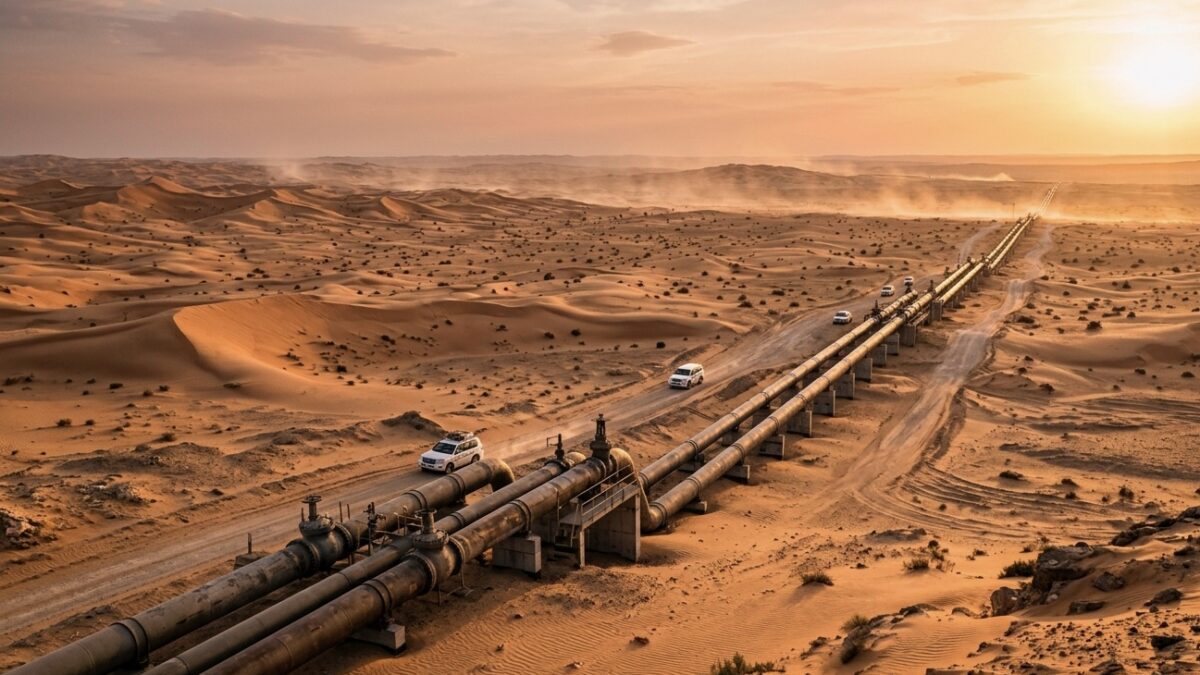
As geopolitical tensions resurface in the Middle East, Saudi Arabia’s “Petroline”—the East-West Pipeline—has once again emerged as the world’s most critical energy artery. Originally conceived four decades ago, this 1,200 km infrastructure marvel is currently operating at peak capacity to bypass the increasingly volatile Strait of Hormuz.
Executive Summary
- Strategic Capacity: Petroline is currently transporting 7 million barrels per day (bpd) from the Eastern Province to Yanbu on the Red Sea.
- Market Stabilization: The pipeline is cited by analysts as a primary reason global oil prices have avoided crisis-level surges despite regional conflict.
- Historical Precedent: Built in the 1980s during the “tanker war,” the system was designed specifically for current high-risk maritime scenarios.
- Future Expansion: Proposals for a second “shadow” pipeline and the rehabilitation of the historic Tapline are being discussed to permanently end the “Hormuz chokehold.”
The East-West Pipeline consists of twin pipes and a sophisticated network of pumping stations connecting the Abqaiq oil field to the Red Sea port of Yanbu. By shifting the delivery point away from the Arabian Gulf, Aramco has successfully mitigated the risks of prohibitive shipping insurance hikes, which have recently spiked to 10% of hull value for vessels traversing the Strait.
The Architecture of Energy Independence
The 7 million bpd flowing across the Kingdom provides a vital lifeline, partially offsetting the potential loss of the 15 million barrels that typically transit the Strait of Hormuz daily. While the Strait remains a sensitive chokepoint for general cargo, the Petroline ensures that the “lubricant of the global economy”—crude oil—continues to reach international markets with minimal disruption.
Innovation Under Pressure: The Tapline and Beyond
The current crisis has renewed interest in the Trans-Arabian Pipeline (Tapline), Saudi Arabia’s first industrial heritage site. Decommissioned in the 1990s, the Tapline once carried over a third of Aramco’s production to the Mediterranean. Experts suggest that modernizing such heritage assets, or constructing a second parallel Petroline, would offer a far more cost-effective and secure solution than proposed canals or alternative maritime routes.
The resilience of this Telecom & Connectivity and logistics network underscores the Kingdom’s role as the “Central Bank of Oil,” providing not just the resource, but the secure infrastructure necessary for global economic stability.
The Saudi Perspective: Vision 2030 and Global Logistics
For the Kingdom, the success of the Petroline is a proof of concept for Vision 2030’s goal of transforming Saudi Arabia into a global logistics hub. By leveraging its unique geography—bordering both the Arabian Gulf and the Red Sea—the Kingdom is effectively de-risking global energy supply chains. This infrastructure doesn’t just protect oil; it paves the way for the “Global Supply Chain Resilience Initiative,” ensuring that Saudi Arabia remains the most reliable partner for international enterprise, even in the face of external geopolitical shifts.


[…] Elham, S. (2026). Petroline: Saudi Arabia’s Shield Against Hormuz Chokepoints. Diambil dari https://saudifuturetech.com/petroline-saudi-arabias-shield-against-hormuz-chokepoints/. […]