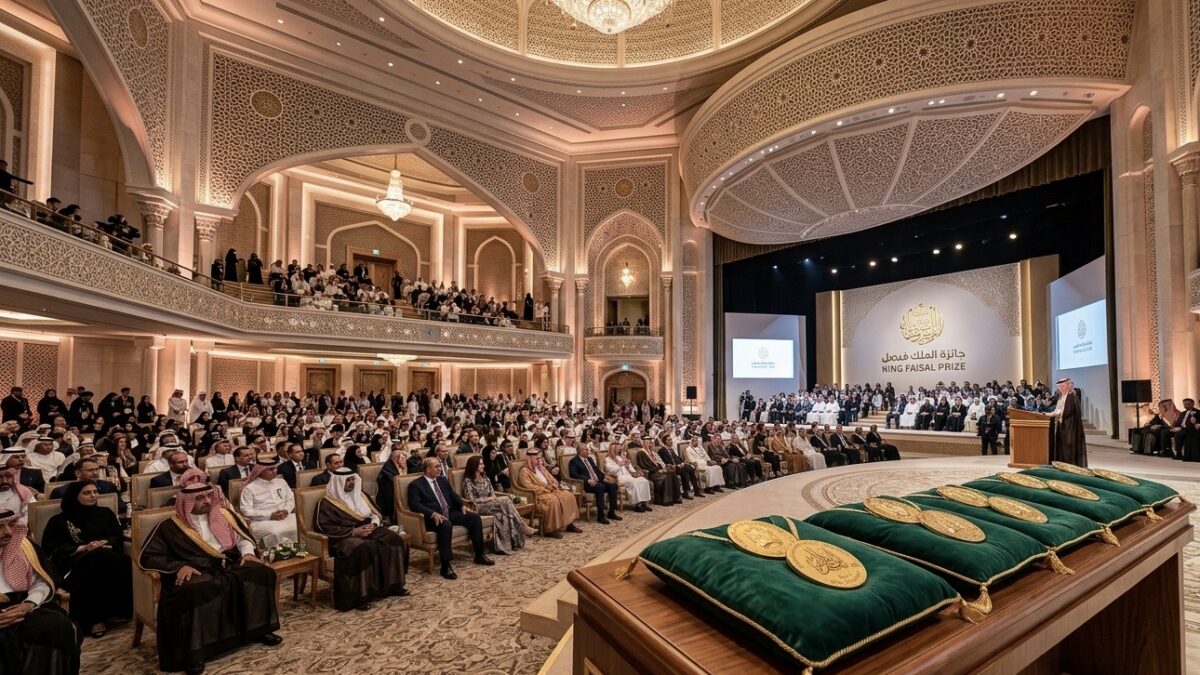
Riyadh Celebrates 48th King Faisal Prize: A Half-Century of Intellectual Excellence
Under the patronage of King Salman, the 48th King Faisal Prize (KFP) ceremony took place in Riyadh, marking a historic milestone: the 50th anniversary of the King Faisal Foundation. The gala honored a diverse group of global laureates whose contributions range from the foundational biology of modern weight-loss drugs to the complex mathematics governing the physical world.
Executive Summary
- Historic Milestone: The ceremony celebrated the 50th anniversary of the King Faisal Foundation (established 1976).
- Medicine Breakthrough: Professor Svetlana Mojsov was honored for her foundational research on GLP-1, the biological basis for Ozempic.
- Scientific Achievement: Prof. Carlos Kenig received the Science prize for his work on nonlinear partial differential equations.
- Cultural Impact: Awards were also presented for Arabic Language, Islamic Studies, and Service to Islam, highlighting the Kingdom’s role as a global cultural hub.
Medicine: The Architect of the Obesity Revolution
The King Faisal Prize in Medicine was awarded to Professor Svetlana Mojsov of Rockefeller University. Her pioneering research into the hormone glucagon-like peptide-1 (GLP-1) identified its active form and receptors in the body. This discovery was the catalyst for an entirely new class of medications, including Victoza and Ozempic, which are currently transforming public health outcomes for hundreds of millions struggling with diabetes and obesity worldwide.
Science: Decoding the Chaos of the Physical World
In the Science category, Prof. Carlos Kenig of the University of Chicago was recognized for his transformative work in mathematics. By mastering nonlinear partial differential equations, Kenig provided the mathematical tools necessary to understand phenomena ranging from ocean wave dynamics to the precision of medical imaging and fiber optic clarity. His work bridges the gap between theoretical math and practical technological application.
The Saudi Perspective: Vision 2030 and Global Scientific Leadership
The 2026 King Faisal Prize underscores Saudi Arabia’s evolving role as a primary patron of global innovation, aligning closely with the Vision 2030 pillar of fostering a vibrant society and a globally competitive economy. By honoring breakthroughs in medicine and deep tech (mathematics), the Kingdom positions itself at the center of the global knowledge economy. Furthermore, the focus on “Service to Islam” and “Islamic Studies”—specifically research into historical trade routes—reinforces Saudi Arabia’s strategic position as the heart of the Arab and Islamic worlds, while simultaneously promoting modern scientific inquiry.
Preserving Heritage and Philanthropy
The ceremony also celebrated cultural and humanitarian leadership. Sheikh Abdullatif Alfozan was recognized for his innovative “Ajwad Endowment,” a model for modern philanthropic digital transformation in the social sector. Additionally, the prizes for Arabic Language and Islamic Studies highlighted the Kingdom’s commitment to bridging the gap between classical scholarship and modern global audiences.