

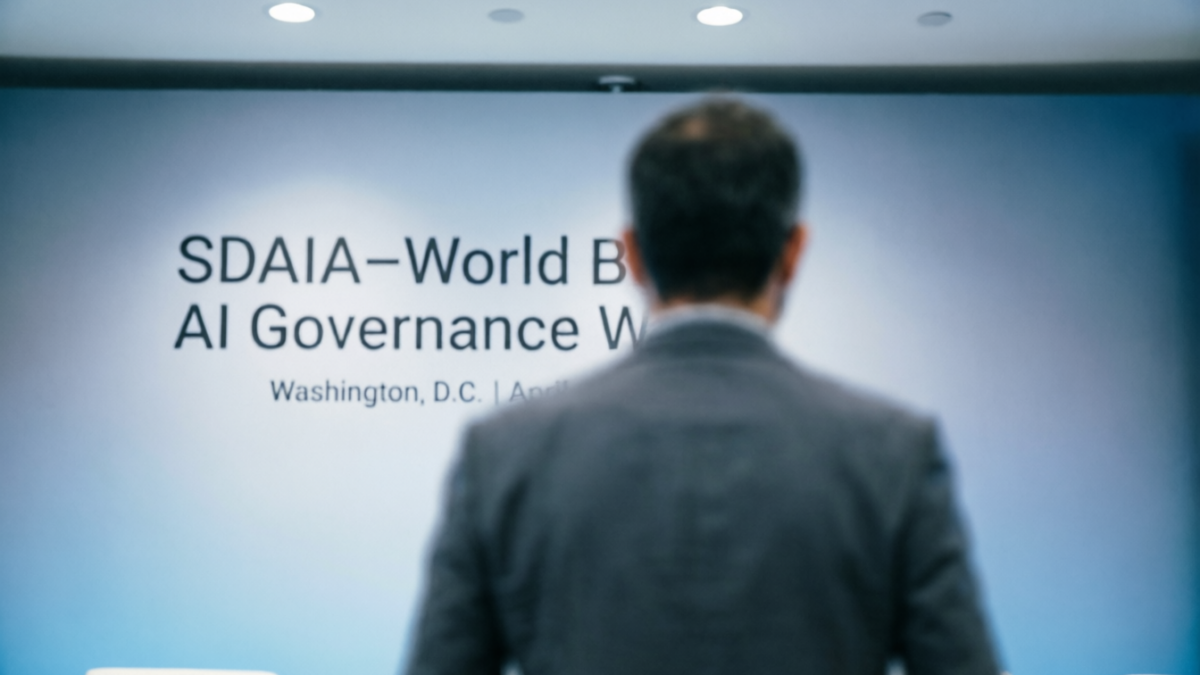
When the Saudi Data and Artificial Intelligence Authority sat down with the World Bank in Washington at the start of April, it was more than a routine bilateral meeting. The five-day workshop, titled Towards the Future: AI Governance and International Cooperation, ran from April 6 to 10, 2026, and drew government delegations, international organisations, and technical experts from across the world. The timing and the company were deliberate.
Saudi Arabia has declared 2026 its Year of Artificial Intelligence, a designation that is pushing SDAIA to translate domestic ambition into international influence. The World Bank partnership is one of the clearest expressions of that push so far.
What Happened in Washington
The workshop set out to do three things: advance shared understanding of AI governance concepts, benchmark global best practices, and explore mechanisms for international cooperation frameworks. Those are broad goals, but the structure of the event gave them texture.
On the sidelines, SDAIA and the Digital Government Authority organised a dedicated Saudi Day of Digital Transformation and Artificial Intelligence at World Bank headquarters on April 10. Speakers from Saudi government entities presented the Kingdom’s national AI model, its data infrastructure, and concrete case studies of AI deployment across public services. The message was clear: Saudi Arabia is not just asking to be part of global AI governance conversations; it is presenting itself as a model worth studying.
The workshop also addressed the growing tension between the pace of AI development and the ability of national regulatory frameworks to keep up. Discussions on multilateral cooperation and the alignment of international standards with domestic policies are directly relevant to Saudi Arabia, which published its own AI Adoption Framework in late 2025 as a mandatory baseline for public-sector AI procurement and deployment.
Why It Matters for the Saudi Tech Sector
For technology companies operating in or entering the Saudi market, this partnership signals a regulatory direction, not just a diplomatic milestone. SDAIA is actively shaping the norms that will govern AI procurement, data sharing, and cross-border AI deployment. Firms that understand where those norms are heading will have a material advantage.
There are several practical implications worth tracking:
- Procurement alignment: Saudi public-sector AI contracts are increasingly evaluated against SDAIA’s governance framework. Vendors who can demonstrate compliance with internationally benchmarked standards, the kind being developed through workshops like this one, are better positioned to win government business.
- Data localisation and cross-border rules: Discussions on multilateral frameworks will eventually shape rules around data flows. Saudi Arabia’s AI sector is heavily dependent on cloud infrastructure and cross-border data movement, making the outcomes of these negotiations commercially significant.
- Talent and standards signalling: Saudi Arabia has set a target of training more than 20,000 AI specialists by 2030. Governance frameworks inform curriculum and professional certification standards, which in turn shape the talent pool the tech sector can draw on.
The GCC context also matters here. Saudi Arabia is not alone in building AI governance capacity; the UAE has its own framework through the National AI Office, and Qatar and Bahrain have both signalled similar ambitions. A Saudi-led international governance narrative, backed by World Bank credibility, could give Riyadh a first-mover advantage in shaping GCC-wide standards, much as it has sought to do through the Riyadh Charter on AI.
A Crowded Diplomatic Calendar
The Washington workshop did not exist in isolation. In February, SDAIA President Dr. Abdullah Al-Ghamdi announced at the India AI Impact Summit in New Delhi that Saudi Arabia had joined the Global Partnership on Artificial Intelligence, an OECD-hosted body with more than 40 members. In late April, SDAIA presented the Kingdom’s governance model at the 29th UN Commission on Science and Technology for Development in Geneva. And later this year, Riyadh will host both the fourth Global Forum on the Ethics of AI, co-organised with UNESCO, and the fourth Global AI Summit in September, under the patronage of Crown Prince Mohammed bin Salman.
That is a lot of international activity for a single authority in a single year. The cumulative effect is a Saudi AI governance profile that is hard to ignore, whether you are a technology vendor, a foreign government, or a multilateral institution looking for a capable partner in the region.
What to Watch Next
The immediate question is whether the April workshop produces concrete deliverables, such as published cooperation frameworks, joint policy papers, or formal technical assistance agreements, or whether it remains primarily a dialogue-building exercise. World Bank partnerships often evolve slowly into implementation, but SDAIA’s track record suggests the authority prefers visible outputs over process.
For the Saudi technology sector, the practical signal is this: governance is becoming a competitive arena, not just a compliance function. Companies that invest in understanding Saudi Arabia’s evolving AI regulatory environment, and its international dimensions, are likely to find themselves better positioned as procurement criteria sharpen and as regional standards begin to converge.
