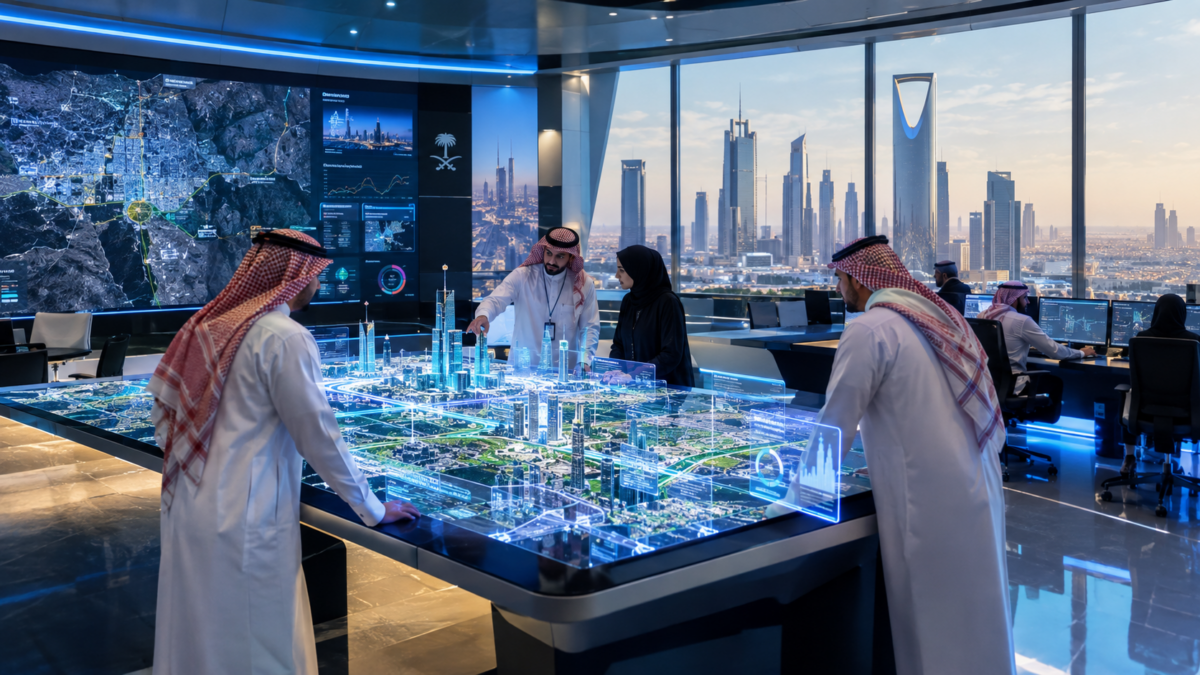
As Saudi Arabia’s urban landscape undergoes an unprecedented expansion under Vision 2030, the underlying digital architecture powering cities has evolved from siloed transactional systems into unified, real-time data ecosystems. Managed under the unified umbrella of the Ministry of Municipalities and Housing (MOMAH), the integration of key municipal platforms, specifically the Balady digital gateway and the National Housing Company’s (NHC) digital services, is creating a new benchmark for cross-agency data interoperability.
By breaking down data silos between urban planning secretariats, real estate developers, and national infrastructure registries, the Kingdom is establishing a dynamic digital foundation. This interoperable framework enables real-time decisions, streamlined commercial licensing, automated land parcel approvals, and precise urban growth modeling.
- Dataset Integration: Centralizing live GIS geo-mapping, commercial permitting, and residential housing supply data between Balady and NHC networks.
- 3D Digital Twin Deployment: Deploying advanced cloud-driven spatial simulations in major urban centers to optimize civil engineering, road maintenance, and flood risk management.
- Rapid Permitting & Licensing: Automated cross-agency checks enable instant commercial and construction permit issuances via unified digital identities.
- National Economic Alignment: Direct alignment with Saudi Arabia’s target of reaching 70 percent homeownership while driving private-sector GDP contributions through streamlined real estate approvals.
Overcoming Data Fragmentation in Urban Growth
Historically, municipal expansion and housing delivery operated through disjointed administrative workflows. Commercial licensing, land title clearing, infrastructure connection permits, and environmental assessments required manual cross-referencing across multiple government registries.
To resolve this friction, MOMAH and the Digital Government Authority (DGA) mandated total framework interoperability. Through standardized Application Programming Interfaces (APIs) and unified identity management, datasets from Balady (the municipal engine) and NHC (the primary residential developer) now synchronize instantly. When a new residential master plan is approved by the NHC, spatial coordinates, utility rights-of-way, and commercial zoning parameters automatically update across national municipal databases.
Strategic Alignment: MOMAH, Balady, and NHC
The synchronized collaboration between municipal authorities, state-backed technology providers, and housing developers underpins the Kingdom’s modern smart city pipeline:
- Ministry of Municipalities and Housing (MOMAH): Sets national spatial policy, drives the digital transformation steering framework, and enforces data governance standards across all regional secretariats.
- Balady Platform: Functions as the primary digital portal for municipal and construction services, providing interactive maps, instant commercial licensing, and road asset management tools.
- National Housing Company (NHC): Drives residential community development and deploys digital twin capabilities alongside cloud infrastructure to model future urban environments, including flagship communities like the Khuzam Digital Valley.
Core Execution Pillars of the Interoperable Engine
Achieving seamless, real-time execution across Saudi Arabia’s municipalities relies on four primary technological pillars:
- Geospatial Digital Twins: Advanced 3D urban models that simulate infrastructure loads, traffic patterns, and environmental variables before physical construction begins.
- Automated Land and Building Permitting: Direct integration between developer portals and municipal engines, reducing approval lead times from months to minutes.
- Unified Road Asset Management: Centralized geo-analytics and field-data mapping used to monitor road networks, prioritize maintenance, and allocate municipal budgets efficiently.
- Predictive Urban Analytics: Machine learning algorithms that evaluate population density shifts, optimizing the deployment of civil services, public parks, and utility nodes.