Pilgrim Logistics Reimagined: Kidana Deploys SCADA Systems and Smart Infrastructure Upgrades Across Holy Sites Ahead of Hajj
In alignment with the digital transformation and crowd-management directives of Saudi Vision 2030, Kidana Development Co. has finalized a massive wave of technical, structural, and infrastructure optimizations across the holy sites in Makkah. Acting as the principal executive arm of the Royal Commission for Makkah City and Holy Sites, Kidana’s phase-two rollouts represent a sophisticated intersection of advanced IoT monitoring, civil engineering, and public sector governance designed to handle high-velocity crowds during the Hajj season.
Executive Summary
- Smart Monitoring: Activation of a centralized SCADA system to oversee hundreds of reserve tanks, cooling arrays, and electrical grids in real-time.
- Grid Optimization: Completion of extensive electrical network upgrades delivering 550 megavolt-amperes (MVA) of reliable energy infrastructure.
- Crowd Safety & Mobility: Deployment of over 240,000 square meters of smart pedestrian paths, continuous surveillance systems, and multi-phase escalator corridors.
- Private Sector Commercial Growth: A 127% year-on-year increase in participating enterprise and consumer brands operating within the updated holy sites.
At the center of Kidana’s technology-driven strategy is the activation of an advanced Supervisory Control and Data Acquisition (SCADA) system. This enterprise-grade industrial control network provides centralized automation and data-driven oversight across a wide footprint. The platform continuously monitors the vital parameters of 400 municipal reserve water tanks, 300 industrial cooling systems, 800 critical electrical panels, 500 misting fan arrays, and 1,000 public sanitation complexes, ensuring rapid response capabilities for any system bottleneck or peak-demand surge.
Upgrading Grid Resilience and Climate-Mitigation Tech
To withstand the high energy loads demanded by modern public services, the utility networks across the holy sites received a complete structural overhaul. Kidana confirmed that electrical infrastructure upgrades totaling 550 MVA are now fully operational. This enhanced power framework underpins a newly optimized fire-suppression and climate-cooling matrix, covering 188 residential blocks that comprise 565 specialized encampments.
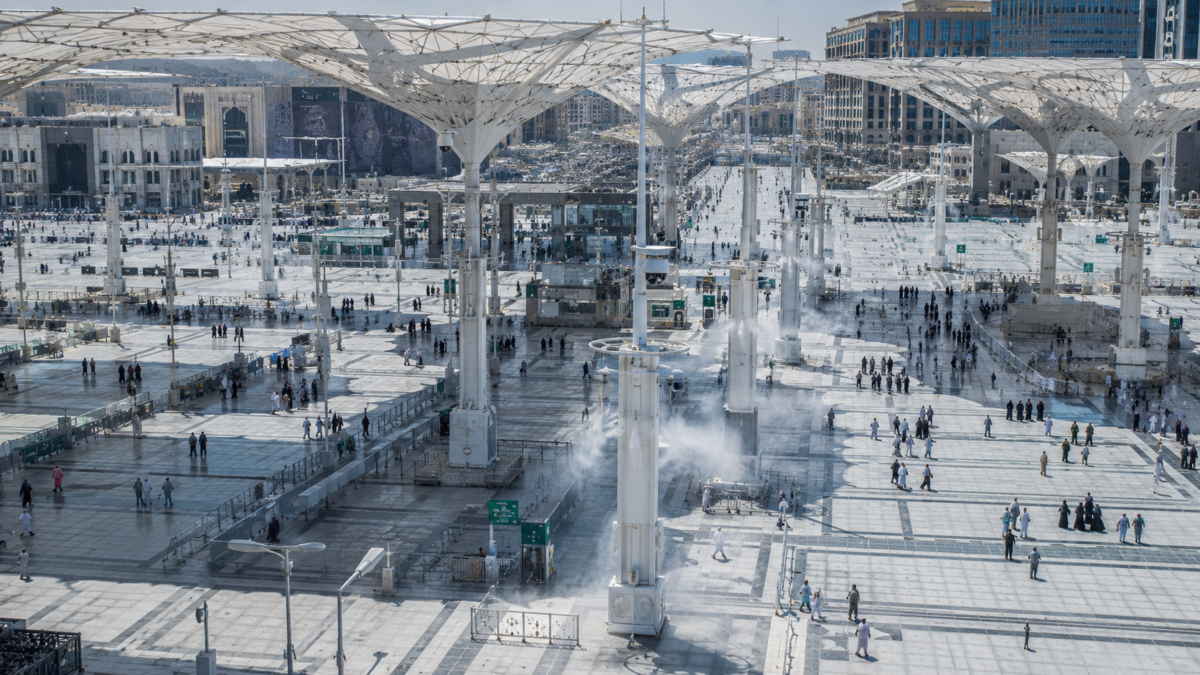
To mitigate intense summer temperatures, heavy engineering assets have been deployed along high-traffic routes. At the Jamarat Bridge courtyards, a two-phase replacement program installed 400 high-capacity misting-fan columns capable of cooling up to 180,000 pilgrims per hour. Similarly, the open areas surrounding Mount Arafat now feature 272,000 square meters of canopy shading supported by a connected network of high-volume misting lines and integrated cooling units.
Vision 2030 and the Scale of Smart Public Management
The modernization of Makkah’s religious tourism infrastructure directly supports the Kingdom’s Pilgrim Experience Program, a primary objective of Saudi Vision 2030 which aims to host over 30 million pilgrims annually while maintaining top-tier international safety standards. By replacing standard walkways with 150,000 square meters of shock-absorbent rubber flooring and installing 240 modular smart-device charging stations along pedestrian paths, public sector planners are utilizing data to optimize every foot of the journey.
This massive influx of tech-driven infrastructure has also generated unprecedented commercial dividends. Kidana reported a 127% expansion in enterprise and local brand participation, with 66 major commercial entities establishing a presence within the newly managed zones. By combining industrial IoT automation, robust electrical grids, and public-private enterprise integration, Saudi Arabia is establishing a global blueprint for large-scale civic engineering and smart public management.