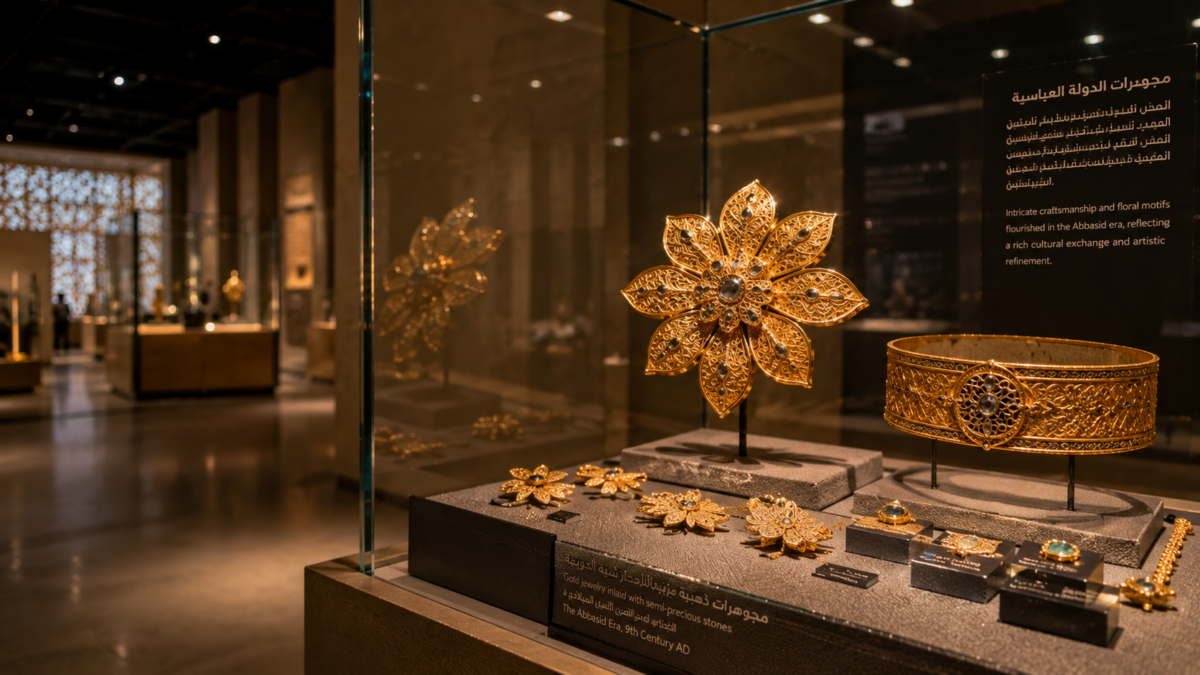
The Saudi Heritage Commission has formally announced the discovery of a pristine, 100-piece collection of gold jewelry dating back to the Abbasid era (late 9th century A.D.) at the Dariyah archaeological site in the Al-Qassim region. Uncovered during the fourth consecutive season of structured field excavations, the high-purity artifacts underscore the strategic importance of the Kingdom’s historical trade network. For institutional investors and tourism operators, the find signals an expansion of high-value cultural assets available for the Kingdom’s rapidly evolving leisure and heritage ecosystems.
Executive Summary
- The Discovery: A 100-piece complete gold adornment set featuring symmetrical floral patterns, colored stone inlays, and sophisticated gold spacers.
- Advanced Metallurgical Work: The artifacts display advanced 9th-century techniques, including hand-forming, decorative embossing, and precise stone framing.
- Socio-Economic Infrastructure: Excavations revealed concurrent architectural foundations, mud walls, and plastered rooms confirming a permanent trading post along the historic Basran Hajj route.
- Strategic Alignment: The operation reflects the Saudi Heritage Commission’s focus on converting historical capital into tangible visual assets for the Saudi cultural tourism sector.
High-Craftsmanship Metallurgical Assets in Al-Qassim
The newly extracted artifacts represent a significant sample of early Islamic luxury production. The set is highlighted by a large, disc-shaped central piece inlaid with symmetrically arranged colored stones, flanked by multi-colored beads and precision-stamped gold separators. According to technical assessments by the Heritage Commission, the artisans utilized complex hammering methods on ultra-thin gold sheets alongside custom-molded frames to lock decorative stones into place.
The level of engineering precision found within these frames indicates a highly developed regional economy with dedicated metallurgy pipelines. These luxury goods were not merely imported novelty items but point to structured commerce, where specialized artisans catered to affluent travelers and permanent residents established along the primary trade corridors connecting Iraq to the wider Arabian Peninsula.
Activating Historical Trade Corridors for Modern Foot Traffic
Beyond the immediate value of the gold hoard, the discovery of underlying urban infrastructure—such as stone building foundations, localized fire hearths, and extensive pottery fragments—redefines the historical footprint of the southwest Al-Qassim region. Dariyah functioned as a critical logistics and hydration hub on the ancient Basran Hajj pilgrimage route. The presence of continuous human settlement dating to the late third century AH confirms that the site possessed the resources needed to support massive crowd logistics centuries ago.
Dr. Jasir Suliman Alherbish, CEO of the Saudi Heritage Commission, noted that the Dariyah finds emphasize the Kingdom’s historic role as an active crossroads for international trade and cultural exchange. By mapping these subterranean networks, the commission provides the primary geographical data required to develop new cultural trails, open-air museums, and experiential historical centers across the Al-Qassim province.
Commercializing Heritage: Driving Vision 2030 Tourism Targets
Under the economic transformation framework of Saudi Vision 2030, safeguarding and documenting these archaeological sites serves as a direct driver for non-oil economic growth. The ongoing discoveries by the Heritage Commission supply the cultural foundation needed to scale up the local hospitality sector, attract foreign scientific investment, and build out localized infrastructure around regional historical destinations.
As the Kingdom targets 150 million annual visitors by the end of the decade, secondary provinces like Al-Qassim are leveraging these unique historic discoveries to secure a share of the national tourism market. Transitioning these excavation zones into accessible, secure tourist destinations creates distinct opportunities for public-private partnerships across the hospitality, transportation, and regional asset management sectors.