Researchers at the King Abdullah University of Science and Technology (KAUST) have successfully tested an innovative solar panel coating designed to address one of the biggest challenges facing solar energy systems in desert climates: dust accumulation. The new technology allows solar panels to clean themselves while simultaneously capturing moisture from the air, offering a sustainable solution for regions with limited water resources.
Executive Summary
- Dual-Action Technology: A transparent nanostructured coating repels dust and water while cooling panels at night.
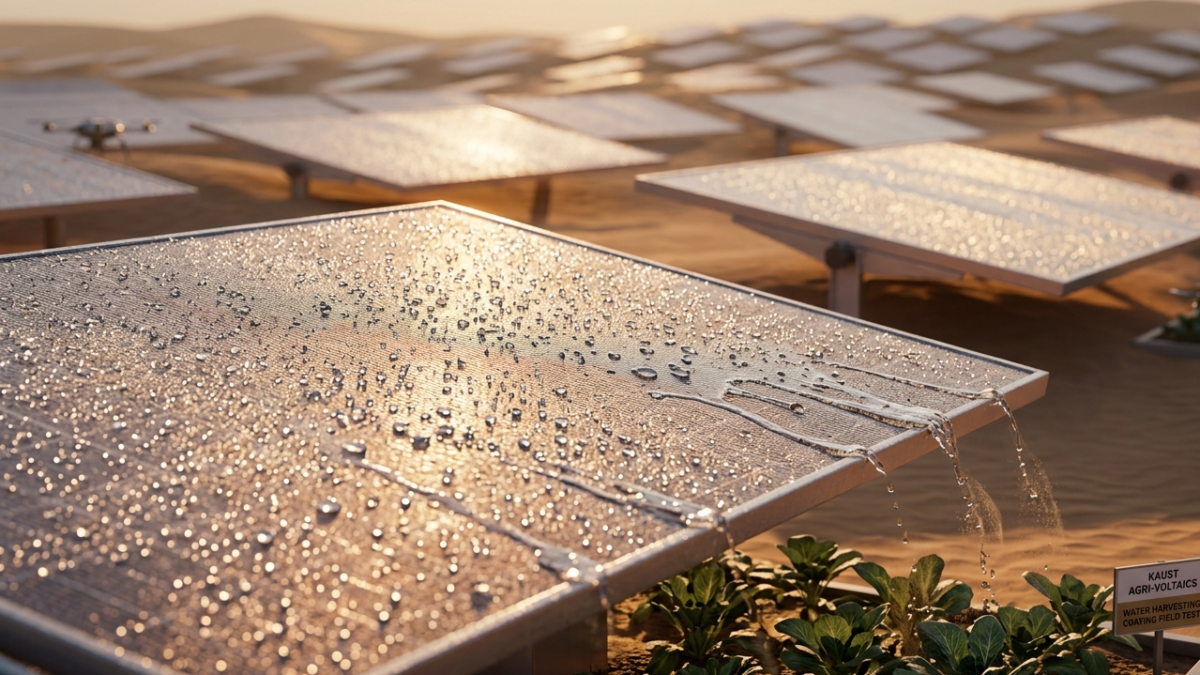
- Atmospheric Harvesting: The coating triggers condensation, creating water droplets that roll off to passively clean the surface.
- Agricultural Synergy: Field tests yielded twice the amount of condensed water, proving the viability of the technology for agrivoltaic farming.
Engineering the Desert Ecosystem
Dust buildup significantly reduces solar panel efficiency and typically requires regular cleaning, a process that consumes large amounts of water and increases operational costs. To overcome this challenge, KAUST researchers developed a transparent nanostructured coating capable of repelling debris while also generating a cooling effect during nighttime hours.
The coating works by cooling slightly below the surrounding air temperature at night, causing atmospheric moisture to condense into droplets on the panel surface. As these droplets roll off, they naturally remove accumulated dust, creating a passive self-cleaning mechanism that requires no additional energy or water.
Researchers tested the coating outdoors on the KAUST campus for six months. Results showed that treated solar panels experienced only minimal performance loss compared to untreated panels, which suffered significant efficiency declines due to dust accumulation. The coating also demonstrated an ability to capture more than twice as much condensed water as uncoated surfaces, with the collected moisture successfully used in a controlled irrigation demonstration.
Advancing Vision 2030’s Sustainability Goals
The innovation could have profound implications for agrivoltaic projects, where energy production and agriculture coexist on the same land. By helping maintain panel efficiency while generating small amounts of water for irrigation, the technology supports more efficient use of resources in arid environments where energy and water security are deeply interconnected.
The research has been published in the scientific journal Energy & Environmental Materials, and the KAUST team is continuing to evaluate the coating’s long-term durability and performance under different environmental conditions. If successfully commercialized, the technology will dramatically reduce maintenance costs, elevate power generation efficiency, and cement the Kingdom’s leadership in sustainable renewable energy systems.