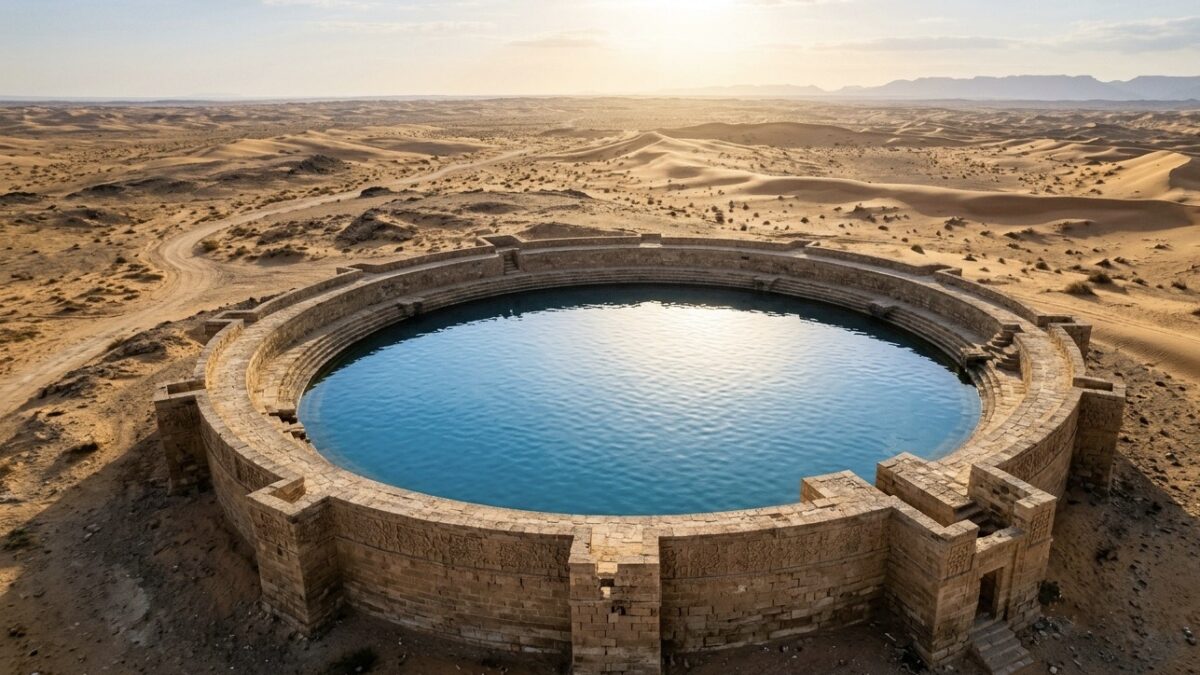
Ancient Engineering Resilience: Al-Jumaimiyah Pond Refills After Millennium-Old Design
Following a period of significant rainfall in the Northern Borders Province, the Al-Jumaimiyah pond—a 1,300-year-old hydro-engineering marvel—has refilled to capacity. This historic reservoir, which once served as a lifeline for travelers on the Hijaz-Iraq trade route, remains a testament to the sophisticated water management systems developed during the Abbasid era.
Executive Summary
- Historical Significance: Part of the legendary Zubaida Trail, established during the reign of Caliph Harun Al-Rashid.
- Engineering Ingenuity: A circular basin featuring a dual-wall filtration and retention system, reaching depths of over 6 meters.
- Climate Adaptation: Designed to harness natural valley flows, capable of storing water for up to an entire year in desert conditions.
- Cultural Heritage: Recognized as a primary landmark in Islamic civil engineering and desert survival strategy.
Located in a strategic basin, the 30-square-meter structure is reinforced with cylindrical supports and features a precise 13-step descent into its core. The recent influx of water highlights the enduring efficiency of early Islamic infrastructure, which utilized the natural topography of flood channels to sustain large pilgrim caravans across 50 km intervals.
The Sophistication of Abbasid Hydro-Tech
The Al-Jumaimiyah pond was more than a simple catchment; it was part of a larger, integrated water grid. The interior wall was set at ground level to allow natural runoff, while the exterior wall, elevated by 60 cm, acted as a pressure barrier and silt trap. This level of planning reflects a deep understanding of fluid dynamics and environmental adaptation that preceded modern smart-infrastructure concepts by over a millennium.
The Saudi Perspective: Heritage as a Pillar of Future Urbanism
As Saudi Arabia leads the world in developing Smart Cities like NEOM and The Line, the resurgence of the Al-Jumaimiyah pond provides critical inspiration for sustainable water management. Under Saudi Vision 2030, the preservation of sites along the Zubaida Trail is not merely about history—it is about integrating ancient wisdom regarding desert resilience into modern urban tech. The Kingdom’s focus on the “circular water economy” finds its roots in these Abbasid structures, proving that low-energy, gravity-fed water systems are a timeless solution for arid environments. These landmarks are now being integrated into the national tourism and heritage strategy, positioning the Northern Borders Province as a hub for both historical exploration and environmental study.