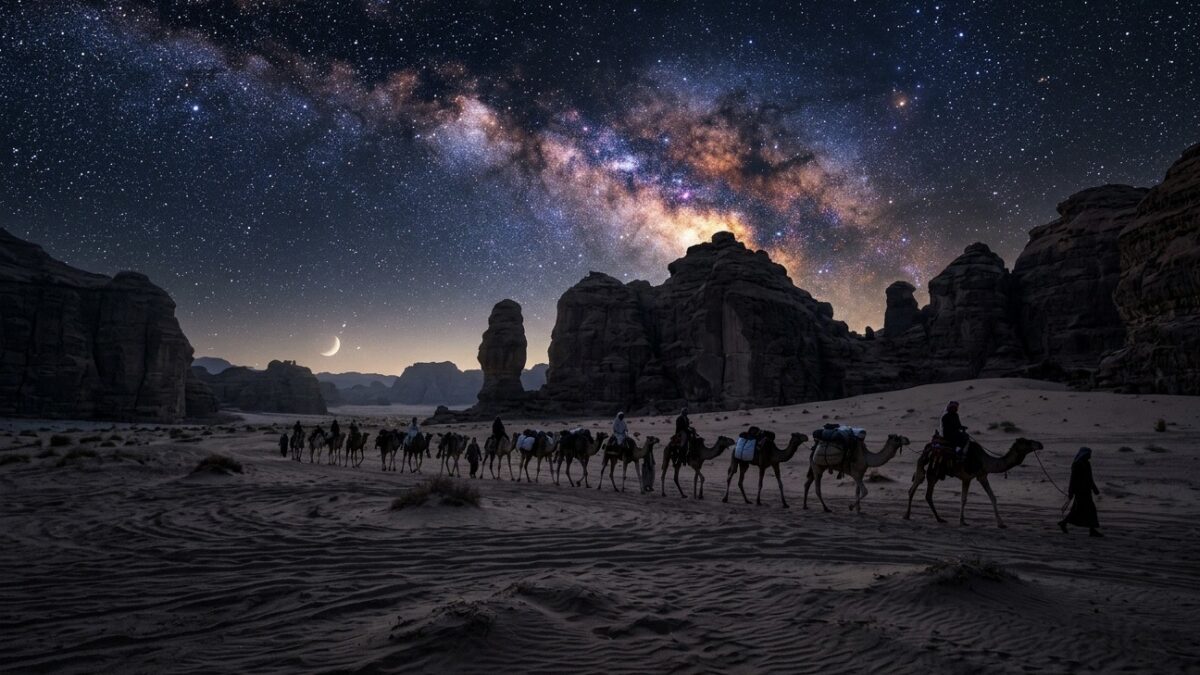
Celestial Wayfinding: The Ancient Astronomy of the Hajj Pilgrimage Routes
Before the advent of paved highways and satellite-based GPS, the desert of the Arabian Peninsula was navigated through a sophisticated understanding of the cosmos. Historical records highlighted by the Saudi Press Agency (SPA) reveal that ancient Hajj caravans relied almost exclusively on celestial navigation—using the stars, sun, and moon—to carve paths through the vast, unmarked sands toward Makkah.
- Navigational Precision: Travelers used the positions of specific constellations to determine latitude and direction with remarkable accuracy.
- Seasonal Planning: Star rising and setting times dictated agricultural cycles and the safest periods for trans-desert travel.
- AlUla as a Gateway: Historically, AlUla served as a vital station where clear desert skies allowed caravans to recalibrate their routes.
- Legacy Preservation: This ancient heritage now forms the backbone of Saudi Arabia’s modern luxury stargazing industry.
The Science of the Skies in Pre-Modern Arabia
For centuries, the movement of the heavens served as the primary navigational toolkit for land and sea travelers. By observing the altitude of the North Star and the transit of the moon, caravan leaders could organize journeys with precision that rivaled early maritime explorers. These celestial maps were not only essential for reaching religious destinations but also for survival, identifying the correct timing for planting, harvesting, and avoiding the peak summer heat during transit.
The Saudi Perspective: From Ancient Wayfinding to Modern Astro-Tourism
In the context of Saudi Vision 2030, the historical reliance on stars is being revitalized through the lens of the “Experience Economy.” AlUla, once a humble stopover for weary pilgrims, is being transformed into a global hub for astronomical tourism. By preserving its “Dark Sky” status, the Kingdom is not only honoring the scientific heritage of its ancestors but also creating a high-growth sector for international investment.
For B2B stakeholders in the tourism and heritage sectors, the narrative of the “Pilgrim’s Path” offers a unique marketing bridge. It connects the Kingdom’s deep historical roots with the modern demand for sustainable, nature-based travel. This synergy is a key driver in the digital transformation of how cultural heritage is consumed by a global audience.
A Link Across Time
Today, the open landscapes of AlUla remain one of the few places on earth where the sky remains as clear as it was for the pilgrims of a thousand years ago. This enduring relationship between the Saudi landscape and the cosmos continues to reinforce the Kingdom’s status as a premier destination for those seeking to understand the historical intersections of faith, science, and nature.