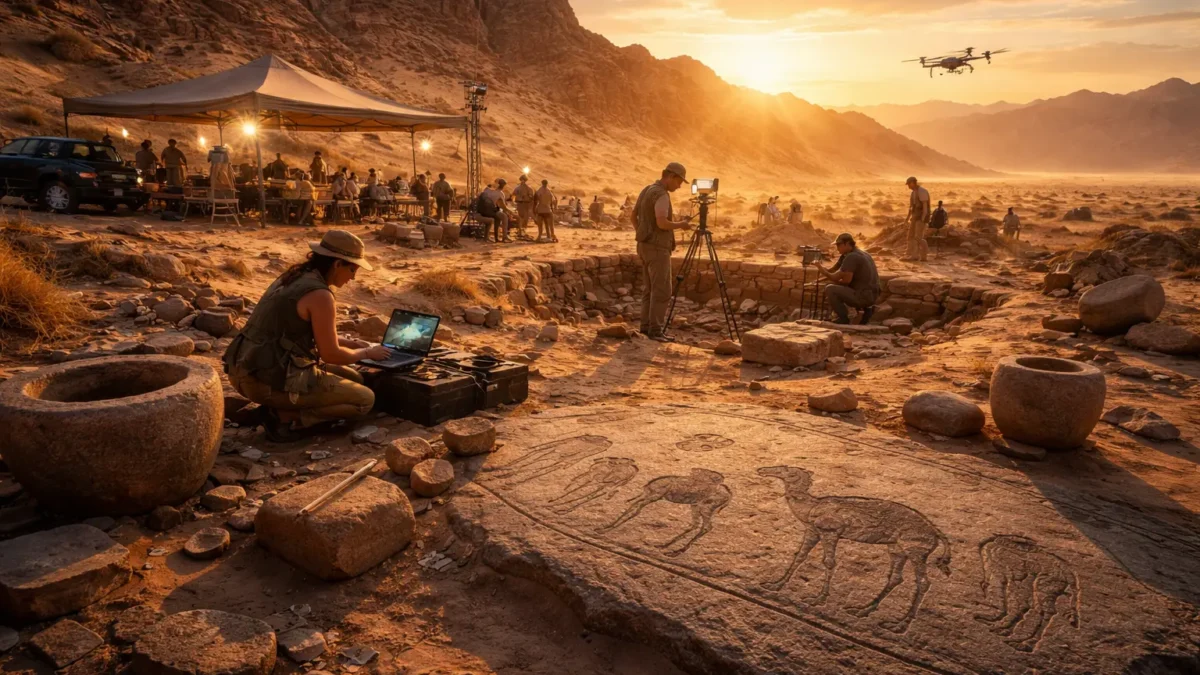
Archaeological Breakthrough: 13,500-Year-Old Settlement Unearthed in Northern Arabia
The Saudi Heritage Commission has announced a landmark discovery at the Sahout archaeological site, revealing a human settlement dating back 13,500 years. Published in the journal Nature, the findings provide definitive evidence of human occupation in the Nefud Desert during the late Ice Age, fundamentally reshaping our understanding of prehistoric migration and settlement patterns in the Peninsula.
- Natufian Connection: First major evidence of Natufian cultural traditions extending from the Levant into northern Saudi Arabia.
- Advanced Lithic Technology: Discovery of Helwan bladelets and Abu Salem points, signaling sophisticated hunting and crafting techniques.
- Prehistoric Trade Networks: Geochemical analysis of obsidian reveals 190km long-distance exchange with the Khaybar region.
- Artistic Heritage: Discovery of carving tools alongside life-size rock art depicting camels and human figures.
Challenging the Historical Narrative of the Nefud Desert
For decades, the arid stretches between the Arnan and Al-Misma mountains were thought to have limited human presence during the Epipalaeolithic period. However, the Sahout excavations reveal multiple layers of human activity. This discovery proves that the region served as a vital corridor for hunter-gatherer groups who were transitioning toward more stable, sedentary forms of existence long before the dawn of modern civilization.
Technological Sophistication and Cross-Border Exchange
The artifacts recovered—specifically the Helwan bladelets—showcase a technical synergy with the eastern Mediterranean’s Natufian culture. Beyond survival, these early inhabitants engaged in a primitive form of “sovereign trade.” By sourcing obsidian from Jabal Al-Abyad, located nearly 200 kilometers away, these communities demonstrated a level of social organization and regional connectivity that predates established historical timelines.
The Saudi Perspective: Preserving Identity through Deep Tech
This discovery is a cornerstone of Saudi Vision 2030, specifically within the mandate of the Heritage Commission to document and preserve the Kingdom’s role as a cradle of civilization. By utilizing advanced geochemical analysis and precise scientific dating, Saudi Arabia is positioning itself as a leader in archaeological deep tech. For the Kingdom, these findings are not just academic; they are essential for the development of “heritage tourism”—a key pillar for diversifying the national economy and enhancing the global cultural standing of the Arabian Peninsula.
A Legacy of Creative Expression
The presence of carving tools in the same archaeological strata as rock art confirms that artistic expression was deeply integrated into the cultural life of these early desert communities. These life-size depictions of camels and humans offer a rare, non-textual record of the spiritual and social lives of the Kingdom’s earliest inhabitants, bridging the gap between the prehistoric past and the cultural identity of modern Saudi Arabia.