Blue Urbanism: How Marine Sustainability is Redefining Saudi Real Estate Value
As Saudi Arabia accelerates its Vision 2030 real estate mandates, a paradigm shift is occurring along the Red Sea coast. No longer a mere compliance checkbox, marine sustainability is emerging as a primary driver of long-term asset valuation and urban resilience. From Jeddah’s historic waterfront to the giga-projects of the north, developers are now integrating advanced marine science directly into the architectural DNA of the Kingdom’s future cities.
- Executive Summary:
- Saudi Arabia is pioneering “Blue Urbanism,” aligning real estate development with the National Red Sea Sustainability Strategy.
- The private sector, led by projects like ALMA Destination, is adopting science-led design to protect the Red Sea’s globally unique, thermally resilient coral reefs.
- Strategic coral relocation and natural tidal flushing systems are becoming standard benchmarks for premium coastal infrastructure.
- Experts from KAUST emphasize that marine ecosystems are now “core assets” on corporate balance sheets, essential for protecting long-term investment.
Under the framework of the National Red Sea Sustainability Strategy, the Kingdom is positioning itself as a global leader in the “Blue Economy.” This strategy emphasizes that the intersectionality of marine life with the real estate sector is critical for economic diversification and attracting international tourism capital.
The ALMA Blueprint: Private Sector Leadership in North Jeddah
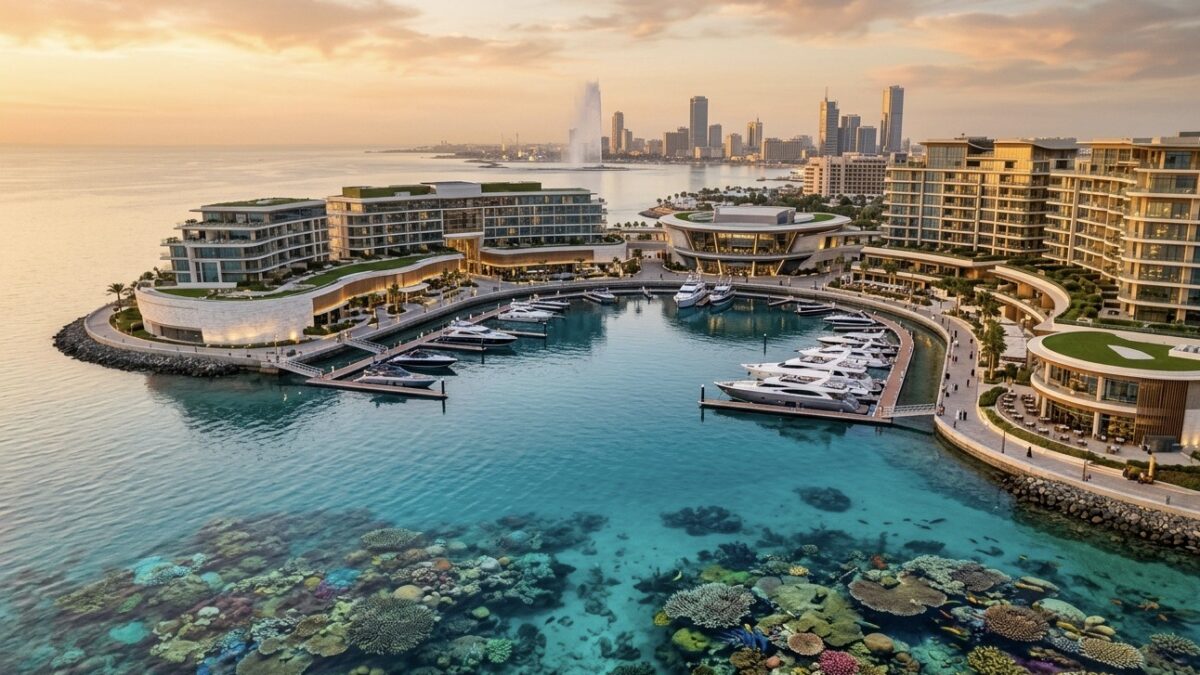
A prime example of this shift is the ALMA Destination in North Jeddah. Spanning 3.12 million square meters, this waterfront development has moved beyond traditional construction methods to embrace a “marina-led urban concept.” By embedding environmental calculations into its foundational framework, ALMA is demonstrating how private developers can mirror government-led sustainability priorities.
Key to ALMA’s strategy was the proactive relocation of coral reefs from dredging zones to protected offshore environments—a complex operation requiring precise calibration of light, depth, and water flow. Furthermore, the project utilizes a canal network powered by natural tidal movements, ensuring continuous water renewal without the energy-intensive mechanical intervention typical of older coastal developments.
The Science of Informed Design
Modern coastal development in the Kingdom is increasingly data-driven. According to Matheus Paiva, Senior Oceanographer at KAUST Beacon Development, early integration of environmental mapping is the only way to prevent “irreversible ecological damage.” By using “informed design,” developers can mitigate risks such as harmful algal blooms caused by nutrient runoff, which have historically plagued urban waterfronts.
The Saudi Perspective: A Vision 2030 Mandate
For the GCC’s enterprise leaders, the message is clear: the Red Sea’s reefs are “natural infrastructure.” As Dr. Taiba Alamoudi, a leading expert in marine ecology, noted, these reefs provide the very protection that sustains the value of waterfront property. In the context of Vision 2030, treating the environment as a “core asset” rather than a “compliance line item” is what will distinguish the next generation of successful Saudi developers.
By leveraging the thermal resilience of local reefs—some of the hardiest in the world—Saudi Arabia is not just building resorts; it is creating a sustainable blueprint for global coastal urbanization.