Smarter transit: Holy Sites Metro scales infrastructure to eliminate 50,000 bus trips this Hajj season
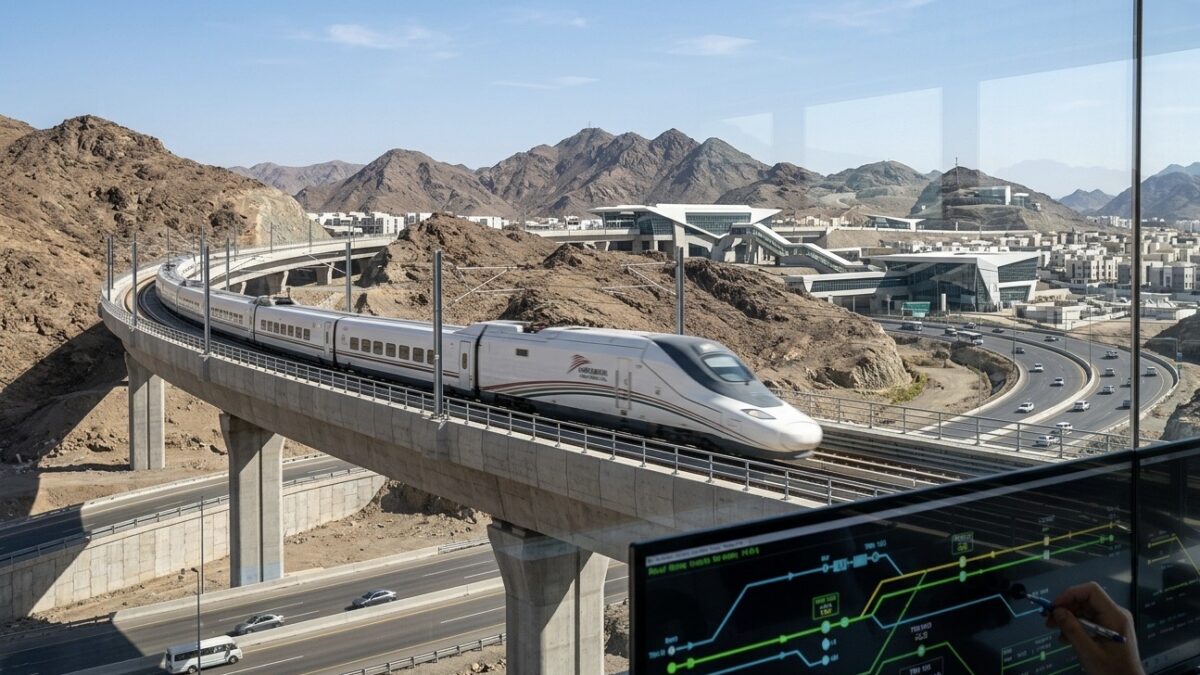
The Saudi Arabia Railways (SAR) has announced the complete operational readiness of the Holy Sites Metro line ahead of the upcoming Hajj season. Acting as a vital pillar of the Kingdom’s seasonal transit architecture, this high-capacity rail network has undergone extensive system-wide upgrades to manage massive passenger volumes between the holy sites. By shifting transit demand away from traditional road networks, the automated rail ecosystem is positioned to significantly lower urban congestion while elevating the benchmark for mega-event municipal logistics.
Executive Summary
- Operational Readiness: SAR has completed maintenance on a fleet of 17 specialized trains to guarantee safe, continuous service.
- Congestion Mitigation: The electrified rail network is projected to replace more than 50,000 bus trips, drastically reducing emissions and road gridlock.
- System Upgrades: Infrastructure overhauls targeted advanced signaling, station communications, and centralized control center operations.
- Strategic Vision: Supported by the Pilgrim Experience Program, the line remains a primary asset in achieving high-efficiency smart cities metrics for visitor comfort and safety.
First entering service in 2010, the Holy Sites Metro represents one of the largest and most complex seasonal transport infrastructure projects in the modern world. Managing high-density commuter flows across short windows requires absolute system precision. To prepare for this year’s demand, SAR engineers executed rigid predictive maintenance schedules across the fleet, ensuring that mechanical, electrical, and cooling networks can withstand peak operational pressure.
The Saudi Lens: Industrial IoT and cognitive mass transit under Vision 2030
For B2B technology leaders, transit authorities, and enterprise operators across the GCC, the scaling of the Holy Sites Metro highlights the rapid maturation of Saudi Arabia’s transport infrastructure. Moving far beyond legacy rail operations, SAR’s upgraded network serves as an active proving ground for automated crowd control systems, real-time telemetry, and smart energy optimization.
By connecting this historical transit asset directly with the data-driven objectives of the Pilgrim Experience Program—a core component of Saudi Vision 2030—the Kingdom is actively shifting mass transit from a reactive service into a proactive, intelligent network. Key enterprise and infrastructure upgrades deployed for this season include:
1. Upgraded signaling and communications architecture
SAR has modernized the line’s digital core, integrating advanced signaling networks that allow safely reduced gaps between trains. This real-time communication framework links onboard telemetry directly to a centralized control center, giving operators instant data visibility over every transit asset on the line to optimize passenger throughput.
2. Data-driven station and control center integration
The centralized operations hub has been reinforced with intelligent transit monitoring platforms. By matching station occupancy metrics with train arrival timetables, control centers can dynamically adjust platform gates and passenger flows, eliminating dangerous bottlenecks before they impact pilgrim comfort.
3. Decarbonizing high-density transport corridors
Replacing more than 50,000 diesel bus trips with an electrified rail system represents a major victory for the Kingdom’s sustainability goals. This shift noticeably lowers the carbon footprint of the holy sites during peak season, aligning municipal transit with Saudi Arabia’s wider environmental and smart city mandates.
By constantly modernizing established heavy rail assets with cutting-edge software and infrastructure layers, Saudi Arabia continues to prove its unparalleled capacity for managing massive complex operations, setting the definitive standard for smart urban transit globally.