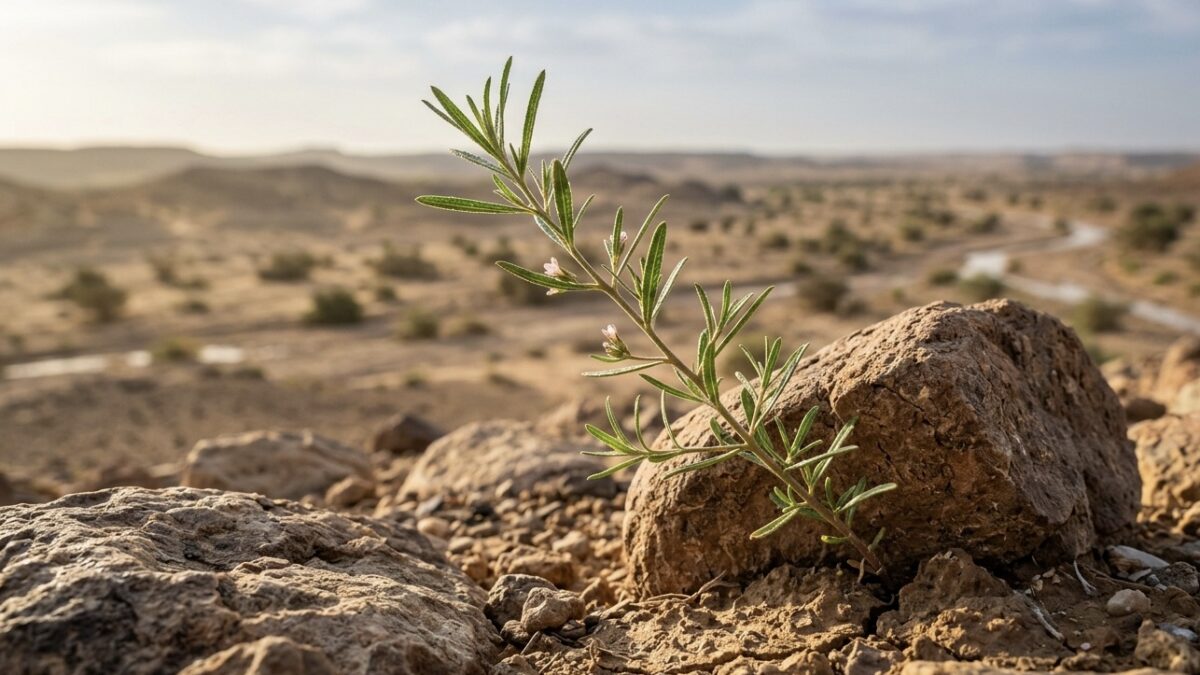
Botanical Resilience: The Daqqaqa as a Pillar of Northern Borders Biodiversity
The Northern Borders region of Saudi Arabia is increasingly recognized not just for its industrial potential, but for its quietly remarkable ecological wealth. Central to this narrative is the “Daqqaqa” (Microparacaryum intermedium), a resilient annual herb that serves as a biological indicator of the region’s unique environmental health and its ability to thrive under extreme desert conditions.
- Scientific Classification: Microparacaryum intermedium, a delicate annual herb specialized for arid climates.
- Habitat: Primarily found in clay-bottomed floodplains where soil moisture retention is highest.
- Conservation Status: Classified as a rare species with localized growth, making it a priority for regional environmental protection.
- Natural Defense: Noted as a non-grazing species, providing a natural buffer against livestock pressures.
Engineering Survival in the Arid North
Reaching heights of only 10 to 15 centimeters, the Daqqaqa is a study in evolutionary efficiency. Its slender, cylindrical stems often utilize rocky terrain for physical support, while its ribbon-shaped leaves adapt their structure—transitioning from stalked to sessile—to minimize water loss. This specialized morphology allows the plant to complete its life cycle within the brief moisture windows provided by seasonal rainfall.
Nasser Arsheed Al-Majlad, Chairman of the Aman Environmental Association, emphasizes that the plant’s presence in only a handful of specific sites highlights the distinctiveness of the Northern Borders’ ecosystem. The recent moderate-to-heavy rainfall in the region has catalyzed a visible expansion of green cover, providing a temporary boost to these fragile micro-environments.
The Strategy for Ecological Wealth
Documenting species like the Daqqaqa is a critical component of Saudi Arabia’s broader environmental mandate. While being a non-grazing plant offers some protection from local fauna, Al-Majlad warns that human activity and shifting climate patterns pose significant risks. Safeguarding these habitats is no longer just a scientific endeavor; it is a strategic necessity to preserve the Kingdom’s natural heritage.
As the Northern Borders region continues to develop, the integration of botanical conservation into urban and industrial planning remains paramount. The Daqqaqa stands as a powerful reminder that the Kingdom’s “green” future relies as much on protecting rare indigenous species as it does on large-scale afforestation.