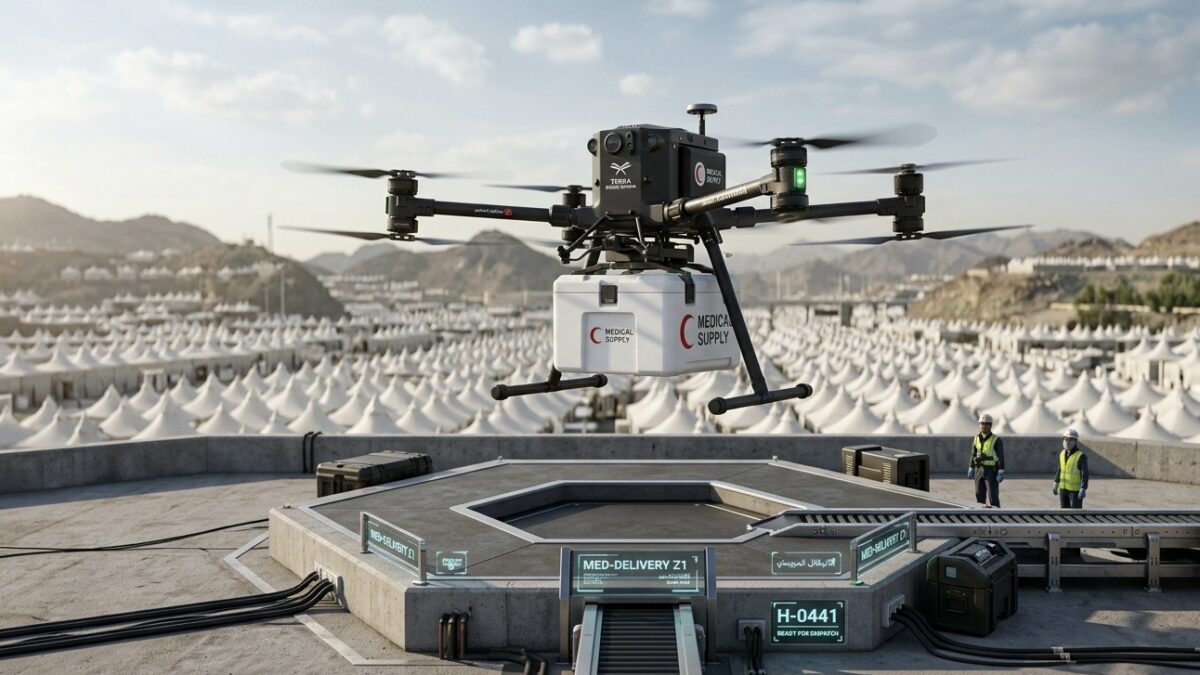
GACA Issues Landmark Drone Operational Permit to Revolutionize Hajj Medical Logistics
Saudi Arabia’s General Authority of Civil Aviation (GACA) has officially issued its first-ever operational permit for drone-based medicine delivery and advanced medical logistics. Granted to Terra Drone Arabia, this historic regulatory milestone authorizes unmanned aerial vehicle (UAV) operations within the strict geographic boundaries of the Holy Sites in Makkah during the active Hajj season. The initiative represents a decisive push by the civil aviation regulator to institutionalize modern autonomous technology into the complex service layers managing millions of global pilgrims.
Executive Summary
- Regulatory Milestone: GACA approves the first official operational permit for autonomous, drone-powered pharmaceutical and medical logistics.
- Strategic Deployment: Operations are targeted inside high-density corridors across the Holy Sites in Makkah during peak Hajj traffic.
- Proven Frameworks: The permit builds directly on iterative operational trials executed during previous pilgrimage seasons.
- Sovereign Alignment: Directly furthers the goals of the national Aviation Program and the Pilgrim Experience Program under Saudi Vision 2030.
According to GACA officials, the newly minted permit forms a core component of the Kingdom’s overarching strategy to upgrade the civil aviation infrastructure. By localizing innovative, tech-driven solutions, the state aims to elevate baseline operational efficiency while vastly accelerating response speeds for medical emergencies. The entire autonomous architecture has been engineered to adhere strictly to premium safety and quality benchmarks mandated for congested airspaces.
Transitioning from Operational Trials to Full Licensing
The issuance of this operational permit is not an isolated experiment. GACA highlighted that the regulatory framework was established following intense pilot phases conducted during past Hajj seasons, where medical drone fleets were meticulously tested for reliability and payload integrity under extreme weather and crowd conditions. Those successful initial runs yielded the empirical data necessary to draft the robust legal and flight-safety guidelines governing this year’s deployment.
By bringing private enterprise capabilities like those of Terra Drone Arabia into the state’s high-density operational environments, the authority is building a highly scalable model for modern public services. This structural integration ensures that medical response systems can completely bypass ground-level bottleneck grids, delivering life-saving payloads directly to field clinics across the Holy Sites.
The Saudi Perspective: Championing the Future of Smart Governance
By embedding autonomous UAV flight models into one of the most densely populated annual mass gatherings on earth, Saudi Arabia is proving the immense power of its national GovTech framework. This initiative is a highly precise execution of the Saudi Aviation Program and the broader Vision 2030 master plan, which commands the complete modernization of the country’s logistical ecosystems and the optimization of pilgrim services.
For enterprise technology leaders, local tech developers, and global smart city contractors, this development signals an aggressive opening for commercial drone systems, automated flight path software, and high-security civil aviation infrastructure. GACA’s progressive regulatory landscape shows that the Kingdom is ready to move beyond theoretical applications, deploying real-world, enterprise-grade autonomous solutions that set an entirely new international benchmark for high-stakes urban crowd logistics.