KAUST Scientists Engineer Nanoscale ‘Drug Factory’ to Produce Medicine Inside Living Cells
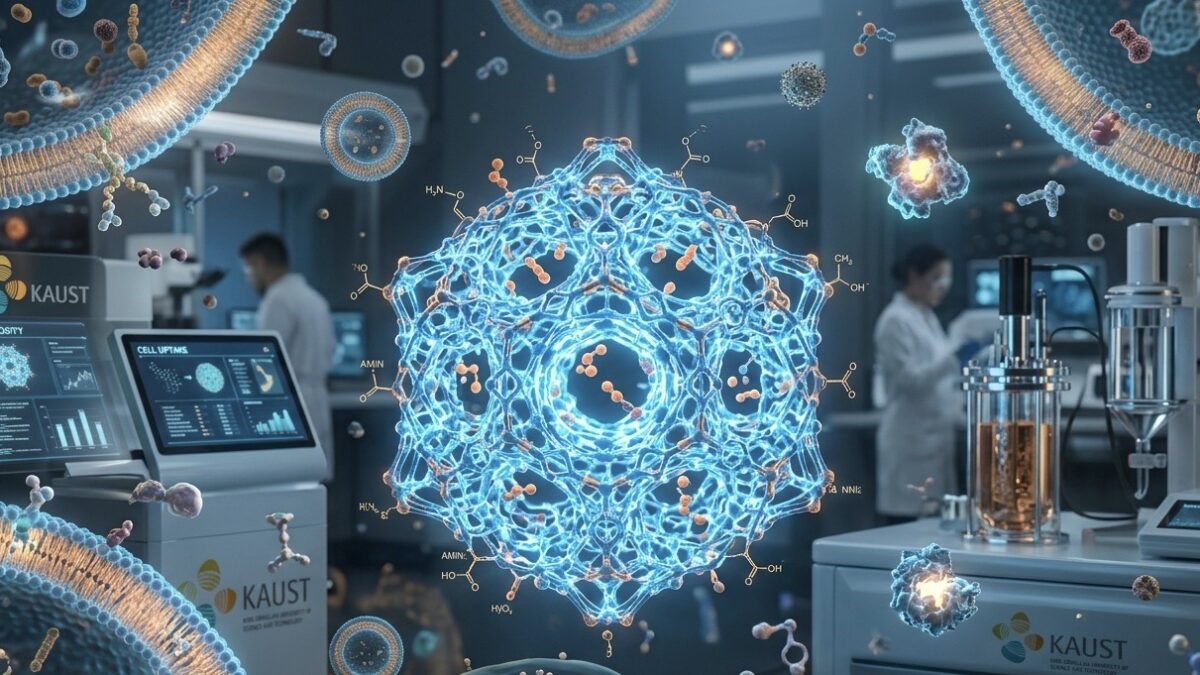
In a breakthrough that merges nanotechnology with bioengineering, researchers at King Abdullah University of Science and Technology (KAUST) have successfully engineered nanoscale particles capable of transforming living cells into miniature “drug factories.” This pioneering study, published in the journal Advanced Materials, marks the first time a complex, multi-protein system has been transplanted into a living cell to function as a single unit.
Executive Summary
- Technological Milestone: Successful delivery of six proteins into mammalian cells using metal-organic frameworks (MOFs).
- Synthetic Organelles: The system mimics natural cellular functions to produce violacein, a bioactive therapeutic compound, directly inside the cell.
- Precision Medicine: The “protein pathway transplant” allows for localized treatment, potentially reducing systemic side effects.
- Vision 2030 Impact: Solidifies Saudi Arabia’s position as a global leader in Deep Tech and advanced biotechnological research.
Overcoming the “Moonshot” Challenge of Protein Delivery
Delivering a single protein into a cell is a significant technical hurdle; delivering six simultaneously to perform a coordinated biological function was previously considered a “moonshot”. The KAUST team, led by senior research scientist Raik Grünberg and professors Niveen Khashab and Stefan T. Arold, utilized porous, sponge-like MOFs to package these proteins without compromising their activity.
Once the MOF enters the cell, the proteins remain active and work sequentially to convert a simple amino acid into violacein. This programmable platform allows scientists to fine-tune protein interactions, paving the way for therapies tailored to specific diseases by generating compounds only where they are needed.
The Saudi Perspective: Driving the National Biotech Strategy
This achievement is a direct reflection of Saudi Arabia’s commitment to becoming a global biotech hub by 2040. By fostering interdisciplinary collaboration between biology and materials science at KAUST, the Kingdom is developing sovereign capabilities in AI & Deep Tech. This research not only advances global oncology and chronic disease treatments but also creates a specialized IP portfolio that supports the National Biotechnology Strategy, a key pillar of Vision 2030.
The team now prepares to move into animal model testing, bringing this “programmable therapy” one step closer to clinical reality.