Saudi Arabia has marked a significant technological leap in its national strategy to reverse land degradation, deploying engineered soil systems capable of transforming arid terrains into self-sustaining ecosystems. This breakthrough, emerging from extensive field trials, underlines the Kingdom’s shifting focus toward precision agro-tech and deep-tech environmental interventions to realize its ambitious ecological mandates under Saudi Vision 2030.
As the Kingdom aggressively scales its environmental initiatives, advanced solutions deployed under the umbrella of Clean Energy are enabling developers to hit rigid sustainability targets without exhausting finite groundwater resources. For further details on the regional development baseline, review the localized updates originally carried on Arab News.
Executive Summary
- The Innovation: Breakthrough deployment of CarboSoil (engineered biochar) and SandX (biomimetic mulch) technologies developed by researchers at King Abdullah University of Science and Technology (KAUST).
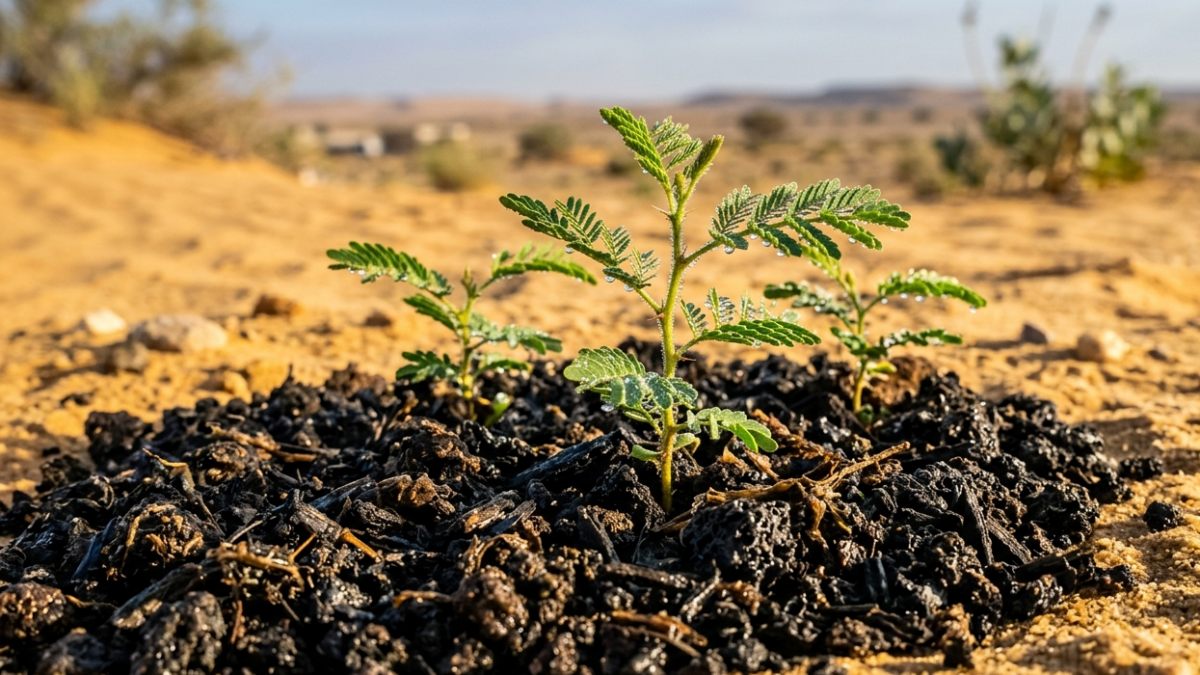
- Measurable Impact: Two-year field trials on native acacia trees demonstrated net carbon-negative results from day one, reversing the historical carbon-emitting footprint of traditional desert irrigation.
- Strategic Alignment: Direct infrastructural support for the Saudi Green Initiative (SGI), which targets the rehabilitation of 40 million hectares of degraded land and the planting of 10 billion trees.
The operational framework relies heavily on intellectual property developed locally. Professor Himanshu Mishra and his research team at KAUST engineered two distinct but complementary soil amendments: CarboSoil and SandX. CarboSoil utilizes transformed organic waste, including date palm fronds and agricultural residues, diverting material from landfills to create a highly porous, stable form of carbon adjusted specifically for alkaline sandy soils. SandX, a biomimetic mulch consisting of sand grains wrapped in a nanoscale biodegradable wax layer, acts as a physical barrier that cuts evaporative water loss by up to 80 percent, ensuring critical moisture remains locked within the root zone.
Traditional raw biochar typically exacerbates the high alkalinity of desert soils, locking away vital nutrients. The KAUST-engineered variant neutralizes this threat by lowering the matrix pH to near-neutral values while embedding slow-release phosphorus and essential micronutrients. Operating at an application rate of 5 to 10 percent by volume, the technology functions as a permanent subsurface reservoir. Unlike standard organic compost or imported peat moss, both of which decompose rapidly under the intense thermal stress of the Arabian Peninsula, this carbon matrix remains structurally stable and effective for centuries, offering enterprise-grade permanence for large-scale landscaping and agricultural megaprojects.
Alleviating Climate and Macro-Economic Risks
Beyond localized ecological restoration, the industrial application of these soil systems directly addresses macro-economic vulnerabilities within the GCC. Arid land degradation amplifies regional dust and sandstorms, which impose severe operational costs on critical solar energy arrays, urban infrastructure, and transport logistics. By stabilizing topsoil and establishing resilient vegetative cover, these deep-tech interventions systematically lower ambient dust levels while strengthening domestic food and water security architectures.
The scale of implementation mirrors the baseline objectives of the Saudi Green Initiative. As the Kingdom moves aggressively to restore millions of hectares of native habitats, the commercialization of local innovations like CarboSoil provides a scalable, economically viable alternative to resource-heavy legacy methods. By proving that desert greening can operate as a viable mechanism for permanent carbon credits, Saudi Arabia is setting a technical benchmark for sustainable land management across global arid and semi-arid economies.