Sovereign Efficiency: How the Makkah Route Initiative Modernizes Saudi Border Control Infrastructure for Hajj
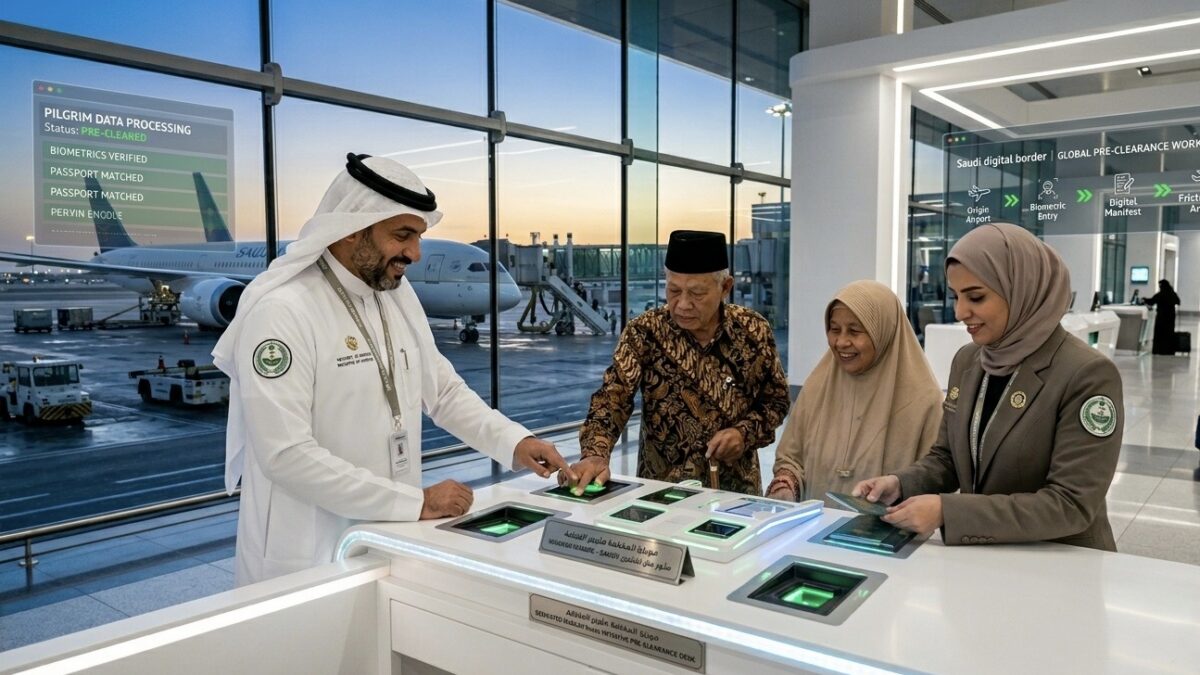
As the annual Hajj season approaches, Saudi Arabia’s Makkah Route Initiative is transforming cross-border logistics for thousands of international pilgrims. Run by the Ministry of Interior in tandem with an array of state entities, this flagship program demonstrates the scalability of the Kingdom’s integrated GovTech networks. By exporting Saudi immigration infrastructure directly to international aviation hubs, the initiative provides a frictionless, domestic-style arrival process for pilgrims from Africa and beyond.
Executive Summary
- Unifying State Infrastructure: The project integrates workflows across the Ministry of Interior, Ministry of Foreign Affairs, Ministry of Health, Ministry of Hajj and Umrah, and the Saudi Data and AI Authority (SDAIA).
- Pre-Clearance Paradigm: Immigration, customs, health verification, and luggage management are fully resolved at the port of departure.
- Proven High Volume: Since launching in 2017 under Vision 2030, the unified system has cleared over 1.25 million pilgrims.
- West African Expansion: The platform expanded into Senegal for the first time this year, setting a standard for cross-border digital identity verification.
Seamless Cross-Border Data Systems in Action
The Makkah Route Initiative functions as a pre-clearance mechanism that redefines regional border control paradigms. Rather than routing arriving passengers through standard international customs upon landing, the platform handles complex passport procedures, health checks, and data entry at foreign airports like Rabat-Salé in Morocco, Blaise Diagne in Senegal, and Félix Houphouët-Boigny in Ivory Coast.
By leveraging advanced technologies to speed up processing, the initiative allows travelers—including elderly, disabled, and visually impaired individuals—to bypass traditional entry bottlenecks. Once flights touch down within the Kingdom, passengers exit the aircraft directly to transit buses, while their coded luggage is seamlessly transferred by automated logistics teams straight to their accommodations in Mina, Arafat, or Muzdalifah.
A Multisector Collaborative Framework
The operational success of this program relies on a unified backend system that connects disparate government frameworks. By linking data fields among aviation, customs, and health authorities alongside specialized digital services, the initiative eliminates the structural friction that typically impacts multi-agency border operations.
For religious scholars and community leaders navigating these hubs, the reduction in travel formalities provides peace of mind, shifting the focus entirely onto the spiritual significance of the journey. The program’s expansion into West African hubs this year demonstrates that the infrastructure is highly scalable, stable, and ready for broader cross-border operations.
Strengthening the Vision 2030 Digital Border Strategy
Beyond its significant humanitarian benefits, the project acts as a major validation point for the Kingdom’s human capability development and e-government roadmaps. By transforming traditional physical checkpoints into a unified digital workflow, Saudi Arabia is actively setting global benchmarks for safe, tech-driven mass migration management.
As national systems continue to evolve, the underlying tech architecture supporting this program proves that the Saudi digital border ecosystem is built to scale. By prioritizing cloud-based synchronization and multi-agency interoperability, the Ministry of Interior and its partners are showing how GovTech can effectively drive national strategy while supporting global human welfare.