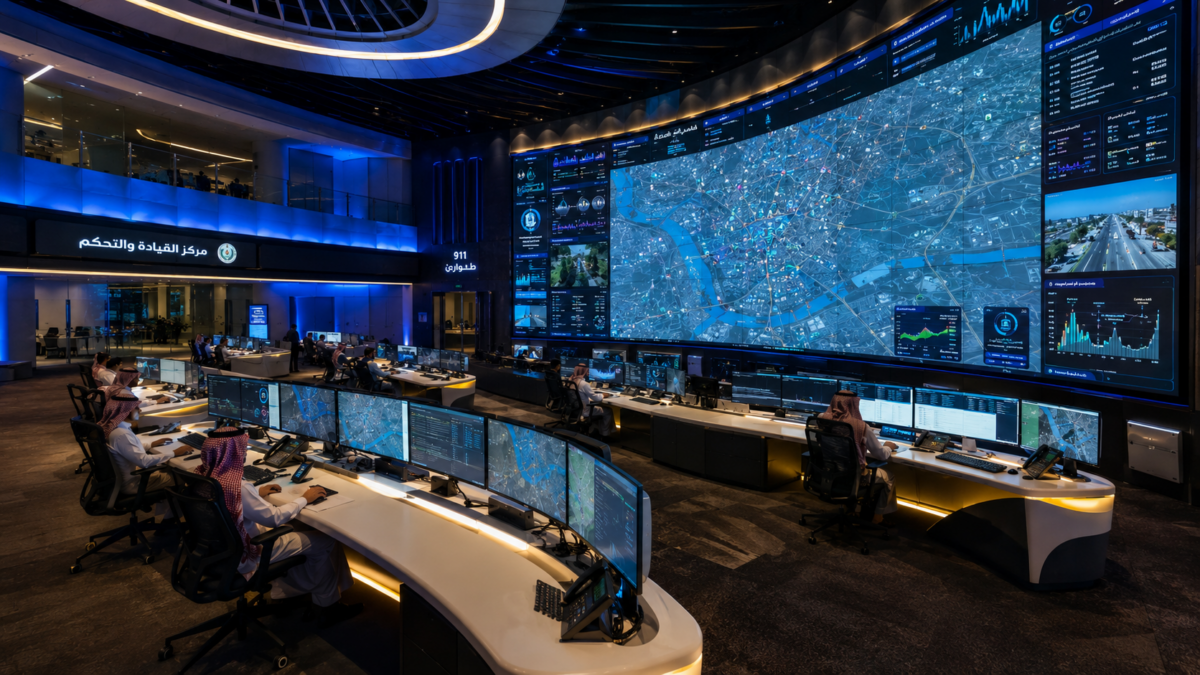
The National Center for Security Operations (NCSO), operating under the Saudi Ministry of Interior, has deployed next-generation command-and-control upgrades at its Unified Security Operations Centers (911) in Makkah and Madinah. Spearheaded as part of the Kingdom’s absolute commitment to public safety and infrastructure excellence during the Hajj season, these technological enhancements allow unified dispatch teams to process incoming security and humanitarian calls with unprecedented velocity. The deployment positions Saudi Arabia at the vanguard of critical event management and digital civic defense globally.
Executive Summary
- Sub-Two-Second Processing: Systemic core upgrades enable multilingual operators to pick up emergency calls within a two-second window.
- Agency Integration: Consolidation of up to 30 distinct security, medical, and municipal service agencies under a single operational roof during peak Hajj operations.
- Advanced Geo-Location: Instant automatic data rendering of a caller’s identity, phone number, and telemetry on unified GIS mapping screens within 45 seconds.
- Vision 2030 Intersect: Co-developed alongside the Quality of Life Program to ensure a seamless, secure environment for millions of international pilgrims.
Consolidating Command and Control for Massive Crowd Logistics
Managing the safety of millions of individuals moving across highly concentrated geographic zones requires an exceptionally resilient digital core. The Unified Security Operations Center model replaces fragmented, legacy agency networks by funneling all security, Civil Defense, and medical dispatch lines into an integrated multi-agency platform. During peak pilgrimage intervals, the infrastructure scales its integration from 15 permanent entities to over 30 municipal and security units to maintain total operational synchronization.
The facility’s architecture is segmentally divided into three distinct operational domains: the call-taking hall, the dispatch hall, and the surveillance hall. By linking real-time data feeds from thousands of intelligent cameras directly with dispatch workflows, the NCSO creates a closed-loop system where situational data instantly informs field unit positioning.
Multilingual Accessibility and Algorithmic Sorting
Given the immense linguistic diversity of global pilgrims arriving for Hajj, the 911 centers employ specialized, highly trained personnel capable of communicating fluently in multiple major languages, including English, Urdu, and French. When an emergency or humanitarian request enters the platform, the caller’s geographic and personal profile is instantly localized on-screen. Critical incidents are automatically formatted and routed to field responders in less than 45 seconds.
To optimize resource allocation, the command center utilizes strict data triage processes. Historical metrics show that approximately 80% of incoming inquiries are informational or advisory requests solved directly by localized handlers, freeing up dedicated dispatch bands to focus strictly on time-critical field deployments.
Driving Public Safety Infrastructure under Vision 2030
This initiative represents a core pillar of the Ministry of Interior’s digital transformation roadmap, executed in close alignment with the Quality of Life Program—a foundational segment of Saudi Vision 2030. By replacing siloed municipal structures with centralized, intelligent networks, the Kingdom continues to establish regional benchmarks for smart public safety infrastructure. The expansion of these unified centers across Riyadh, the Eastern Province, and the Holy Sites highlights a broader enterprise shift toward predictive, highly responsive government operations.