

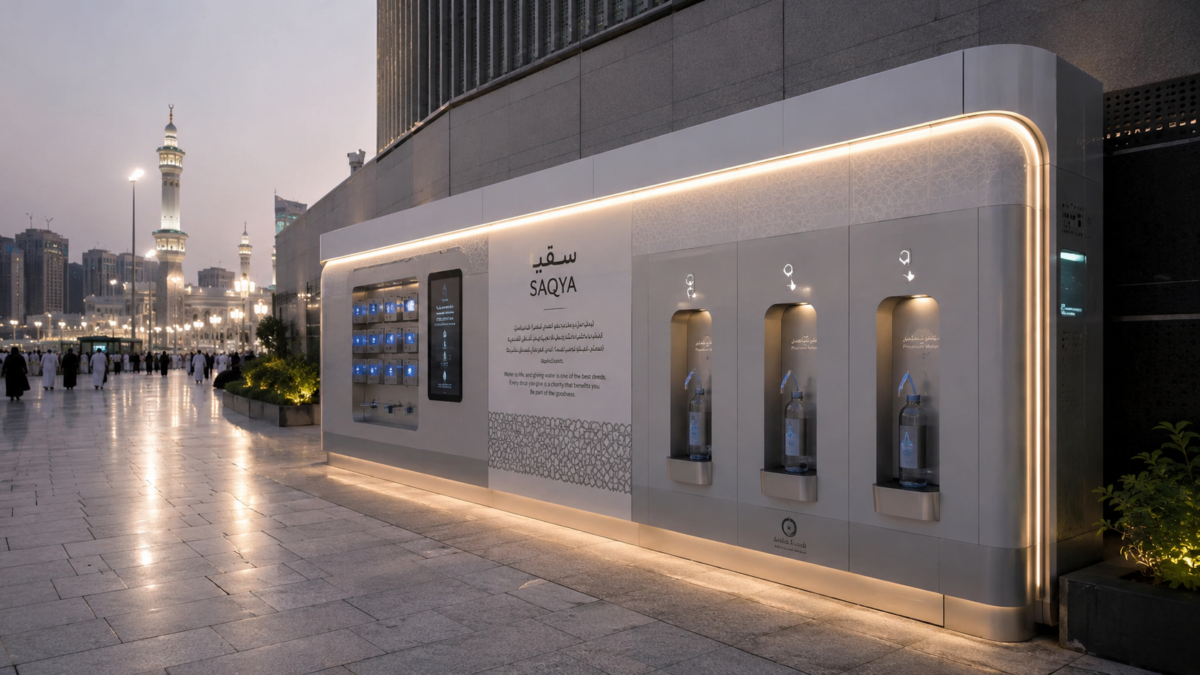
Saudi Arabia’s drive toward human-centered smart cities has achieved a significant milestone in the holy sites. Kidana Development Co., the executive arm of the Royal Commission for Makkah City and Holy Sites, has deployed an innovative, automated drinking-water network to transform the pilgrim experience during Hajj and Umrah. The project replaces traditional distribution models with a continuous, tech-driven hydration ecosystem designed to withstand extreme climate conditions.
Executive Summary
- Infrastructure Scale: Deployment of over 2,400 automated, chilled, and purified water stations along major pedestrian corridors.
- Crowd Management: Strategic, data-backed positioning to optimize pedestrian flow and minimize bottlenecking in high-density zones.
- Health & climate Resilience: Engineered to mitigate heat stress, ensuring high-purity water delivery under stringent public health standards.
- Vision 2030 Alignment: Direct contribution to the Pilgrim Experience Program by scaling up sustainable public infrastructure.
Next-Gen Engineering Replaces Legacy Water Distribution
The traditional logistics of moving packaged water to millions of pilgrims presents massive operational and environmental challenges. To address this, Kidana’s new infrastructure introduces modular, high-capacity water points integrated directly into the urban fabric of the holy sites. Every station features advanced filtration and cooling loops, ensuring an uninterrupted supply of purified water while significantly cutting down on plastic waste.
By treating hydration as a critical utility rather than a logistical distribution task, the Royal Commission is setting a new benchmark for large-scale event management. The architectural design of these stations ensures high throughput, allowing multiple pilgrims to utilize a single station simultaneously without disrupting the flow of foot traffic on adjacent walkways.
Mitigating Heat Stress and Optimizing Pedestrian Flow
In the arid climate of the Hijaz region, heat stress poses a major operational risk during peak pilgrimage seasons. This automated network acts as a frontline public health intervention. By strategically placing these smart points along pedestrian routes, the infrastructure actively reduces dehydration risks while maintaining crowd momentum.
Furthermore, Kidana leveraged spatial analytics to map out high-density bottleneck zones. The water points are organized in decentralized clusters rather than single mass stations, preventing overcrowding and ensuring that crowd movement between the holy sites remains fluid, safe, and organized.
Preserving Local Context: Driving Vision 2030 Infrastructure
This initiative is a direct reflection of Saudi Vision 2030’s Pilgrim Experience Program, which aims to host up to 30 million pilgrims annually. By deploying advanced smart water infrastructure, local stakeholders like Kidana and the Royal Commission for Makkah City are demonstrating how localized tech solutions can solve massive, complex crowd-logistics challenges. This project proves that sustainable, long-term infrastructure assets are rapidly replacing temporary operational fixes in the Kingdom’s sacred spaces.



[…] Elham, S. (2026). Saudi Arabia Deploys Smart Water Infrastructure for Hajj. Diambil dari https://saudifuturetech.com/saudi-arabia-deploys-smart-water-infrastructure-for-hajj/. […]