Saudi Arabia is entrenching its position as a global leader in ecological urbanism, with green building authorities emphasizing that the rapid build-out of next-generation smart centers is central to achieving the United Nations Sustainable Development Goals (SDGs) by 2030. According to the leadership of the Saudi Green Building Forum (SGBF), environmentally responsible urban planning is actively serving as a force multiplier across multiple sustainability metrics simultaneously.
Executive Summary
- Strategic Mandate: Harnessing urban development to accelerate national and international UN SDG compliance.
- Primary Institutional Insights: Faisal AlFadl, Secretary-General of the SGBF, details the systemic benefits of macro-engineered ecosystems.
- Flagship Frameworks: The Riyadh Metro and The Red Sea Project cited as prime operational examples of low-carbon development.
- Core Socioeconomic Focus: Reducing per capita carbon footprints while improving local economic mobility and municipal liveability.
Speaking on the future of the Kingdom’s construction ecosystem, Faisal AlFadl, Secretary-General of the Saudi Green Building Forum, noted that well-planned, circular municipal infrastructures fundamentally improve mass transit, green residential design, energy grid efficiency, and long-term ecosystem preservation — all pillars of Saudi Vision 2030.
Decarbonizing Mega-Scale Municipal Footprints
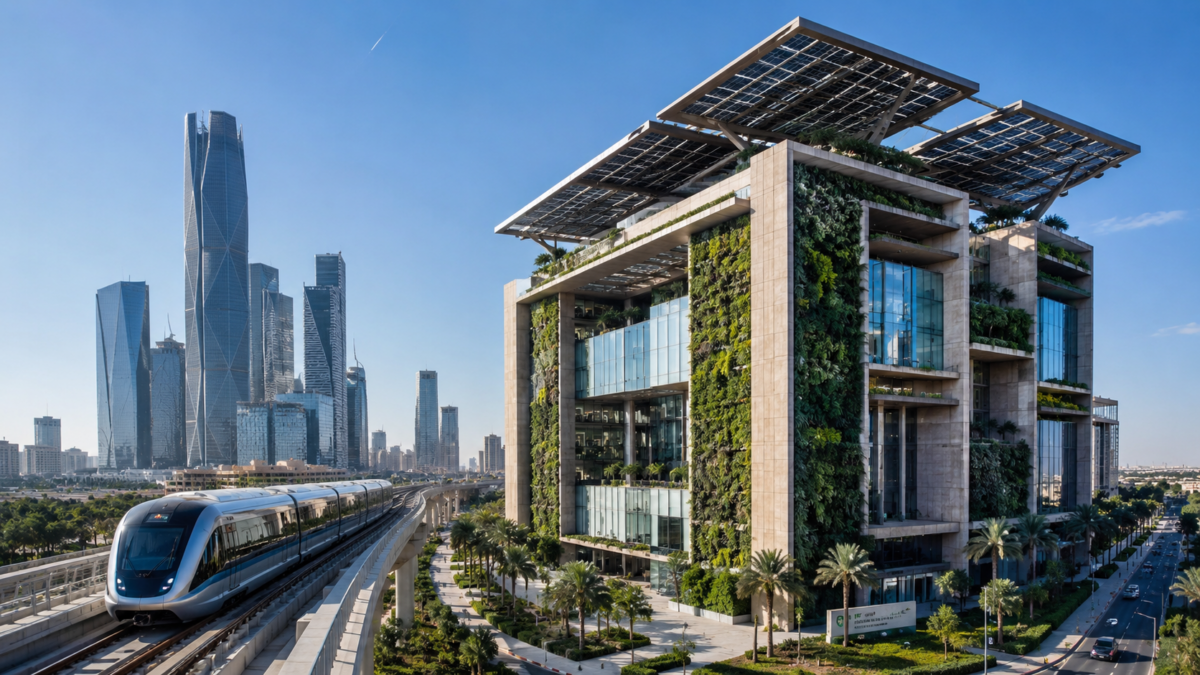
The transformation is anchored by massive, multi-billion-dollar infrastructure developments designed to serve as real-world laboratories for future urban living — a philosophy also driving NEOM’s 170km linear smart city, The Line. Flagship deployments like the Riyadh Metro network, overseen by the Royal Commission for Riyadh City, drastically reduce urban congestion and carbon emissions by providing sophisticated, energy-efficient alternatives to private vehicle transit.
Simultaneously, the Red Sea Project represents a global benchmark for regenerative tourism. Powered entirely by independent renewable energy storage networks and engineered to preserve delicate surrounding marine and desert ecosystems, it highlights how capital-intensive projects can actively enhance, rather than merely sustain, local biodiversity.
Inter-Sector Integration for Climate Resilience
These massive initiatives are structurally bound to Saudi Vision 2030, a blueprint aimed at shifting the macroeconomic foundation away from hydrocarbon dependency while elevating urban health standards. AlFadl stressed that hitting the target requires rigorous, coordinated cooperation between government entities, private real estate developers, and green tech providers.
As international construction paradigms shift under the pressure of climate change, the Kingdom’s ongoing rollouts in the Smart Cities sector show how aggressive infrastructure investment can turn modern urban centers into powerful engines for social well-being and economic resilience. This same sovereign approach to digital and urban innovation is playing out in the desert too — read how AI-powered drones are modernizing camel herding as another facet of the Kingdom’s tech-driven transformation.