

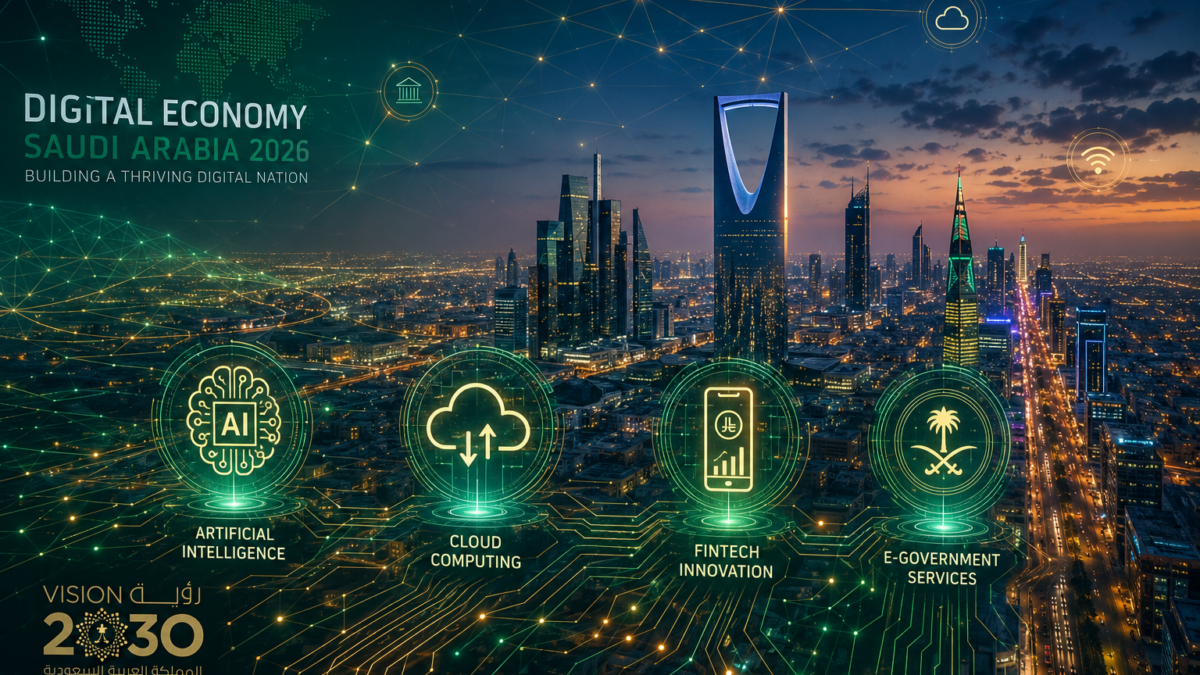
Saudi Arabia’s digital economy has arrived at a defining moment. What began as an ambitious policy objective under Vision 2030 has become a measurable, growing sector that now sits at the core of the Kingdom’s broader economic strategy. In 2026, the digital economy is no longer a parallel track running alongside the traditional oil-based economy. It is woven into the fabric of how the country does business, delivers public services, and positions itself on the global technology map.
This report brings together the latest data on market size, growth trajectories, key sectors, and government investment commitments. Whether you are an investor, a technology executive, or a policy analyst tracking the Middle East’s fastest-moving digital landscape, the numbers and trends outlined here provide a comprehensive foundation for informed decision-making.
| Key Insight: Saudi Arabia’s digital economy reached approximately SAR 495 billion in 2025, contributing 15% to the national GDP, according to the Ministry of Communications and Information Technology. The ICT market alone surpassed SAR 180 billion the same year, making it the largest technology market in the region. |
1. Market Size: Where the Digital Economy Stands Today
The headline figure that defines Saudi Arabia’s digital economy in 2026 comes from official government data published by the Ministry of Communications and Information Technology (MCIT). The digital economy now accounts for 15 percent of national GDP, a figure confirmed by the Saudi Vision 2030 Progress Report. The General Authority for Statistics (GASTAT) has separately placed the digital economy’s GDP contribution at 15.6 percent, reflecting strong momentum across multiple sub-sectors.
To put this in context, Saudi Arabia’s nominal GDP reached USD 1.275 trillion in 2025, according to GASTAT. A 15 percent digital share translates to a sector generating well over USD 190 billion in economic activity annually. The government has set an official target to raise the digital economy’s GDP contribution to 19.9 percent by 2030, meaning the sector still has a defined upward trajectory built into national planning documents.
The ICT market, which forms the backbone of the digital economy’s infrastructure, surpassed SAR 180 billion in 2024 and continues to grow. This positions Saudi Arabia as the largest technology market in the Arab world by a significant margin, ahead of the UAE and Egypt.
2. Growth Rate and Forward Projections
Growth in the Saudi digital economy is not a recent phenomenon. It has compounded steadily over the past five years, accelerated by government mandates, private sector investment, and a population demographic that is inherently digital. According to available data, 71 percent of the Kingdom’s population is under 35 years old, and this group expects digital-first interactions in commerce, government, and entertainment.
The Digital Cooperation Organization, headquartered in Riyadh, projects the global digital economy will reach USD 28 trillion by 2026, growing at 9.5 percent, three times the rate of the overall global economy. Saudi Arabia is tracking ahead of that global average across several verticals. AI venture funding in the country grew 61 percent year-on-year in the first half of 2025, and government spending on emerging technologies rose by more than 56 percent in 2024 alone.
The cloud computing market, a strong proxy for enterprise-level digital adoption, is forecast to grow at a compound annual growth rate of 11.33 percent between 2025 and 2033, reaching USD 38.23 billion by 2033 from a base of USD 14.55 billion in 2024. This trajectory makes Saudi Arabia one of the fastest-growing cloud markets in the emerging world.
| Growth Snapshot AI venture funding: +61% YoY (H1 2025) | Government tech spending: +56% (2024) | Cloud CAGR 2025-2033: 11.33% | Data center capacity growth since Vision 2030 launch: 6x |
3. Key Sectors Driving the Digital Economy
Artificial Intelligence
Artificial intelligence sits at the top of Saudi Arabia’s digital agenda in 2026. The National Strategy for Data and AI (NSDAI) sets an objective to attract USD 20 billion in AI investments and train 20,000 AI specialists by 2030. Progress against this target is visible across sectors from healthcare diagnostics to predictive construction modeling on giga-projects.
In May 2025, the Public Investment Fund launched Humain, a dedicated AI company intended to position Saudi Arabia as a global AI infrastructure provider. The country currently ranks 14th in the 2025 Global AI Index and holds the leading position in the Arab world for AI model development. AI companies operating in the Kingdom secured USD 9.1 billion in funding during 2024, a figure that reflects both international interest and domestic confidence.
For a closer look at how Saudi Arabia is performing against global peers, the analysis in Saudi Arabia Leads Global AI Adoption and Digital Investment Returns, KPMG Report Reveals provides a detailed breakdown of the KPMG findings that placed the Kingdom at the top of global AI adoption rankings in 2026.
Cloud Computing and Data Centres
Cloud infrastructure is the physical backbone of the Kingdom’s digital ambitions. Saudi Arabia’s data centre sector has expanded sixfold since the launch of Vision 2030, with cumulative investments exceeding SAR 16 billion. The number of operational data centres has grown to more than 60, developed by over 20 companies across the country.
Hyperscale cloud regions from both AWS and Microsoft were in advanced development as of late 2025, with Microsoft’s new cloud datacenter region in the Kingdom planned to be operational in 2026. These investments are designed to address data residency requirements under the National Data Management Office frameworks, while providing enterprise-grade AI and cloud services to regulated industries.
Market revenue from data centres is projected to reach USD 2.83 billion by 2030, growing at an annual rate of 6.45 percent. Fibre-optic network coverage has already expanded to over 3.9 million kilometres across the Kingdom, providing the connectivity layer that makes cloud adoption possible at scale.
Fintech and Digital Payments
The fintech sector represents one of the most visible transformations in daily Saudi life. As of 2025, 75 percent of all transactions in Saudi Arabia are conducted digitally, a shift driven by consumer behavior, regulatory reform, and the expansion of mobile payment infrastructure across the Kingdom.
The Saudi Central Bank (SAMA) has built a regulatory sandbox that has enabled dozens of fintech companies to operate and scale. Payment infrastructure, digital lending, insurance technology, and open banking applications have all seen sustained growth. Saudi Arabia’s fintech ecosystem is now one of the most developed in the GCC, attracting both regional players and international firms looking to establish a Middle East presence.
E-Government and GovTech
Over 90 percent of government services in Saudi Arabia have been digitized, according to the National Strategy for Digital Transformation. Platforms such as Absher, which handles everything from residency permits to driving licenses, and Tawakkalna, originally built for health management during the pandemic, have become permanent fixtures of how citizens and residents interact with the state.
Saudi Arabia ranked among the top global performers on the United Nations E-Government Development Index, and the country is actively building next-generation GovTech capabilities. Smart city integration, AI-driven public service delivery, and fully digital government procurement are all active programs within the current Vision 2030 work plan.
Smart Cities and IoT
Saudi Arabia’s giga-projects function as living laboratories for advanced digital infrastructure. NEOM, the Red Sea Project, and Qiddiya are each designed to run on integrated IoT, AI, and digital twin platforms from the ground up. The Kingdom’s smart tech market was projected to reach USD 2.9 billion by 2025, with giga-projects serving as both anchor clients and global showcases.
For companies evaluating where to base their operations within Saudi Arabia’s digital ecosystem, NEOM vs Riyadh vs Jeddah: Which Saudi City Is the Best Base for Technology Companies in 2026? provides a practical comparison of each city’s strengths, incentives, and infrastructure maturity.
4. Government Investment Frameworks and Spending Commitments
The scale and speed of Saudi Arabia’s digital growth cannot be understood without looking at the investment architecture that sits behind it. The government is not a passive enabler in this market. It is an active architect, a majority funder in many cases, and the primary driver of demand across the largest digital verticals.
The Public Investment Fund (PIF), with assets under management exceeding USD 925 billion, has been the central vehicle for strategic digital investments. Beyond Humain, the PIF has backed cloud infrastructure, AI companies, and digital health platforms as part of a broader thesis that technology is the primary lever for economic diversification.
The MCIT has its own investment pipeline, with responsibilities covering broadband infrastructure, spectrum allocation, cybersecurity frameworks, and the enabling regulations that allow international technology companies to operate in the Kingdom. Saudi Arabia’s 5G network has reached 95 percent urban coverage, a milestone that directly supports the digital economy across both enterprise and consumer applications.
The National Data Management Office (NDMO) governs data handling and residency requirements, which in turn has driven domestic data center construction and cloud infrastructure investment. International cloud providers must comply with NDMO frameworks to serve regulated industries, which has effectively created a domestic infrastructure investment requirement that runs into the billions annually.
| Government Investment Highlights PIF assets: USD 925 billion+ | Humain (AI company) launched under PIF, May 2025 | Data center investment: SAR 16 billion+ since Vision 2030 launch | NSDAI target: USD 20 billion in AI investment by 2030 | 5G urban coverage: 95% |
5. Challenges and Areas to Watch
The growth story is real, but it does not come without friction. Saudi Arabia’s digital economy faces several challenges that investors and operators should factor into their forward planning.
- Talent supply: The Kingdom is actively training AI specialists and technology workers, but demand for skilled talent is outpacing domestic supply. International recruitment and partnerships with global universities are filling some of the gap, but this remains a constraint on growth rates.
- Regulatory evolution: As new sectors emerge, including decentralized finance, generative AI applications, and autonomous systems, regulatory frameworks are still being written. Companies operating at the frontier of these areas need to maintain close engagement with SAMA, MCIT, and the Communications, Space and Technology Commission.
- Data sovereignty requirements: NDMO compliance requirements add cost and complexity for international operators. Companies entering the market need to account for data localization from the outset of their architecture planning.
- Execution risk on giga-projects: Projects of the scale and ambition of NEOM carry inherent execution risk. Phase 2 of NEOM construction has begun, but timelines and scope have been adjusted from initial projections.
6. Saudi Arabia’s Position in the Regional and Global Digital Landscape
Saudi Arabia is not competing only within the Gulf. It is actively positioning itself as a global digital economy leader, with the DCO headquarters in Riyadh serving as both a symbol and an instrument of that ambition. The Kingdom chairs an organization with 54 member countries, giving it a governance platform that amplifies its voice on digital standards, AI regulation, and cross-border data flows.
Regionally, Saudi Arabia’s ICT market is the largest in the Arab world. Its cloud infrastructure investment, AI commitments, and government digitization programs are ahead of any comparable market in the Middle East and North Africa. The 2026 GITEX Global conference, held in Riyadh for the first time, underscored the Kingdom’s growing centrality to the regional technology conversation.
For global technology companies, Saudi Arabia now represents a first-tier entry point into the broader Middle East market, not just a secondary destination after the UAE. The combination of market size, government spending power, and regulatory modernization has shifted the calculus for where international technology firms allocate their regional resources.
Conclusion
Saudi Arabia’s digital economy in 2026 is a story of momentum, infrastructure, and government will. The market has moved from ambition to execution across AI, cloud, fintech, GovTech, and smart cities. The SAR 495 billion base and 15 percent GDP contribution give the sector genuine weight, and the investment pipeline, anchored by the PIF and MCIT, ensures that this weight will keep growing toward the 2030 targets.
The opportunity for international investors and technology companies is structural, not cyclical. The drivers of growth in Saudi Arabia’s digital economy, Vision 2030’s diversification mandate, a young and digitally native population, a government willing to be a first mover on technology adoption, and a regulatory environment that is becoming more sophisticated by the quarter, are durable. They will still be in place when the next progress report is written.
Frequently Asked Questions (FAQ)
What is the current size of Saudi Arabia’s digital economy in 2026?
Saudi Arabia’s digital economy reached approximately SAR 495 billion (roughly USD 132 billion) in 2025, contributing 15 percent of national GDP, according to official data from the Ministry of Communications and Information Technology. GASTAT has placed the contribution at 15.6 percent of GDP.
What is Saudi Arabia’s target for its digital economy by 2030?
The government has set an official target for the digital economy to contribute 19.9 percent of national GDP by 2030, up from the current 15 to 15.6 percent range. This target is embedded in Vision 2030’s National Strategy for Digital Transformation.
Which sectors are leading the growth of Saudi Arabia’s digital economy?
The primary growth sectors are artificial intelligence, cloud computing and data centres, fintech and digital payments, e-government and GovTech, and smart cities and IoT. AI venture funding grew 61 percent year-on-year in the first half of 2025, while the cloud computing market is projected to reach USD 38.23 billion by 2033.
How much is the Saudi government investing in the digital economy?
Government spending on emerging technologies rose by more than 56 percent in 2024. The Public Investment Fund has invested over SAR 16 billion in data centres alone since Vision 2030 launched. The National Strategy for Data and AI targets USD 20 billion in total AI investment by 2030. The PIF-backed Humain company was launched in May 2025 as a dedicated AI infrastructure vehicle.
How developed is Saudi Arabia’s 5G and digital connectivity infrastructure?
Saudi Arabia’s 5G network has reached 95 percent urban coverage. Fibre-optic network coverage has expanded to over 3.9 million kilometres across the country. These infrastructure milestones directly enable higher adoption rates for cloud computing, AI applications, and digital government services.
Is Saudi Arabia considered a global leader in AI adoption?
Yes. Saudi Arabia ranked 14th in the 2025 Global AI Index and holds the leading position among Arab countries for AI model development. According to KPMG’s 2026 Technology Report, Saudi Arabia ranked first globally in both AI adoption rates and digital investment returns among the countries surveyed.
What role does the Public Investment Fund play in the digital economy?
The Public Investment Fund (PIF), with assets exceeding USD 925 billion, is the primary state vehicle for strategic digital investments. It launched Humain as an AI infrastructure company in 2025, backs cloud and data centre development, and participates in international technology partnerships as part of Saudi Arabia’s broader digital diversification strategy.

[…] The Saudi government has also launched a National Data Center Strategy, led by MCIT and SDAIA, targeting up to 1.5 gigawatts of data centre capacity by 2030. This initiative alone represents a significant pipeline for cloud, hardware, integration, and managed services vendors. For a broader context on what sectors are driving government technology spend right now, see the Saudi Arabia Digital Economy Report 2026: Size, Growth, Key Sectors, and Government Investment. […]