

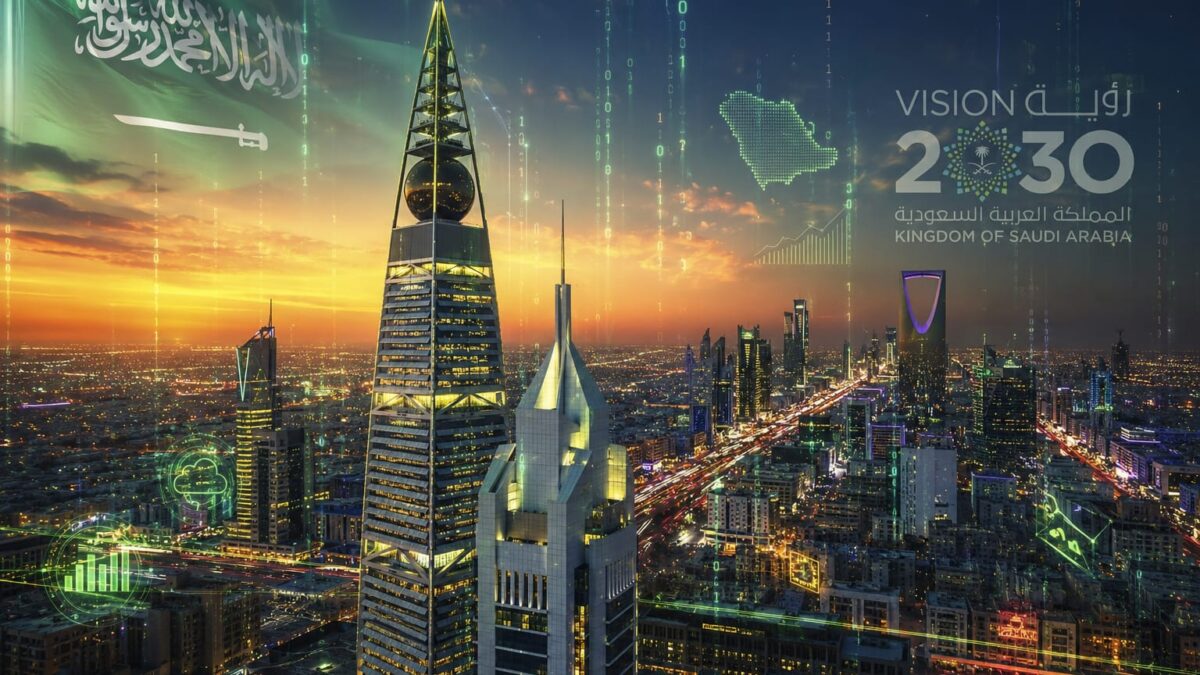
AS A TECHNOLOGY COMPANY IN 2026
The Complete Guide
If you run a technology company and you are not paying close attention to Saudi Arabia right now, you are missing one of the most significant market opportunities of this decade. The Kingdom is moving fast, investing heavily, and actively welcoming international technology businesses. This is not a market that is “opening up” someday. It is open today, and the window for early movers is right now.
This guide is written for founders, business development leaders, and executives who are seriously evaluating the Saudi market and want a clear, practical roadmap. We will walk you through everything: the market landscape, the regulatory process, how to structure your entry, and what to get right culturally. No fluff, just the information you need to make informed decisions.
1. Why Saudi Arabia, and Why Now
Saudi Arabia has committed to investing over $100 billion in artificial intelligence and advanced technologies by 2030. That number alone should get any technology company’s attention. But it is not just the scale of spending that matters. It is the seriousness and speed with which the Kingdom is executing.
Vision 2030, the national transformation program led by Crown Prince Mohammed bin Salman, is the engine behind all of this. Its goal is to diversify Saudi Arabia away from oil dependency and build a knowledge-based economy. Technology sits at the very centre of that ambition. Sectors being actively developed include artificial intelligence, cloud computing, cybersecurity, fintech, healthtech, edtech, smart cities, and e-commerce.
ICT spending in Saudi Arabia is projected to reach $39.6 billion in 2025, according to IDC, and growth is being driven by giga-projects, smart city development, and deep digitization across key government and private sector industries. The e-commerce sector alone is projected to reach $24.7 billion in revenue by 2027.
Key Market Insight
Saudi Arabia has one of the highest mobile penetration rates in the world, a young and digitally native population, and a government that is actively incentivizing foreign technology investment. It is a rare combination of demand, infrastructure, and political will.
Beyond those numbers, the Kingdom is now a hub for regional ambition. Companies that establish a presence in Riyadh or other major cities gain proximity to emerging markets across the Middle East, Africa, and South Asia. This is not just a Saudi play. It is a regional one.
To understand how this environment connects to broader regional trends, it is worth reading Vision 2030 and the Future of the Saudi Digital Economy, which covers the long-term roadmap shaping investment decisions across the Kingdom.
2. Understanding the Regulatory Landscape Before You Enter
Before you register a company, hire a local team, or sign a commercial agreement, you need to understand how Saudi Arabia’s regulatory environment works for foreign technology companies. The good news is that it has become significantly more streamlined and investor-friendly in recent years.
The MISA License: Your Starting Point
Any foreign company establishing a legal presence in Saudi Arabia must first obtain a license from the Ministry of Investment of Saudi Arabia (MISA). Think of this as your permission to invest. Without it, you cannot legally operate, hire, or sign contracts as a registered entity in the Kingdom.
Under the updated Saudi Investment Law that took effect in February 2025, the traditional foreign investment licence has been largely replaced by a streamlined investor registration process. This reform has reduced bureaucracy considerably while still maintaining appropriate regulatory oversight where it matters.
In 2026, the initial processing time for most tech sector MISA applications has been reduced to as little as 3 to 5 business days when documentation is complete. That is a meaningful improvement from the multi-week timelines of previous years.
| Important Note on MISA and CR Think of the MISA license as your entry permit and the Commercial Registration (CR) from the Ministry of Commerce as your operational passport. You need both to legally operate. The MISA license always comes first. |
Step-by-Step: The Registration Process
- Determine your legal structure. Decide between a Limited Liability Company (LLC), a branch office of your foreign parent company, or a joint-stock company. For most technology entrants, an LLC or branch office is the practical choice. Your legal structure affects tax treatment, ownership flexibility, and how quickly you can hire local staff.
- Classify your business activity. Saudi Arabia uses ISIC classifications for business activities. Getting this right from the start matters because it determines which regulatory bodies oversee your operations and what compliance requirements apply to you.
- Prepare and submit your documents. Applications are submitted online through the MISA e-portal. All documents must be legalized and translated into Arabic before submission. Standard requirements include corporate documents from your home country, proof of financial standing, a business plan, and details of your proposed activities in the Kingdom.
- Receive your MISA license. Once approved, proceed immediately to the Commercial Registration step with the Ministry of Commerce.
- Obtain your Commercial Registration (CR). This finalizes your legal identity as an operating company in Saudi Arabia.
- Secure a physical address. You will need a registered National Address and a physical office to obtain your municipality license and begin hiring employees. Virtual offices can work initially but will not satisfy all downstream requirements.
Sector-Specific Approvals
Some technology sub-sectors require additional regulatory approvals beyond MISA and CR. Fintech companies need clearance from the Saudi Central Bank (SAMA). Healthtech businesses require approvals from the Ministry of Health. EdTech platforms serving regulated institutions need coordination with the Ministry of Education. Build this into your timeline from the beginning so it does not become a surprise six months in.
3. Choosing Your Market Entry Strategy
There is no single correct way to enter the Saudi market. The right strategy depends on your company’s size, product maturity, available capital, and long-term ambitions in the region. Here are the four most common paths technology companies take.
Option A: Establish a Wholly-Owned Subsidiary
Saudi Arabia now allows 100% foreign ownership in most technology and services sectors under Vision 2030 reforms. This gives you full control over your operations, your brand, and your commercial decisions. It is the preferred route for companies with an established product and a clear revenue plan in the Kingdom. It takes longer to set up and requires more upfront investment, but it pays off in credibility and long-term flexibility.
Option B: Open a Branch Office
A branch office is an extension of your foreign parent company rather than a separate legal entity. It is faster and cheaper to establish than a subsidiary. However, branches are typically restricted to specific activities and cannot engage in some commercial transactions that a locally incorporated company can. For technology consultancies and software service providers, a branch is often a sensible first step.
Option C: Form a Joint Venture with a Saudi Partner
While 100% foreign ownership is now possible in most sectors, partnering with a credible Saudi company remains a strategically powerful move. A strong local partner brings existing government relationships, client networks, and market knowledge that can shorten your path to revenue significantly. This is particularly valuable if your technology solution serves government entities or regulated industries.
| Pro Tip Even when a local partner is not legally required, many experienced international technology companies choose to work with one anyway. The relationship capital and cultural navigation a respected Saudi partner provides is difficult to replicate from the outside. |
Option D: Work Through a Local Distributor or Agent First
For companies that want to test market demand before committing to a full legal entity, working through a local distributor or technology reseller is a lower-risk first step. U.S. exporters, for example, are not legally required to appoint a local agent to sell to Saudi companies, though it is widely recommended as a way to navigate regulations and identify the right business opportunities before investing in full market entry.
4. Understanding Saudization and Workforce Requirements
One of the most important compliance areas for any foreign technology company operating in Saudi Arabia is Saudization, formally known as the Nitaqat system. This is Saudi Arabia’s national employment program that requires companies to hire a defined percentage of Saudi national employees relative to their total headcount.
The required Saudization percentage varies by industry classification and company size. Technology companies typically fall into specific Nitaqat categories, and your target percentage will be communicated as part of your commercial registration process. Meeting and maintaining your Saudization quota is not optional. Non-compliance can result in fines, restrictions on hiring expatriate employees, and, in serious cases, suspension of your operating license.
The practical upside is that Saudi Arabia now has a growing pool of technically educated young nationals. Programs like MISA’s Fuel initiative have equipped over 98,000 Saudi citizens with digital skills in a single year. The talent pipeline is building, and companies that invest in developing local talent find it genuinely rewarding from both a compliance and a cultural perspective.
| Compliance Reminder Build your Saudization plan into your hiring strategy from day one, not as an afterthought. Companies that treat it as a compliance checkbox tend to struggle. Those who treat it as a talent investment build stronger teams and better community relationships. |
5. Technology Sectors with the Strongest Opportunities
Not all technology verticals carry the same level of opportunity or competitive pressure in Saudi Arabia right now. Based on current government investment priorities and market dynamics, the following sectors represent the strongest entry points for international technology companies in 2026.
- Artificial Intelligence and Machine Learning: SDAIA, the Saudi Data and AI Authority, is actively building the Kingdom’s AI infrastructure and is partnering with both global technology giants and specialized AI firms. The recent HUMAIN initiative, backed by the Public Investment Fund, has signed partnerships with Nvidia, Microsoft, Amazon, Google, Qualcomm, and others. There is an appetite for specialized AI applications across healthcare, energy, finance, and government.
- Cloud Computing and Data Centres: A planned 500MW hyperscale data centre signals the scale of infrastructure investment underway. Cloud migration services, data management platforms, and edge computing solutions are in strong demand.
- Cybersecurity: As the Kingdom’s digital infrastructure grows, so does the need for robust security. Government entities and critical national infrastructure projects are priority buyers in this space.
- Fintech and Digital Payments: Vision 2030 has set a target of 70% cashless transactions by 2030. The fintech ecosystem is growing rapidly, with SAMA actively licensing new players and supporting open banking frameworks.
- Smart Cities and IoT: Giga-projects such as NEOM, Qiddiya, and Red Sea Global are creating massive demand for integrated technology solutions. Smart mobility, connected infrastructure, and IoT platforms are all active procurement areas.
- EdTech and Digital Learning: With a young population and a government committed to upskilling its workforce, demand for digital learning platforms, vocational training technology, and corporate training solutions is accelerating.
For a detailed breakdown of funding and procurement pathways in these sectors, see Top Technology Investment Opportunities in Saudi Arabia Under Vision 2030, which covers the specific programs and tenders technology companies can pursue once they are established in the market.
6. Cultural Considerations That Directly Affect Business Success
Regulatory compliance gets you into the market. Cultural intelligence keeps you there and helps you grow. Saudi business culture has distinct norms that shape how decisions are made, how relationships are built, and what it takes to become a trusted partner.
- Relationships come before transactions. Saudi business culture is relationship-driven. Decision-makers want to know and trust the people they are doing business with before they sign agreements. Plan for multiple meetings, site visits, and relationship-building activities before expecting a signed contract.
- Hierarchy matters. Respect for seniority and formal titles is important. Make sure your Saudi counterparts are meeting with people at an equivalent level of seniority from your organization.
- Patience is not optional. Decision timelines can be longer than Western companies expect. This is not a sign of disinterest. It reflects a culture where thoroughness and relationship confidence are prerequisites for commitment.
- Arabic communication signals respect. While English is widely spoken in the Saudi technology sector, having Arabic-language materials, a local phone number, and Arabic-speaking team members on the ground signals a genuine commitment to the market.
- Understand the role of Vision 2030. Every senior Saudi decision-maker is thinking about how their decisions contribute to the Vision 2030 agenda. Frame your technology’s value in terms of how it advances Saudi Arabia’s economic goals, and you will speak directly to what matters most.
7. Practical Steps to Take Before You Land
Preparation significantly affects how fast you can move once you are on the ground. Here is what experienced market entrants recommend doing before your first formal business trip to the Kingdom.
- Research the specific government bodies and procurement systems relevant to your sector. MISA, SDAIA, MCIT, SAMA, and the relevant line ministries all have different processes and priorities.
- Identify potential local partners, advisors, or distributors and initiate introductory conversations before you arrive. Cold approaches work, but warm introductions through Saudi business networks move faster.
- Engage a Saudi-experienced legal and regulatory advisor early. The documentation requirements for MISA and commercial registration have specific Arabic translation and legalization requirements that are time-consuming if you try to navigate them without guidance.
- Attend LEAP, the annual technology conference held in Riyadh each spring. It is the single best event for building relationships, understanding market dynamics, and meeting government stakeholders in a concentrated period of time.
- Get your Arabic-language materials ready. Company profiles, pitch decks, and product brochures in Arabic are not just a nice touch. They signal that you are serious about the market.
| Action Item Start your MISA application preparation 90 days before your intended market entry date. Gather all corporate documents, arrange for legal translation and apostille certification, and engage a local Saudi law firm or market entry specialist to guide the submission. |
8. Key Incentives Available to Foreign Technology Companies
Saudi Arabia has put meaningful incentives in place to attract international technology investment. Understanding what is available helps you build a more accurate financial model for your market entry.
- 100% Foreign Ownership: Available in most technology and services sectors, removing the historical requirement for a Saudi business partner.
- Tax Holidays and Exemptions: Certain Special Economic Zones and investment categories offer corporate tax exemptions for qualifying businesses. The NEOM Special Economic Zone, for example, offers competitive tax frameworks for companies operating within its boundaries.
- Government Procurement Access: Registered foreign technology companies can participate in government tenders and the Etimad government procurement platform, accessing one of the largest public-sector procurement markets in the region.
- Access to PIF-Backed Funds: The Public Investment Fund’s technology-focused arms actively invest in and partner with technology companies that align with Vision 2030 priorities.
- MISA Business Support Services: MISA operates investor centres in major cities, offering concierge support for new investors navigating licensing, permits, and government connections.
Frequently Asked Questions
Below are the questions technology company leaders most commonly ask when evaluating the Saudi market for the first time.
| Q: Do I need a Saudi partner to enter the market? No. Since the Vision 2030 reforms, Saudi Arabia allows 100% foreign ownership in most technology and services sectors. However, having a strong local partner remains strategically valuable for relationship-building, government access, and navigating cultural dynamics, even when it is not legally required. |
| Q: How long does the MISA registration process take in 2026? With complete documentation, the MISA registration process now takes as little as 3 to 5 business days for most technology sector applications. More complex cases requiring approvals from additional sector regulators may take several weeks longer. |
| Q: What is the minimum capital requirement for a technology company? Capital requirements vary by legal structure and business activity. A service-oriented technology LLC can be established with relatively modest capital. A branch office of an existing foreign company typically requires proof of financial standing from the parent entity rather than a fixed local capital deposit. Your legal advisor can confirm the exact requirements for your specific business category. |
| Q: Is English sufficient for doing business in Saudi Arabia? English is widely used in the Saudi technology sector, particularly in meetings with government innovation bodies and major private sector companies. However, having Arabic-language materials and at least one Arabic-speaking team member on the ground makes a significant practical and symbolic difference. Legal documentation, government filings, and MISA applications must be submitted in Arabic. |
| Q: Which city should we establish our headquarters in? Riyadh is the capital and the centre of government, finance, and corporate decision-making. Most international technology companies establish their Saudi headquarters there. Jeddah is a strong secondary hub, particularly for companies with a focus on the western region or the Red Sea giga-projects. NEOM’s special economic zone in the northwest is worth evaluating for companies whose technology aligns specifically with the smart city and sustainability projects being developed there. |
| Q: What are the main compliance risks to be aware of? The three most important compliance areas are: Saudization quotas (which must be met and maintained), data residency and cybersecurity regulations for technology companies handling Saudi user data, and intellectual property registration (which should be completed before you begin commercial activity in the Kingdom). Non-compliance in any of these areas can result in significant operational disruption. |
Final Thoughts
Saudi Arabia’s technology market is not a distant opportunity on the horizon. It is a present-day, high-growth market with real buyers, real budget, and a government that is actively making it easier for international technology companies to participate. The regulatory environment has improved dramatically, the talent pipeline is growing, and the ambition behind Vision 2030 is backed by serious capital and political commitment.
The companies that will benefit most are those that enter thoughtfully, invest in relationships, take compliance seriously from day one, and position their technology as a genuine contributor to Saudi Arabia’s national goals. The market rewards seriousness and punishes a transactional, short-term mindset.
If you are evaluating whether 2026 is the right time to enter the Saudi technology market, the honest answer for most technology companies is yes. The preparation required is real, but the opportunity is equally real.
| Start Here Begin with your MISA documentation checklist, identify your sector-specific regulatory pathway, and book your first market visit around the LEAP conference calendar. Those three steps will give you a concrete foundation to build your entry strategy on. |



[…] a detailed breakdown of the current investment landscape, read our guide on HOW TO ENTER THE SAUDI ARABIAN MARKET, which covers licensing, commercial registration, and sector-specific entry requirements that apply […]