

When the Kingdom of Saudi Arabia unveiled its Vision 2030 blueprint in April 2016, macroeconomic observers questioned whether a post-oil economic identity could be engineered within a single generation. A decade later, through mid-2026, the data reveals a mature, highly integrated digital transformation ecosystem that has redrawn strategic priorities in real time. The transformation has avoided linear simplicity; megaprojects have undergone pragmatic optimization, timelines have adapted to global supply chain realities, and the global artificial intelligence race has fundamentally shifted public sector spending priorities toward high-performance compute infrastructure.
The foundational metrics confirm deep structural change. The Kingdom’s macro economic trajectory saw total GDP reach $1.27 trillion in 2025, positioning Saudi Arabia as the largest economy in the Middle East and the 18th globally. Critically, the non-oil sector drives 56% of total economic performance, reaching $893 billion in 2025. Official records indicate that 93% of all program performance indicators have either been achieved or remain firmly on track, with 1,290 initiatives activated, 935 fully completed and 225 remaining in active delivery. This structural rebalancing underpins the current state of Saudi Vision 2030 technology progress 2026, shifting the territory from an aspirational narrative into an enterprise-grade digital powerhouse.
Digital Infrastructure: The Hyperscale Core
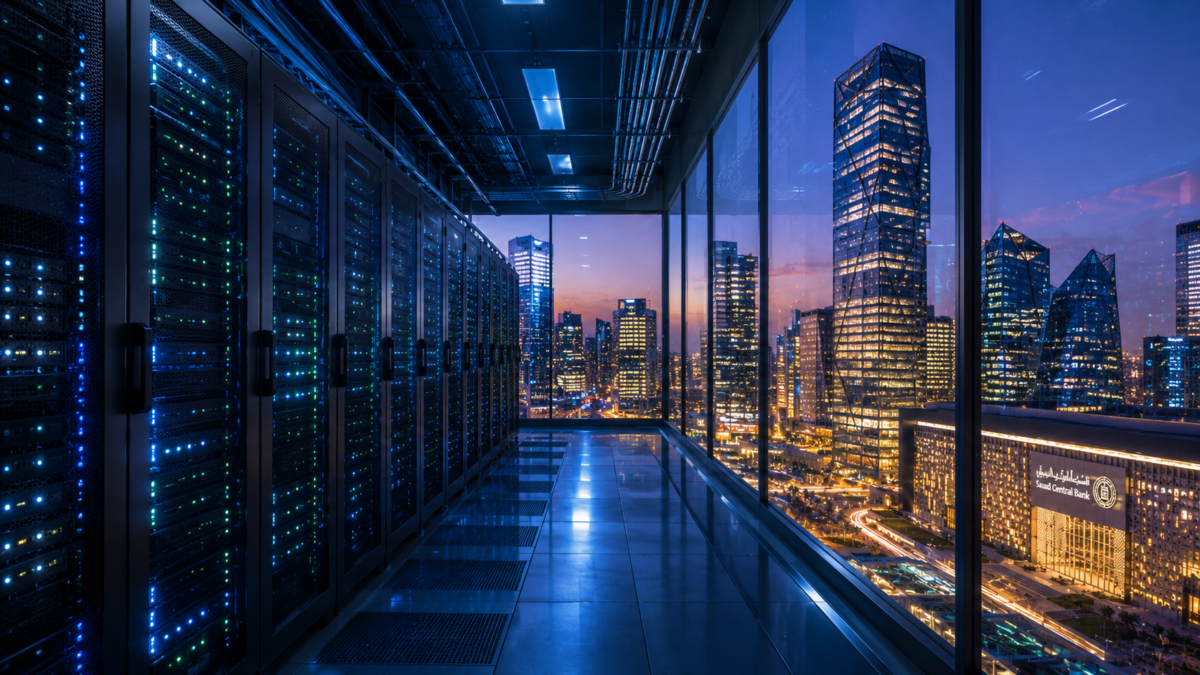
One of the most consequential chapters of the Saudi Vision 2030 technology progress 2026 narrative is the localized expansion of core digital architecture. Saudi Arabia’s data center sector has expanded sixfold since the program’s launch, drawing over SR16 billion ($4.26 billion) in capital deployment. Over 60 operational data centers run under the supervision of the Ministry of Communications and Information Technology (MCIT), with total sectoral revenues projected to scale to $2.83 billion by 2030, expanding at a compound annual growth rate of 6.45%.
The National Data Center Strategy aims to centralize 1.5 gigawatts of aggregate capacity by 2030. This target is led by massive implementations such as the $2.7 billion Hexagon Data Centre initiative, a 480-megawatt Tier-IV facility deployed in early 2026 designed to anchor public sector workloads. Backed by a 97% smartphone penetration rate and a highly connected demographic where 71% of the population is under 35, global hyperscalers have deployed massive regional clouds. Key investments include a $10 billion partnership between the Public Investment Fund (PIF) and Google Cloud alongside dedicated regional zones by AWS and Microsoft. These partnerships represent real capital commitments from global technology firms, positioning the Kingdom as the dominant cloud computing hub for the region.
HUMAIN: The $100 Billion Sovereign Compute Play
The core engine of the Kingdom’s tech strategy in 2026 is HUMAIN, a dedicated AI infrastructure powerhouse launched in May 2025 under the PIF. Backed by a broader $100 billion state allocation toward AI, data center clusters, and specialized hardware since 2023, HUMAIN holds an explicit operational mandate: elevating Saudi Arabia into the tier of top-three global AI providers alongside the United States and China.
To establish this compute backbone, HUMAIN initiated the building of massive twin campuses housing 11 data centers, each rated at 200 megawatts, split between Riyadh and Dammam, with operations commencing in 2026. Following the clearance of international regulatory holdouts in late 2025, the US Commerce Department authorized the export of 70,000 high-performance NVIDIA GB300 Blackwell chips to Saudi Arabia. The first batch of 18,000 chips is delivering direct compute capabilities to local enterprise and public sector tenants.
HUMAIN’s structural capacity roadmaps are heavily scalable. The five-year target aims for 500 megawatts of active AI factory capacity powered by several hundred thousand NVIDIA GPUs. Long-term capacity targets are staged systematically: 1.9 gigawatts by 2030, scaling to 6 gigawatts by 2034, which would command roughly 6% of the world’s projected AI compute supply. Demonstrating high market demand, HUMAIN had already pre-sold the entire capacity of its existing and under-construction facilities by August 2025. Reflecting this pace, the Saudi Cabinet officially designated 2026 as the Year of AI, a milestone extended by HUMAIN’s direct $3 billion venture investment into Elon Musk’s xAI to claim equity ownership across the global foundational model layer.
The Arabic Language Artificial Intelligence Stack
True technological sovereignty requires localized intellectual property designed specifically for the Middle East. The Kingdom has addressed this through ALLaM, a large language model developed via collaboration between the Saudi Data and AI Authority (SDAIA) and IBM. Trained on over 101 billion highly curated Arabic words, ALLaM is integrated into IBM’s enterprise-grade watsonx platform, delivering customized, context-aware automation workflows to regional ministries and enterprise platforms.
This localized stack is paired with optimized infrastructure models. HUMAIN successfully deployed open-source architectures inside domestic data centers using Groq’s ultra-fast LPU inference engines, allowing local developers to run ultra-low-latency AI operations without exposing sensitive operational data outside national borders. These regulatory safeguards helped Saudi Arabia secure the top position among Arab nations in Tortoise Media’s Government Strategy Index for Artificial Intelligence. The total domestic AI market was valued at $1.5 billion in 2025 and is projected to reach $6.8 billion by 2030, contributing an estimated $135 billion to national GDP. At LEAP 2025, technology commitments exceeded $20 billion, including a $1.5 billion deal between Groq and Aramco Digital to establish what could become the world’s largest AI inference data center.
Fintech and Digital Commerce Ecosystems
Saudi Arabia’s fintech segment represents a significant target overperformance within the Vision 2030 framework. The government’s goal to achieve a 70% non-cash transaction share by 2025 was met two years ahead of schedule in 2023. By the close of 2025, digital payments captured 85% of total transactional volume, up from a baseline of just 18%. This rapid adoption fueled a massive surge in e-commerce volumes, expanding from $2.75 billion in 2019 to $86.7 billion in 2025, while the broader digital economy is on track to reach $133 billion by 2030.
This development was driven by the regulatory sandboxes managed by FinTech Saudi alongside structural capital market updates. The financial sector has transformed structurally, with banking sector assets rising from $693 billion in 2016 to $1.31 trillion in 2025. Furthermore, 675 global companies established regional headquarters in Riyadh. In February 2026, the Capital Market Authority opened the Tadawul stock exchange fully to all foreign investor classes. This modern framework pushed international institutional asset holdings to $157 billion, marking the most significant capital markets reform in the Kingdom’s history and giving technology startups a direct path to localized liquidity.
Pragmatic Realignment: NEOM’s Infrastructure Evolution
A balanced assessment of Saudi Vision 2030 technology progress 2026 requires looking closely at the evolution of NEOM. Following the strategic adjustment of construction schedules on The Line in late 2025 after a $50 billion capital deployment, public sector planners chose to optimize near-term economic returns. Rather than focusing purely on grand architectural targets, NEOM shifted its focus toward advanced industrial tech and foundational computing infrastructure.
In February 2026, NEOM closed a $5 billion partnership with sustainable infrastructure builder DataVolt to establish a massive AI data center campus inside the Oxagon industrial district. Oxagon utilizes natural seawater cooling along the Red Sea coast, solving the high thermal and energy challenges that typically limit AI clusters. This is matched by a $5 billion net-zero data center facility developed by Aramco and a separate $3 billion campus backed by Humain, AirTrunk, and Blackstone. NEOM now commands nearly 50% of upcoming national power allocations for data centers, transforming the megaproject into a foundational base for heavy industrial computing. Concurrently, the NEOM Green Hydrogen Project remains on schedule for infrastructure completion in 2026, incorporating 4 gigawatts of solar and wind power to produce 600 tonnes of green hydrogen daily.
Analyzing Structural Delivery Gaps
Maintaining a rigorous, data-driven perspective requires identifying areas where the Kingdom is actively working through macroeconomic and logistical bottlenecks:
- Renewable Energy Integration: Converting signed power purchase agreements into active grid-connected capacity continues to face logistical challenges, making the target of 50% renewable electricity generation by 2030 a difficult climb.
- Private Sector Scaling: The private sector’s contribution to GDP rose to 45%, moving toward the 2030 goal of 65%. Developing a deep ecosystem of mid-tier technology firms capable of absorbing massive sovereign AI computing resources remains a critical decade-long challenge.
- Foreign Direct Investment (FDI): FDI as a percentage of overall GDP reached 2.85% in 2024, showing positive momentum but trailing the final 2030 goal of 5.7%.
The 2026-2030 Final Horizon
As Saudi Arabia steps into the final phase of its transformation roadmap, the megaproject era has evolved into a targeted, data-backed digital infrastructure deployment. The state projects a 4.6% GDP growth rate for 2026, supported by expanding manufacturing networks, digital logistics, and an active technology ecosystem. With 93% of performance indicators on track and over $100 billion committed to high-performance computing assets, the Kingdom has established a powerful digital reality. The remaining years of the decade will determine how effectively the local private sector transforms this infrastructure into sustainable economic value. As highlighted by the IMF’s analysis of Saudi structural reforms, the ultimate success of the 2026–2030 phase will rely on developing human capital and an innovation culture at the same pace as the physical and digital infrastructure being deployed.

[…] understand how this environment connects to broader regional trends, it is worth reading Vision 2030 and the Future of the Saudi Digital Economy, which covers the long-term roadmap shaping investment decisions across the […]