From ancient marble tiles in Makkah to a living-heritage storytelling program gaining global recognition in Paris, Saudi Arabia wrapped up a packed week blending deep history with forward-looking tourism ambition. Here is everything that caught our eye this weekend.
1. Makkah Exhibition Puts 19th-Century Grand Mosque Tiles on Display
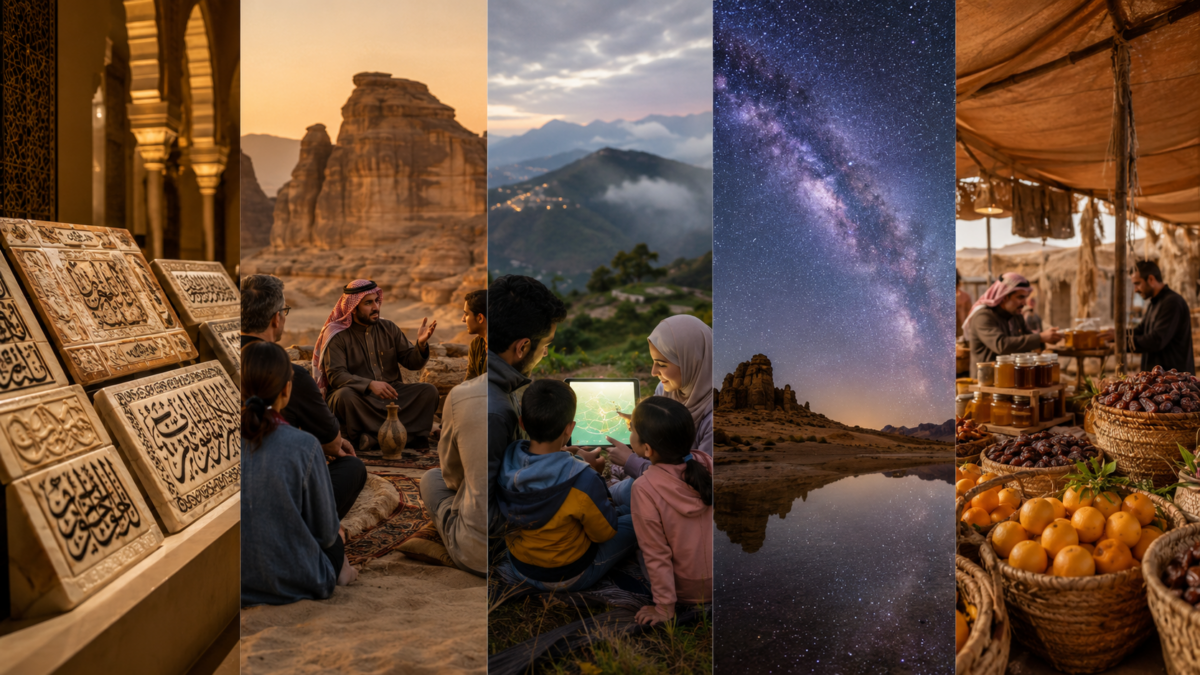
The Exhibition of the Two Holy Mosques Architecture in Makkah is currently showcasing six marble tiles that once lined the corridors of the Grand Mosque. The tiles date back to 1881 CE (1299 AH) and carry Arabic calligraphy bearing the names of Allah, the Prophet Muhammad (PBUH), and four of the Prophet’s companions: Abu Bakr Al-Siddique, Omar bin Al-Khattab, Othman bin Affan, and Ali bin Abi Talib.
Beyond the tiles, the 1,200-square-metre space walks visitors through every major phase of the mosque’s development, from the era of the Prophet Muhammad through to the modern Saudi expansion projects that now accommodate more than 1.7 million pilgrims during peak Hajj season. Researchers, historians, and architecture enthusiasts have been frequent visitors since the exhibition opened.
The display reflects a broader Saudi commitment to making Islamic heritage accessible across generations rather than locking it away in storage. For more on how Saudi Arabia is investing in cultural preservation, see our coverage of AlUla and UNESCO’s living heritage program.
2. AlUla’s Rawi Storytellers Take the Stage in Paris
The Royal Commission for AlUla, in partnership with UNESCO, is continuing its support for the Rawi program, an initiative that trains local community members to share AlUla’s stories, knowledge, and cultural legacy with audiences worldwide.
This weekend, the spotlight fell on Paris. UNESCO is hosting the photography exhibition “I’m Rawi: Sharing Stories, Discovering Cultures” at its Paris headquarters through August 31, 2026. The showcase highlights how AlUla’s Rawis build bridges between cultures, communities, and generations, drawing on inherited knowledge and lived experience that cannot be found in any textbook.
The Rawi concept operates on the idea of a “living museum,” where people, place, and heritage are inseparable. Since its launch, the program has positioned AlUla as a global hub for cultural exchange, fully in line with the goals of Saudi Vision 2030.
For more on how Saudi Arabia is investing in cultural tourism infrastructure, see our article on Asir’s digital tools for attracting summer visitors.
3. Asir Launches Interactive Digital Map for Summer Tourism
Timing its debut with the official start of the Asir Summer Season, the Asir Development Authority has released an interactive digital map that lets visitors explore tourist destinations, events, and activities across the region’s governorates in real time. The map is accessible through the Discover Asir platform and is updated regularly with routes, activities, and event schedules.
The season was inaugurated by Asir’s governor, Prince Turki bin Talal bin Abdulaziz, with backing from the Ministry of Tourism and the Saudi Tourism Authority, in partnership with the National Events Center. The goal is ambitious: attract more than three million visitors through over 100 events, spanning cultural, artistic, entertainment, sports, and family-oriented experiences.
Digital trip-planning tools like this are becoming a standard part of Saudi regional tourism strategies, reflecting a growing understanding that the visitor journey starts long before anyone arrives at a destination.
4. The Milky Way Is Putting on a Show Over Saudi Arabia’s Northern Borders
If you have ever wanted to photograph the Milky Way, now is the time. The Northern Borders region is currently bathed in one of the year’s most dramatic celestial displays, as the galaxy’s core and spiral arms become clearly visible on clear summer nights over the desert landscape.
Adnan Khalifa, a member of the Astronomy and Space Club, explained that mid-summer places the galactic center near the southern horizon, revealing stars, nebulae, and star clusters in a single sweeping view. The Scorpius constellation is particularly prominent right now, with Antares, a bright red supergiant at its heart, serving as a striking focal point.
Khalifa noted that the Northern Borders’ low light pollution and wide open terrain make it one of the best places in the Kingdom for astrophotography. For serious hobbyists or anyone curious about stargazing in Saudi Arabia, this is a seasonal window worth planning around.
5. AlUla Opens Registration for Khayrat Agricultural Celebrations
The Royal Commission for AlUla has invited farmers and cottage-industry families to register for the annual Khayrat AlUla seasonal agricultural celebrations. The program covers dedicated events throughout the year, including the Summer Fruits Season, Dates Season, Bergamot Season, Citrus Season, Honey Season, and a date auction.
The initiative is designed to strengthen market access for local producers, put AlUla’s agricultural diversity in front of domestic and international consumers, and add economic momentum to the governorate’s broader development agenda.
This effort ties directly into AlUla’s position as both a cultural and economic destination, supporting livelihoods while reinforcing the region’s identity in the eyes of visitors. It also complements the storytelling work of the Rawi program covered earlier in this roundup.
Looking Ahead
This weekend’s stories paint a consistent picture: Saudi Arabia is treating its heritage, natural landscapes, and local communities as strategic assets, not just backdrops. Whether it is a marble tile from 1881, a storyteller in Paris, or a digital map helping tourists plan a summer road trip through Asir, the common thread is intentional investment in experiences that connect people to place.
Stay with SaudiFutureTech for weekly roundups covering the stories that shape the Kingdom’s future.
| FAQ Section |
Q1. What is the Exhibition of the Two Holy Mosques Architecture?
It is a 1,200-square-metre exhibition in Makkah that traces the development of the Grand Mosque and the Prophet’s Mosque across different historical eras, from the time of the Prophet Muhammad through to modern Saudi expansion projects. It currently features six marble tiles from 1881 CE that once adorned the Grand Mosque’s corridors.
Q2. What is the Rawi program and why is it significant?
The Rawi program, run by the Royal Commission for AlUla in partnership with UNESCO, trains local community members to serve as cultural storytellers who share AlUla’s history, traditions, and heritage with visitors. It operates on the concept of a living museum and is part of Saudi Arabia’s Vision 2030 push to develop AlUla as a global cultural destination. A photography exhibition tied to the program is currently on display at UNESCO’s Paris headquarters through August 31, 2026.
Q3. How can I access the new Asir interactive digital map?
The map is available through the Discover Asir platform. It provides updated information on tourist destinations, routes, events, and activities across Asir’s governorates and is designed to help visitors plan their trips ahead of time during the Asir Summer Season.
Q4. When is the best time to see the Milky Way in Saudi Arabia?
Mid-summer is considered one of the peak periods for Milky Way observation in the Kingdom, particularly in desert areas with low light pollution such as the Northern Borders region. During this time, the galaxy’s core and spiral arms become visible near the southern horizon on clear nights, along with prominent formations such as the Scorpius constellation.
Q5. What is Khayrat AlUla and who can participate?
Khayrat AlUla is a series of seasonal agricultural celebrations organized by the Royal Commission for AlUla. Events include the Summer Fruits Season, Dates Season, Bergamot Season, Citrus Season, Honey Season, and a date auction. Farmers and families working in cottage industries can register to participate and gain access to new markets among domestic and international consumers.