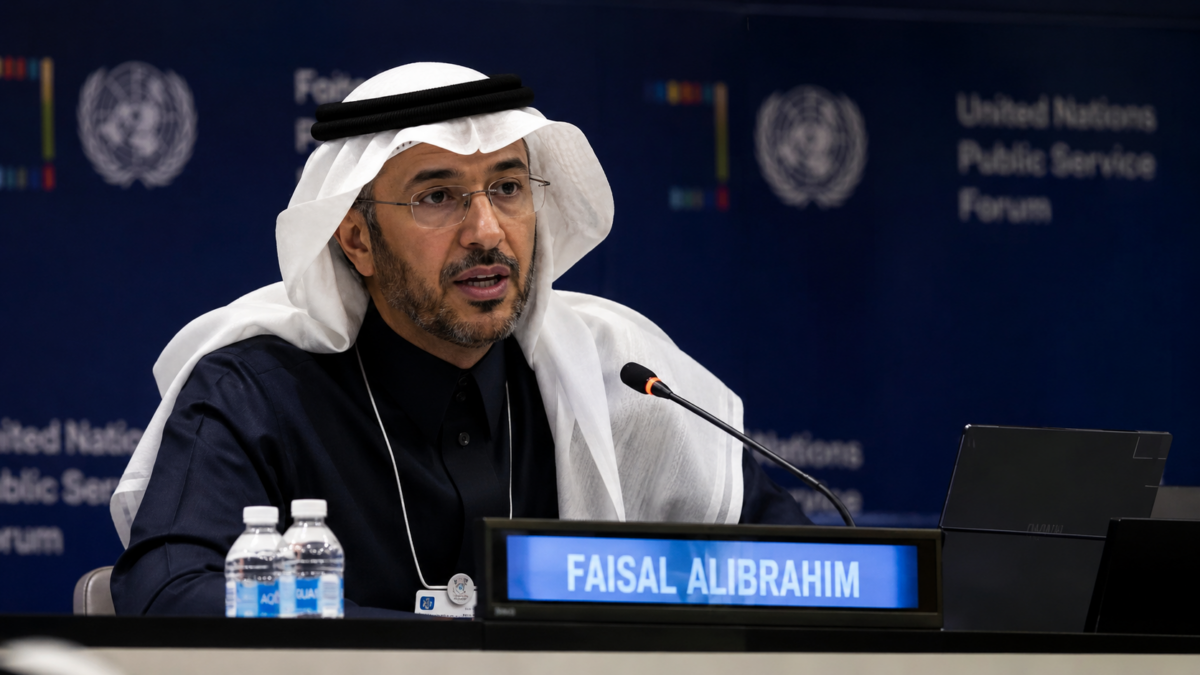
Saudi Arabia has officially presented its third Voluntary National Review (VNR) at the United Nations High-Level Political Forum on Sustainable Development in New York, proving that its strategic national transformation is delivering concrete global milestones. Addressing international delegates, the Minister of Economy and Planning, Faisal F. Alibrahim, explained that the Kingdom’s journey began with a rigorous, honest self-assessment of its structural challenges, which has since matured into a highly sophisticated blueprint for resilient, long-term growth. For more on how the Gulf’s tech and innovation landscape is evolving alongside these national strategies, see our continuing coverage on Saudi Future Tech.
Executive Summary
- Structured National Transformation: The 2026 Voluntary National Review showcases how Saudi Arabia has successfully mapped global Sustainable Development Goals (SDGs) to its domestic delivery systems.
- Accelerated Non-Oil Expansion: Sustained investment in digital systems, clean energy, and public infrastructure is driving record private-sector engagement and economic diversification.
- Whole-of-Society Collaboration: The national report incorporates strategic data and contributions from more than 140 public, private, academic, and non-profit entities.
A Strategic Shift Toward Measurable Global Progress
The presentation of the 2026 VNR highlights how Saudi Arabia is utilizing the final years of the Vision 2030 timeline to institutionalize sustainable practices. Under the leadership of King Salman and Crown Prince Mohammed bin Salman, the national economy has crossed the critical one trillion-dollar threshold. Crucially, the growth rate of non-oil activities is now outpacing traditional oil-dependent sectors, indicating a permanent structural shift in the Kingdom’s financial landscape. As Minister Alibrahim told delegates at the forum, the country stood at a genuine crossroads a decade ago and chose the harder path of reform over a familiar economic model.
By converting the UN’s global SDGs into the Saudi National Sustainable Development Blueprint, the government has organized more than 90 development priorities into nine integrated missions. This approach ensures that every riyal invested in public infrastructure directly yields measurable social and economic returns. Readers tracking how this translates into the Kingdom’s broader innovation economy can follow related analysis on Saudi Future Tech.
Key Milestones in Diversification and Inclusivity
The review outlines outstanding performance metrics across several key development areas. Chief among these is the dramatic increase in female workforce participation, which has consistently exceeded initial Vision 2030 targets. This labor market evolution is supported by extensive digital transformation efforts across government services, significantly reducing administrative friction and boosting overall public sector productivity.
Additionally, massive state and private investments in water security, such as advanced desalination technologies, have run parallel to the rapid deployment of utility-scale renewable energy projects. By prioritizing biosecurity, vaccine capacity, and preventive healthcare, the Kingdom is actively building a highly resilient population capable of driving future industrial growth. This year’s forum specifically included in-depth reviews of clean water, clean energy, industry and infrastructure, sustainable cities, and global partnerships, five goals directly tied to these domestic gains.
Global Partnerships and Future Priorities
Looking ahead, the Ministry of Economy and Planning is shifting its focus toward higher-impact, prioritized delivery models. The next phase will see a concerted push to expand financial inclusion, manage groundwater reserves with greater technological precision, and accelerate the export of non-oil goods. On the global stage, Saudi Arabia continues to position itself as a key exporter of clean energy and a leading provider of humanitarian assistance, reinforcing its status as an indispensable partner in international development. Full details of the review, including the Kingdom’s official statements to the forum, are available via the Ministry of Economy and Planning’s official release.