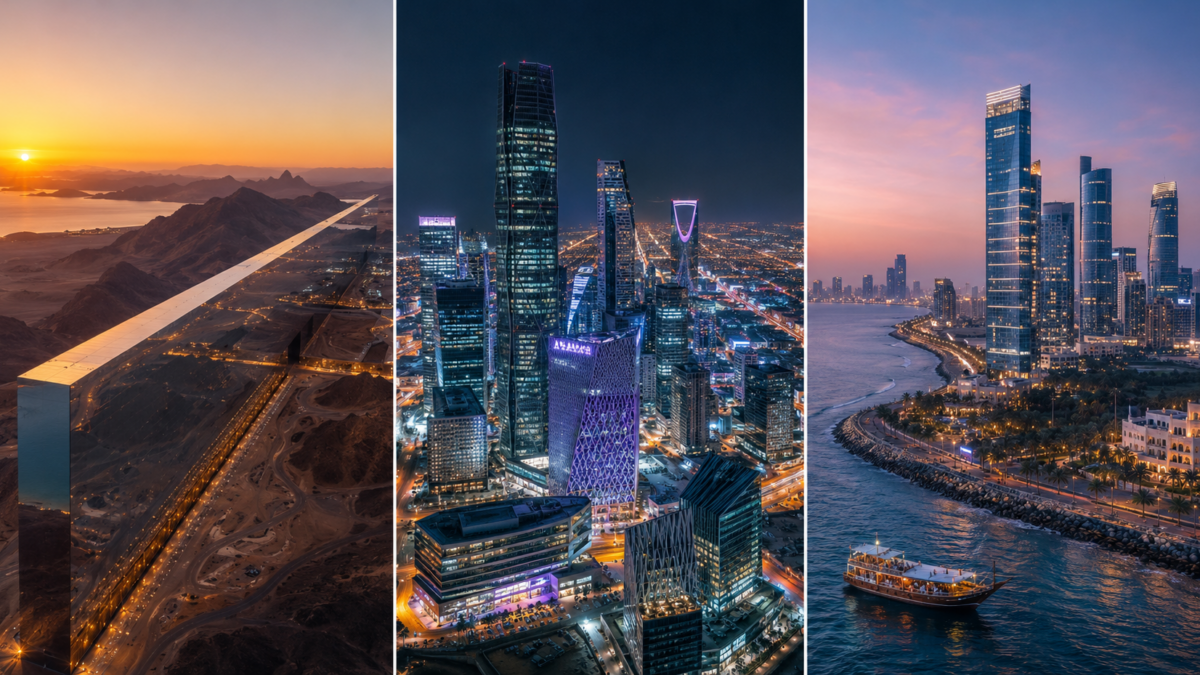
Saudi Arabia has never been short on ambition. But in 2026, with Vision 2030 in full execution mode, technology companies are facing a question that no analyst had to answer a decade ago: which Saudi city actually gives you the best platform to build, scale, and compete? NEOM promises a future that does not exist yet. Riyadh offers a capital with proven commercial depth. Jeddah brings the infrastructure, the port, and a commercial culture that predates the oil economy. This guide breaks down what each city genuinely offers in 2026 so you can make a strategic choice rather than a speculative one.
The Big Picture: Saudi Arabia’s Tech Economy in 2026
Before comparing cities, it is worth framing the national context. Saudi Arabia’s ICT sector is now one of the fastest-growing in the G20, driven by a combination of sovereign investment, regulatory reform, and a young, mobile-first population. The Saudi government has committed to raising the digital economy’s share of GDP, and the demand for enterprise software, cloud services, cybersecurity, fintech, and AI tools is accelerating across both the public and private sectors.
For a detailed breakdown of the current investment landscape, read our guide on HOW TO ENTER THE SAUDI ARABIAN MARKET, which covers licensing, commercial registration, and sector-specific entry requirements that apply regardless of which city you choose.
That national momentum means that choosing a city is not a binary decision between a good market and a bad one. All three cities offer genuine commercial opportunities. The real question is which environment aligns with your company’s stage, sector, and operational model.
Riyadh: The Capital Advantage
Riyadh is the obvious anchor for companies whose primary clients are government ministries, state-owned enterprises, or large Saudi corporates. The capital concentration of procurement budgets, regulatory authority, and institutional relationships is hard to replicate from any other city. If you are selling enterprise software to ARAMCO, pitching cybersecurity solutions to SAMA, or building a GovTech platform for any of the major ministries, your decision-making chain runs through Riyadh.
KEY ADVANTAGE: Riyadh is home to the Regional Headquarters (RHQ) programme, which now requires multinationals seeking Saudi government contracts to base their regional HQ in the capital. Over 200 global companies had established RHQs by early 2026.
What Riyadh offers tech companies in 2026:
- The deepest pool of enterprise clients in the Kingdom
- Direct access to SDAIA, NCA, ZATCA, and major government digital transformation programmes
- A growing startup ecosystem anchored by the King Abdullah Financial District (KAFD) and Riyadh Front
- Extensive flight connectivity, including direct routes to London, New York, Singapore, and Paris
- A rapidly expanding talent base, particularly in software engineering and data science
- Strong VC and PE presence, including STV, Sanabil Investments, and international funds with Riyadh offices
The honest challenges are also worth naming. Riyadh’s cost base has risen sharply. Grade A office rents in KAFD and the Diplomatic Quarter are competitive with comparable space in Dubai’s DIFC. Hiring experienced local engineers remains competitive, and the city’s lifestyle offering, while improving rapidly, still lags behind regional hubs for attracting some international talent profiles.
Jeddah: The Commercial Port and the Gateway to the Red Sea
Jeddah is often underestimated in the technology conversation, and that is a strategic error. The city’s commercial DNA runs deep. It is Saudi Arabia’s primary gateway for trade, the home of its largest port complex, and a city where business relationships have been built across generations. For technology companies operating in logistics, supply chain, maritime tech, e-commerce fulfilment, or retail tech, Jeddah’s physical infrastructure and commercial networks are a genuine differentiator.
| MARKET SIGNAL: Jeddah’s Islamic economy credentials are also significant. The city hosts the Organisation of Islamic Cooperation (OIC) and is the closest major commercial hub to Makkah and Madinah, making it the natural base for fintech, travel tech, and hospitality tech companies serving the Hajj and Umrah economy, which manages tens of millions of visitors annually. |
What Jeddah offers tech companies in 2026:
- Strong private sector commercial base, less dependent on government procurement cycles
- Natural hub for logistics tech, port tech, and the Red Sea economic corridor plays
- Lower operating costs than Riyadh across office space, hospitality, and some staff categories
- Proximity to the Hajj and Umrah economy, one of the world’s most data-intensive crowd management challenges
- A historically cosmopolitan culture that many international employees find more accessible than the capital
- Growing NEOM proximity benefit: Jeddah is the closest established city to NEOM’s core project sites
The challenge for pure-play B2B technology companies in Jeddah is that the enterprise software procurement cycle tends to route through Riyadh regardless. Many technology firms have found Jeddah effective as a secondary office or a regional sales base rather than a primary headquarters, unless their vertical specifically maps to the city’s commercial strengths.
NEOM: The Long-Game Bet on a City That Is Still Being Built
NEOM is the most discussed and least understood option for most technology companies evaluating Saudi Arabia. The scale of ambition is genuine. The timelines have been recalibrated. And the commercial logic for choosing NEOM as a base in 2026 is narrow but real for specific types of companies.
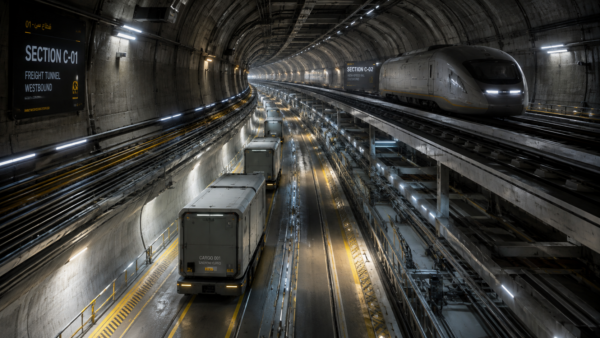
Phase 2 construction of NEOM’s core developments is underway as of mid-2026, and the project has moved through a significant recalibration of its original delivery milestones. THE LINE, OXAGON, SINDALAH, and TROJENA each represent distinct urban environments with distinct technology requirements. The NEOM Tech and Digital Company continues to operate as both a developer and a technology procurer, and the ecosystem around NEOM’s digital infrastructure is real and active.
| IMPORTANT CONTEXT: NEOM remains a construction-phase project in 2026. Companies establishing a physical presence there today are primarily contractors, technology integrators, and concept-testing partners working directly with NEOM’s delivery structure. Consumer-facing technology companies seeking retail customers or established enterprise pipelines will find very limited addressable market within NEOM itself in the near term. |
What NEOM offers tech companies in 2026:
- Direct access to one of the world’s most ambitious smart city technology procurement programmes
- First-mover positioning in AI urban management, autonomous mobility, and energy management systems
- Regulatory sandbox potential: NEOM operates under a distinct legal framework that can accelerate pilots
- High-value, long-term contracts for companies building core digital infrastructure
- Proximity to the Red Sea Special Economic Zone and OXAGON’s industrial-maritime technology cluster
- Genuine opportunity to deploy and reference technology at a scale unavailable anywhere else in the world
The risks are also real. Delivery timelines have shifted, talent pools within NEOM itself are limited, and the regulatory environment, while progressive in intent, is still being codified in practice. Companies that have built strong NEOM relationships have typically done so from a Riyadh or Jeddah base, travelling to project sites rather than relocating their core team.
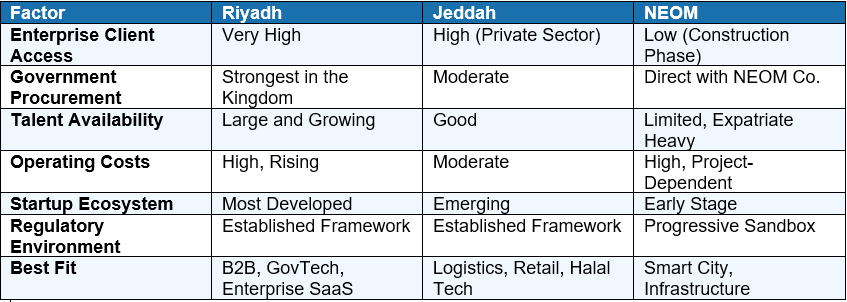
Quick Comparison: NEOM vs Riyadh vs Jeddah for Tech Companies
The AI and Digital Infrastructure Layer
One factor that cuts across all three cities is Saudi Arabia’s national AI investment programme. The Kingdom’s commitment to sovereign AI infrastructure, cloud localisation, and data governance is creating technology procurement opportunities that are not confined to any single city. SDAIA, the national data authority, operates from Riyadh, but its mandates extend to every sector of the economy.
The implications of this national direction are explored in depth in Saudi Arabia Leads Global AI Adoption and Digital Investment Returns, KPMG Report Reveals, which documents how the Kingdom now ranks first globally in AI adoption rates according to KPMG’s 2026 benchmark.
For technology companies, this national AI posture means that regardless of which city you choose as a base, your sales and delivery teams will be navigating a market where AI integration is not a differentiator but an expectation. The companies winning the largest contracts in 2026 are those that can demonstrate measurable outcomes rather than capability claims.
Which City Should Your Company Choose?
There is no universal answer, but there is a logical framework. Your choice should be driven by three variables: your primary buyer, your operational maturity, and your risk tolerance for timeline uncertainty.
Choose Riyadh if:
- Your primary buyers are government entities, state-owned enterprises, or large Saudi corporates
- You need to participate in the RHQ programme to qualify for government contracts
- You want access to the most developed venture and PE ecosystem in the Kingdom
- Your team includes international executives who prioritise flight connectivity and business infrastructure
Choose Jeddah if:
- Your technology serves logistics, e-commerce, maritime, retail, or the Hajj and Umrah economy
- You are building a sales presence in the private sector and want lower fixed costs than Riyadh
- You are using Jeddah as a secondary office alongside a Riyadh headquarters
- You want the closest established city base for accessing NEOM project sites
Choose NEOM if:
- You are a technology integrator, smart city platform provider, or infrastructure technology company
- You have a direct contract or active partnership with the NEOM Technology and Digital Company
- You are prepared for a longer commercial cycle in exchange for landmark reference deployments
- Your company’s strategy explicitly includes first-mover positioning in AI-managed urban environments
| PRACTICAL NOTE: Many technology companies operating successfully in Saudi Arabia in 2026 maintain a Riyadh headquarters for enterprise and government sales, a Jeddah presence for commercial and logistics verticals, and a project-based relationship with NEOM that does not require permanent headcount in the region. This multi-city model is increasingly common and is worth considering before committing to a single base. |
Frequently Asked Questions
Q: Do technology companies need to choose one Saudi city as their headquarters?
A: Not necessarily. Many international technology companies operating in Saudi Arabia maintain a registered headquarters in Riyadh (often to comply with the RHQ programme) while running business development or operational teams from Jeddah or on a project basis in NEOM. Your legal registration address and your operational footprint do not have to be identical.
Q: Is NEOM a viable base for a technology startup in 2026?
A: For most early-stage startups, NEOM is not an ideal primary base in 2026. The addressable market within NEOM is still primarily its own construction and technology procurement ecosystem. Startups typically do better launching from Riyadh, where the VC ecosystem, client base, and talent market are most developed, and then pursuing NEOM contracts from there as they grow.
Q: What is the Regional Headquarters (RHQ) programme, and does it affect city choice?
A: The RHQ programme requires multinational companies that want to access Saudi government contracts to establish their regional headquarters in Saudi Arabia, and in practice, this means Riyadh. Companies that do not comply risk being excluded from government procurement. If your revenue mix is heavily weighted toward public sector clients, this requirement effectively decides your headquarters city.
Q: How does talent availability compare across the three cities?
A: Riyadh has the deepest and fastest-growing talent pool for software engineering, data science, and technology roles, supported by universities, bootcamps, and returning Saudi graduates. Jeddah has a solid talent base with particular strength in commercial and business functions. NEOM relies heavily on internationally recruited talent and project-based contractors, which can create higher turnover and onboarding complexity.
Q: Is Jeddah’s tech ecosystem growing?
A: Yes, meaningfully. Jeddah has seen increased startup activity, co-working space growth, and private sector digital transformation investment over the past three years. It is not at Riyadh’s scale but the trajectory is upward, and for companies in logistics, retail, food and beverage tech, and hospitality technology, Jeddah’s commercial networks can outperform the capital’s.
Q: Can a technology company operate across all three cities?
A: Absolutely, and this is increasingly the model for companies with broad Saudi ambitions. A Riyadh headquarters covers regulatory and enterprise requirements, a Jeddah presence accesses the commercial and logistics economy, and a project engagement model with NEOM allows companies to participate in its technology ecosystem without the cost and complexity of a permanent NEOM office.