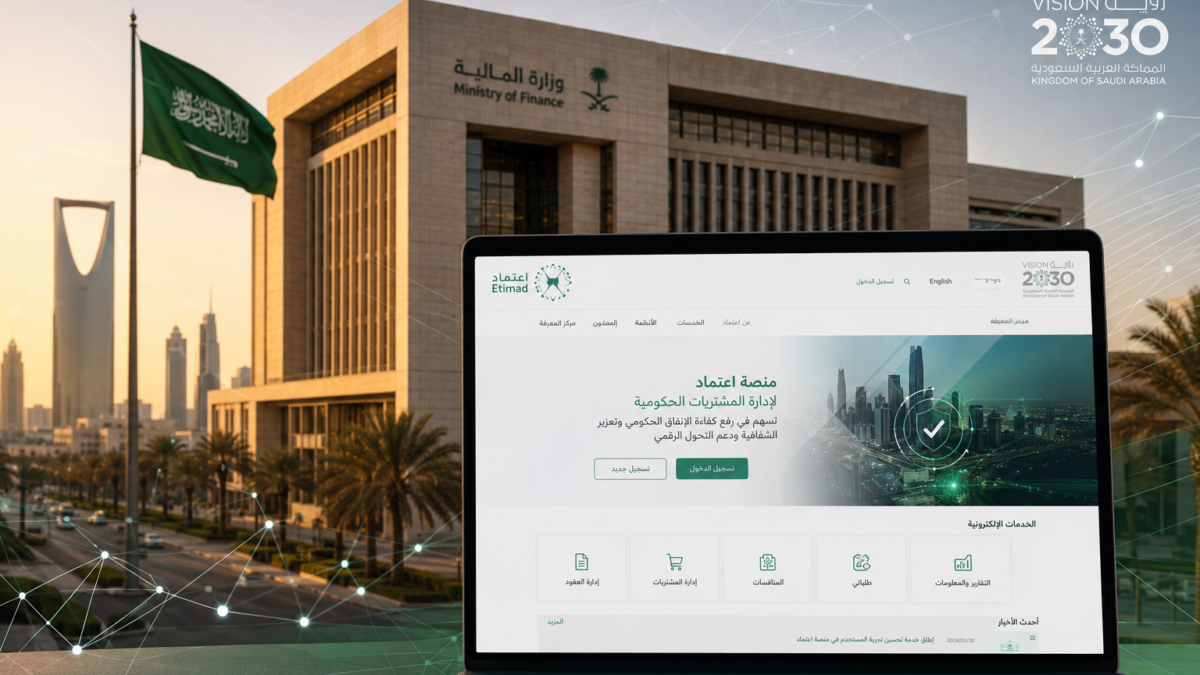
Saudi Arabia’s public sector is one of the largest technology buyers in the Middle East. Backed by Vision 2030, the government has committed hundreds of billions of riyals to digital infrastructure, artificial intelligence, smart cities, and cybersecurity. For technology companies, both regional and international, this represents a serious commercial opportunity. But the procurement system is structured, regulated, and specific about who can participate and how.
This guide walks you through the complete process of winning Saudi government technology contracts in 2026, from legal setup and Etimad registration through to bid submission and post-award compliance. Every step is based on current requirements as of mid-2026.
Who Buys Technology in the Saudi Government?
Before you can bid, you need to know who the actual buyers are. Saudi Arabia’s technology procurement is distributed across several ministries and authorities, each with its own vendor register and tender pipeline.
- Ministry of Communications and Information Technology (MCIT) – the lead ministry for digital transformation, cloud, and national connectivity projects
- Saudi Data and AI Authority (SDAIA) – manages national AI strategy, data governance, and the government AI procurement framework introduced in November 2025
- National Cybersecurity Authority (NCA) – procures cybersecurity solutions, audits, and services for government and critical infrastructure
- Digital Government Authority (DGA) – oversees e-government service digitisation and integration across all ministries
- NEOM – running its own vendor application programme for technology infrastructure and smart city systems
- Public Investment Fund (PIF) entities – including HUMAIN and sector-specific funds that manage their procurement independently of the Etimad portal
The Saudi government has also launched a National Data Center Strategy, led by MCIT and SDAIA, targeting up to 1.5 gigawatts of data centre capacity by 2030. This initiative alone represents a significant pipeline for cloud, hardware, integration, and managed services vendors. For a broader context on what sectors are driving government technology spend right now, see the Saudi Arabia Digital Economy Report 2026: Size, Growth, Key Sectors, and Government Investment.
Step 1: Understand the Eligibility Requirements Before You Apply
The Saudi government procurement has strict entry criteria. Failing to meet even one of these requirements will result in automatic disqualification, regardless of how competitive your technology offer is.
| Eligibility Checklist for Saudi Government Tech Tenders: Valid MISA investment license (Ministry of Investment, Saudi Arabia), Active Commercial Registration (CR) issued by the Ministry of Commerce, GOSI certificate of good standing (General Organisation for Social Insurance), Zakat certificate of compliance (where applicable to your entity structure), Nitaqat Green or Platinum classification (Saudization labour compliance), Registered and active account on the Etimad platform (etimad.sa), Pitch deck or capability statement matching the tender’s sector and scope |
Nitaqat compliance deserves particular attention. Red or Yellow Nitaqat-rated companies are automatically excluded from government tenders. You must maintain Green or Platinum status through your Qiwa portal, which tracks your Saudization percentage and labour contract compliance in real time. This is not a one-time check; it is an ongoing requirement that must be maintained throughout the procurement cycle and for the full contract duration.
The RHQ Requirement and 2026 Exemptions
Since January 2024, foreign companies without a Regional Headquarters (RHQ) licensed in Saudi Arabia have been restricted from bidding on government contracts above SAR 1 million. By early 2026, more than 700 multinational companies have established RHQs in Riyadh, surpassing Vision 2030’s original target of 500. However, the government formalised an exemption framework in early 2026 that allows non-RHQ firms to participate under two specific conditions: only one technically compliant bid is received, or the non-RHQ bid is evaluated as the best offer and is priced at least 25 percent lower than the next competitor. Contracts valued at SAR 1 million or less are exempt from these controls entirely.
For technology companies currently outside the Kingdom, this exemption does not replace the strategic case for establishing an RHQ. It is a procurement safety valve, not a route to market. If public sector contracts are central to your Saudi growth plan, the RHQ route remains the most reliable path to consistent procurement access.
Step 2: Register on the Etimad Platform
Etimad is Saudi Arabia’s official government procurement portal, operated by the Ministry of Finance. All ministries and government entities publish their tenders through Etimad, and all bids must be submitted through it. You cannot participate in government procurement without an active, verified Etimad account.
What You Need to Register
- National ID or Iqama (for individual account holders) authenticated via Absher or Nafath single sign-on
- Commercial Registration number and company documents
- MISA investment license (for foreign-owned entities)
- Professional practice license (for foreign suppliers registering under the Foreign Supplier option)
- Annual subscription fee of SAR 1,500 for company accounts (individuals and government entities register free)
Go to etimad.sa and select the company registration pathway. Foreign companies register under the Foreign Supplier option and must attach their professional practice license. Authentication is handled through Nafath, so ensure your Nafath account is active and linked to your company’s authorised representative before starting the registration process.
| Important: Etimad Subscription. Your Etimad account must be renewed annually. An expired subscription will prevent you from submitting bids even if all other documents are in order. All bid bonds are verified via direct integration between Etimad and the Saudi Central Bank (SAMA). Ensure your banking arrangements support this before tender deadlines. |
Step 3: Identify the Right Tender and Confirm Sector Fit
Once registered, you can search active tenders through the Etimad portal. You can also monitor tenders.gov.sa as a secondary source for procurement notices and contract award announcements.
For technology contracts specifically, pay close attention to the issuing entity. Tenders from MCIT, SDAIA, NCA, and DGA often require additional technical certifications or ministry-level approvals before your bid will be considered. Some MCIT tenders, for example, require vendors to hold specific CITC cloud certifications or NCA Essential Cybersecurity Controls (ECC) compliance documentation.
Use the CPV (Common Procurement Vocabulary) classification codes in the Etimad search to filter by sector. Broad categories relevant to technology vendors include IT services, software development, system integration, network management, and cybersecurity. The more specific your CPV match to a tender, the stronger your sector fit argument during evaluation.
Types of Tenders Available
- Open tenders – published on Etimad, available to all qualified and registered companies
- Limited tenders – invitation-only, issued to a shortlist of prequalified vendors
- Direct contracts – awarded without open competition, typically for highly specialised or proprietary technology
- Semi-governmental entity tenders – Aramco, SABIC, and PIF entities manage procurement independently through their own supplier portals, not through Etimad
Step 4: Prepare Your Technical and Financial Bid
The Saudi government tender evaluation runs through four rounds. Your bid package must be strong enough to survive all four stages.
- Complete all fields in the Etimad bid submission form, including your company overview, operating sector, solution description, and business model. Do not leave any fields blank; incomplete submissions are rejected at the initial review stage.
- Prepare a compliant proposal document. Most technology tenders require a technical proposal covering your proposed solution architecture, implementation methodology, project team credentials, and your experience with comparable government deployments. Vague or generic proposals score poorly on technical evaluation.
- Include a financial proposal with detailed cost breakdowns. The Saudi government procurement values transparency in pricing. Line-item costs, unit rates, and total contract value are all evaluated. Your financial proposal must be submitted as a separate sealed section within the Etimad system.
- Address local content and Saudization in your proposal. Saudi Arabia’s Local Content and Government Procurement Authority (LCGPA) scores bids on their contribution to local economic value. Technology companies that can demonstrate local hiring plans, partnerships with Saudi firms, training programmes for Saudi nationals, or in-Kingdom delivery infrastructure will score higher on this dimension.
- Upload all supporting compliance documents: MISA license, CR, GOSI certificate, Zakat certificate, and Nitaqat compliance printout from Qiwa. Ensure none of these documents has expired at the time of submission.
- Submit your bid before the published deadline. Unlike some procurement systems, Etimad does not accept late submissions under any circumstances. Build in at least five working days before the deadline to resolve any technical upload issues.
| What Evaluators Are Looking For: Technical superiority: your solution must directly address the stated problem, not a generalised version of it. Team credentials: Senior engineers and project managers with verifiable GCC government project experience carry significant weight. Local content score: Saudi national hiring, local partnerships, and in-Kingdom delivery improve your LCGPA score. Price competitiveness: for non-RHQ foreign bidders under the exemption framework, your price must be at least 25% below the next compliant bid |
Step 5: Navigate the Four-Round Selection Process
Saudi government procurement follows a structured evaluation process. Understanding what happens at each stage lets you prepare supporting materials in advance rather than scrambling when you receive a request.
- Initial application review: Etimad’s system and the issuing entity’s procurement team review submissions for completeness and eligibility. Disqualifications at this stage are almost always administrative, not technical. Missing documents are the most common reason for rejection here.
- Technical evaluation: The issuing ministry or agency scores your technical proposal against the published evaluation criteria. For complex technology contracts, specialist technical committees are assembled. This stage can take several weeks.
- Partner and stakeholder evaluation: For larger contracts, relevant government partners and regulators are invited to review shortlisted proposals. For SDAIA tenders, for example, the AI Adoption Framework criteria introduced in November 2025 are applied at this stage, covering data governance, model accountability, transparency, human oversight, and risk management.
- Final selection committee: Senior procurement officials make the award decision. Shortlisted vendors may be invited to present or clarify their proposals at this stage. The award decision is communicated through Etimad.
Step 6: Understand Post-Award Compliance Obligations
Winning a government technology contract in Saudi Arabia is not the end of the compliance journey. Post-award requirements are enforced with real consequences.
- Maintain Nitaqat Green or Platinum status for the entire contract duration. Dropping into Red or Yellow will put your contract at risk of suspension.
- PDPL compliance – the Saudi Personal Data Protection Law is enforced across all government technology systems. Your solution must comply with SDAIA’s data classification and localisation requirements from day one of deployment.
- NCA cybersecurity controls – government systems must comply with NCA Essential Cybersecurity Controls (ECC). If your technology is integrated into a government network, you are responsible for demonstrating ECC compliance.
- Progress reporting and KPIs – most technology contracts specify milestone-based payments tied to delivery KPIs. Report on time and in the format requested; delayed reporting can trigger payment holds.
- Local content reporting – LCGPA may require periodic updates on your Saudi hiring numbers and supply chain localisation progress.
If you are at the earlier stage of deciding where in the Kingdom to base your operations, the analysis in NEOM vs Riyadh vs Jeddah: Which Saudi City Is the Best Base for Technology Companies in 2026? is directly relevant. Your physical location in Saudi Arabia affects Nitaqat scoring, talent access, and your proximity to the ministries and agencies that award the contracts you are targeting.
Key Platforms and Contacts for Saudi Tech Procurement
- Etimad (etimad.sa) — primary portal for all government tenders, bid submission, and contract management.
- tenders.gov.sa — secondary source for procurement notices and contract award announcements
- MISA (misa.gov.sa) — Ministry of Investment for MISA license applications and RHQ registration
- Qiwa (qiwa.sa) — labour compliance and Nitaqat status management
- Absher / Nafath — national digital identity authentication required for all Etimad logins
- LCGPA (localcontent.gov.sa) — Local Content and Government Procurement Authority guidance and local content scoring tool