Riyadh Metro Completes Iconic Station Quartet with Western Station Launch
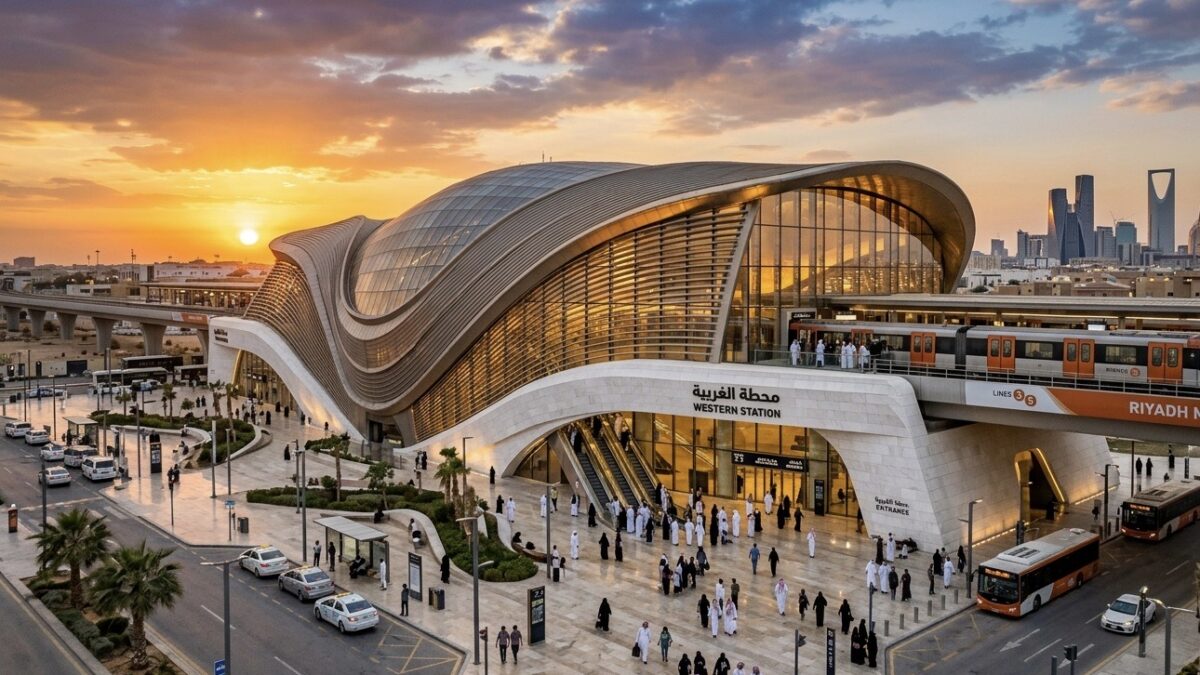
The Royal Commission for Riyadh City (RCRC) has officially commenced full operations at the Western Station, marking a definitive milestone for the Riyadh Metro project. As the largest of the capital’s four “iconic” transit hubs, the Western Station joins the ranks of the King Abdullah Financial District (KAFD), STC Al Olaya, and Qasr Al Hokm stations, completing the architectural and functional backbone of the Kingdom’s most ambitious public transport network.
- Unmatched Scale: Spanning 112,000 square meters, it stands as the largest station in the entire network.
- Capacity & Efficiency: Built to handle 60,000 rail passengers and 1,300 bus passengers per hour.
- Sustainability Excellence: Awarded the LEED Gold certification for design and environmental performance.
- Strategic Location: Situated in Dhahrat Al Badiah, serving as a critical interchange on the Orange Line.
- Vision 2030 Alignment: A cornerstone project for improving urban quality of life and reducing carbon emissions.
Architectural Grandeur Meets Functional Sustainability
The Western Station is more than a transit point; it is a multi-modal landmark designed to accommodate the rapid expansion of Riyadh’s population. Beyond its primary transport function, the facility houses significant commercial spaces and a mosque capable of accommodating 550 worshippers. To support the shift away from private vehicle reliance, the station includes a massive parking infrastructure with a capacity for over 600 vehicles, facilitating a seamless “park and ride” experience for commuters.
The LEED Gold certification underscores Saudi Arabia’s commitment to sustainable smart cities infrastructure. By prioritizing energy efficiency and environmental performance, the Western Station sets a new regional benchmark for public works projects under the Vision 2030 framework.
The Pulse of the Orange Line
Positioned southwest of downtown Riyadh, the Western Station serves as a vital artery for the Orange Line, which bridges the gap between Tuwaiq in the west and Khashm Al An in the east. By integrating rail and bus networks at this scale, the RCRC is actively decentralizing the city’s traffic flow, ensuring that key commercial and residential sectors remain interconnected as the capital prepares for global events such as Expo 2030.